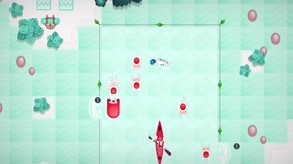
Dive into the relaxing and refreshing atmosphere of Swim Out, a strategic, turn-based puzzle game, that will transport you into a sunny day by the swimming pool, the river or the sea.
Modeled estimate, not a reported figure. How we estimate →
Discounts
Every price cut of more than 20% we have observed, in each market that quoted one, with this game's chart position on either side of it. These are episodes, not a model: a sale is one event, and one event cannot tell you what the next one will do.
Reviews, worldwide (the counter carries no country): 0/day in the week to Aug 12 → 0/day in the week after.
For scale, across Steam · Top Sellers · Brazil over the last 30 days: the 26 chart moves that followed a price cut of more than 20% went a median of 7 places towards #1, and the 2,400 moves with no price cut behind them went 2 away. One store, one chart, one country — it is the only place we have enough observations to say even that.
Prices outside the United States have been collected since 6 August 2026 and chart positions since 19 July 2026, so a cut older than that has no market to compare and a market that joined later has no history yet. Nothing here is converted between currencies.
About
Genres
Sums Steam only; App Store, Xbox publish no volume signal, so the true total is higher by an unknown amount.
Engagement
Reviews
Themes across 40 recent reviews and how positive each mention is. A keyword signal, not full sentiment analysis.
Reviews
И вправду расслабляющая головоломка, в неё играть наверно надо на рабочем месте в жарком офисе. Но я работаю не в офисе, да и кондиционеры на работе есть. Куча уровней, усложняющихся по мере прохождения игры, поначалу увлекают. Но потом я стал засыпать, однообразное действие, выбор клетки... движение... снова выбор... и музыка способствует расслаблению и погружению в какое-то оцепенение, так что пока забросил игру, жду депрессивного настроя или очень жаркой поры.
Beautiful, relaxing puzzle game
Media

Related
Related
Price dynamics, follower growth, revenue and sales trajectories with interactive tooltips
This and every other Pro feature is free until October 20, 2026. A free account is all it takes.
Stats
All-time low is the lowest price we've recorded for this game since we started tracking it.
Languages: English, French, Italian, German, Spanish - Spain, Arabic, Bulgarian, Czech, Danish, Dutch, Finnish, Greek +91 more
| $5.99 |
| 35ratings |
| 76% |
| — |
| not modelled |
Matched by title — a reused name can pair the wrong games. * is a critic aggregate. Prices and positions are each store's United States storefront; Epic charts worldwide. Audience and Score too, except Steam's, which is worldwide.
Hours played at review time, across 40 reviews with recorded playtime.
positive critical· bar length = how often the theme comes up
While the title screen and resized screenshots on the store page look slick, in-game the figures come off a bit sloppier, and some are difficult to distinguish from each other at a glance. Backgrounds are nice, but level transitions appear to be bite-sized prerendered movies. The resolution drop on these, despite their use of primarily (if not completely) in-game assets, is impossible to ignore. I would have been happier with a level results screen—perhaps one that pointed out any optional objectives. I only figured what the dots represented by exceeding a turn limit in II-10, and didn't realize the objectives could be seen until several stages later...by stumbling across a thread in the Steam forums. There were a few levels of trying things randomly until the dots stopped turning red. Glad I at least found that information before reaching the levels with mutually-exclusive objectives... Not only can music and SFX be toggled individually, but the settings are separate for in-level vs stage select. This is great! That said, the levels effectively only have sound effects. (There is an infrequent three-note synth vox, but you'd have to pay attention to notice.) Some may be disappointed, but I like this decision a lot; the SFX are lively and well-executed, crab walk aside...and I actually like them a lot more than the stage select music. The core path traversal mechanics with different obstacles and items have plenty of merit, but the execution has some faults. You can bang out directional inputs lightning fast on a keyboard, but there is a full second or more of delay after each action while objects move and animations play out during the obstacle turn. You may not notice as much on the first try of a level, but on subsequent attempts (and there are almost always subsequent attempts, because there is no undo) the lag time and unresponsiveness get old fast. There's no way to skip animations or otherwise speed things up. Mashing through the parts you know to get back to the part you're still trying to figure out results in missed or unintended inputs...which are additionally punishing because there is no undo. Later stages are broken into multiple checkpointed areas to soften the blow of irrevocable actions. This does prevent later levels from becoming grueling memory tests, but I'm not sure the consequences were fully considered. Restricting undo nudges the player toward only correct actions by punishing errors, whether unforced or as part of brute-forcing. But breaking levels into smaller, inherently less-complex areas facilitates trial and error perhaps even more than unlimited undo because there are fewer possibilities to churn through. On top of that there's no penalty for leveraging checkpoints, no reward for doing full levels perfectly, and most levels don't have turn or item restrictions. Players will likely find themselves deliberately failing in order to "respawn at a checkpoint" rather than restart—which feels [i]really weird[/i] in a puzzle game. Limited undos would do a better job of preserving the intended strain on working memory without punishing the occasional unintended input. Or: yes, allowing recovery from minor mistakes. (It's a turn-based puzzle game. No need to be that tryhard about it. But I digress...) Ultimately, the sluggishness is probably what tips the scales from "flawed but there's still a game here that maybe you'll dig" to "I can't recommend this in good conscience" for me. Kudos to the creators for offering a demo; don't make my mistake and try it before buying.
Réflexion. Concept tout simple. Joueur = bonhomme bleu. Sortie = échelle de la piscine. Rouge = recommence au début du niveau. Le tout en "déplacement avec flèches en tour par tour", c'est à dire qu'on se déplace dans une direction, les rouges bougent en même temps, on se redéplace, les rouges bougent en même temps, etc... En soit je suis assez friand de ce genre de jeu, et j'aurai pu aimer Swim Out s'il ne se posait pas 2 gros soucis. Le premier, c'est que c'est beaucoup trop long. J'ai abandonné le jeu après quasi 5h, et j'en étais à 75%, sachant que la difficulté va TRÈS crescendo. Le second, c'est que dès qu'on touche du rouge, on recommence le niveau au début. Pour les premiers, ce n'est pas trop grave, puisqu'en général en une quinzaine de mouvements, on arrive à nos fins. Mais là où j'en suis, il faut parfois essayer des mouvements, tâtonner, d'autant qu'il n'y a qu'une seule solution possible, ce qui amène souvent à une centaine de mouvements ! Alors quand à ce moment là, on se prend un rouge qu'on a oublié d'anticiper 15 mouvements plus tôt, c'est la rage. Heureusement, c'est possible de faire "route arrière", mais ce n'est pas suffisant, et finalement, Swim Out m'aura beaucoup plus frustré qu'autre chose.
Swim Out is a thoughtfully designed puzzle game developed and published by Lozange Lab that stands out through restraint, clarity, and a quietly clever understanding of how tension can exist even in the most relaxed settings. At first glance, its sun-drenched pools, beaches, and gentle soundscape suggest something breezy and casual, but beneath that inviting surface lies a deeply methodical turn-based puzzle experience that demands careful planning and spatial awareness. The game’s calm presentation is not meant to lull players into mindless play, but rather to create a focused, almost meditative space where logic and foresight take center stage. The core premise is elegantly simple: guide a swimmer from the starting point to the exit without colliding with any other moving entities in the water. Every level is built on a grid, and each action taken by the player advances the entire system by one turn, causing other swimmers, obstacles, and hazards to move according to their own rules. This single design decision defines the entire experience, turning each puzzle into a compact simulation where success depends on understanding patterns, predicting outcomes, and sequencing moves with precision. What makes Swim Out compelling is how quickly this simplicity gives way to complexity, as even a small grid can become a tightly wound problem once multiple movement behaviors are layered together. As players progress, the game steadily introduces new elements that expand the puzzle language without overwhelming the player all at once. Different swimmer types move at varying speeds or intervals, larger obstacles like kayaks occupy multiple tiles, and environmental hazards such as waves, jellyfish, crabs, and even flying volleyballs disrupt otherwise safe paths. Items like flippers or beach balls add further wrinkles, allowing temporary manipulation of the grid while also increasing the number of variables the player must account for. Each new mechanic feels purposeful, not just adding difficulty for its own sake but encouraging players to rethink assumptions formed in earlier levels. One of Swim Out’s most defining characteristics is its deliberate pacing. There is no timer, no pressure to act quickly, and no penalty for taking time to think. Instead, difficulty arises from mental load rather than execution. Later puzzles can be lengthy and intricate, often requiring players to plan several turns ahead and mentally simulate how the entire grid will evolve. The absence of an undo or rewind feature amplifies this tension, as a single misstep can force a full restart. For some players, this design choice reinforces the importance of thoughtful play and makes success feel more earned, while for others it can lead to frustration during longer, more complex stages. Visually, Swim Out embraces a clean, minimalist art style that complements its design philosophy. Bright colors, clear silhouettes, and readable animations ensure that every element on the grid is easy to interpret at a glance, which is crucial for a puzzle game built around anticipation and pattern recognition. The ambient audio design, filled with gentle water sounds and seaside atmosphere, enhances the sense of calm without becoming distracting. This cohesive audiovisual approach reinforces the game’s identity as something relaxing on the surface, even when the puzzles themselves become mentally demanding. Another notable strength is the game’s flexible structure. Many levels and chapters are accessible without strict linear progression, allowing players to step away from a stubborn puzzle and explore others instead. This freedom helps mitigate frustration and encourages experimentation, making the game well suited to both short sessions and longer stretches of focused play. It also highlights how thoughtfully handcrafted each puzzle feels, as no level exists merely as filler; each one introduces a specific idea or challenge that contributes to the overall learning curve. In the end, Swim Out is a puzzle game that thrives on balance—between calm presentation and challenging design, between simplicity and depth, and between accessibility and rigor. It may not appeal to players who prefer fast-paced or forgiving puzzle experiences, but for those who enjoy turn-based logic challenges that reward patience and careful thought, it offers a uniquely satisfying experience. Its ability to turn a serene summer setting into a playground for complex reasoning is what ultimately defines its charm, making Swim Out a quietly memorable entry in the indie puzzle genre. Rating: 6/10

It's a very good puzzle game, with good mechanisms, but after chapter 4 it becomes really too hard.
Looks good but I did not enjoy it. In every chapter there are new tools to use, but this did not make it more enjoyable. I do love puzzle games but I can't recommend it. Only but if you are die hard puzzle gamer and have nothing better to play.
로딩만 멀쩡하면 흠 잡을데 없는데 너무 빡친다
Je joue sur Linux. Version Linux : excellente. [h1]Le jeu[/h1] Dans ce jeu au tour par tour, on déplace notre nageur pour atteindre la sortie de chaque niveau. Après chaque déplacement, tous les autres nageurs bougent à leur tour. Il ne faut jamais leur rentrer dedans. Il faudra donc bien observer leurs déplacements et agir en fonction. Pour nous aider, il y a quelques objets qui nous permettent d'immobiliser les autres nageurs, ou bien d'avancer plus vite pendant un temps par exemple. Les niveaux longs sont parfois séparés en plusieurs bassins, avec un checkpoint au début de chacun, ce qui permet de ne pas recommencer tout au début si on foire. Ce qui peut amener à un problème d'ailleurs si on s'est mis dans une position ou on ne peut plus gagner. Le jeu ne propose par ailleurs pas d'undo, ce qui finit par être pénible sur certains niveaux longs quand on cherche une solution. Graphiquement, c'est épuré, pas grand chose à y redire. Par contre, si au début les bruitages sont acceptables, au bout d'un moment ils tapent sur les nerfs. La bande son atmosphérique est à oublier. Heureusement, il est possible de désactiver l'un et l'autre dans les options. Niveau difficulté, c'est assez bien dosé au début, mais ça devient assez inégal par la suite. Globalement le jeu est plutôt difficile. [h1]Rejouabilité, achievements[/h1] Pour obtenir les achievements, il faudra obtenir tous les objectifs optionnels de tous les niveaux. [h1]En bref[/h1] Le jeu n'est pas mauvais, mais j'ai vraiment eu trop de mal à accrocher pour le recommander. [h1]GNU/Linux[/h1] Je n'ai rencontré aucun problème. OS: Linux Mint 21.2, MATE edition. Hardware : 5950x, AMD RX 6900XT, 64GB ram. Screens : Dualscreen, 1x 4K & 1x 1920x1200, un seul screen X.
很不错的解谜游戏,过关的方法基本都能想出来,但是有些额外的目标不会直接写出来,需要试。一开始比较容易,最后那些关都有点难度,基本都是自己想出来过关了,再看攻略把目标补完。全目标通关就全成就了。
Selling now
See how fast this game is selling right now — estimated copies and revenue per day from recent review growth.
Players by region
Where this game's players are, estimated from review languages.
Related
| Game | Estimated lifetime revenue | Reviews | Review score | Price |
|---|---|---|---|---|
| $3.9K | 57 | 96% | $2.99 | |
| $6.1K | 22 | 82% | $9.99 | |
| $2.3K | 16 | 100% | $4.99 | |
| $2.2K | 47 | 85% | $1.99 | |
| $1.4K | 17 | 100% | $4.99 | |
| $1.1K | 41 | 95% | $0.99 |
Related
| Game | Estimated lifetime revenue | Reviews | Review score | Price |
|---|---|---|---|---|
| $8.7K | 111 | 94% | $7.99 | |
| $8.7K | 62 | 82% | $6.99 | |
| $8.7K | 89 | 84% | $4.99 | |
| $8.7K | 109 | 63% | $2.49 | |
| $8.7K | 63 | 94% | $6.99 | |
| $8.7K | 61 | 85% | $5.99 |