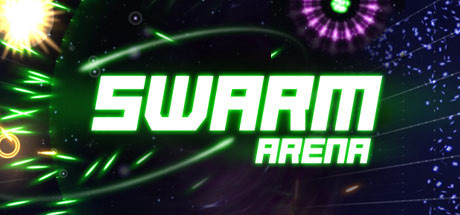
Swarm Arena is a compact but conceptually distinctive indie arcade title developed and published by Dedication Games that experiments with control, motion, and tactical pressure through its central swarm-based mechanic. Rather than presenting players with a conventional avatar wielding weapons, the game asks them to master a living cloud of entities that function simultaneously as offense, defense, and identity. This design choice immediately separates Swarm Arena from typical top-down shooters and gives it a personality rooted in abstraction, momentum, and spatial awareness.
At the heart of the experience is the “virtual organism,” a core entity surrounded by a shifting swarm of smaller particles. These particles behave as extensions of the player, forming a protective shell when held close and transforming into projectiles when launched outward. Combat revolves around deciding when to expand the swarm aggressively and when to retract it for defense, creating a push-and-pull rhythm that rewards timing and positioning over raw reflexes. Encounters are fast, tense, and often decided in seconds, making every movement and input feel consequential.
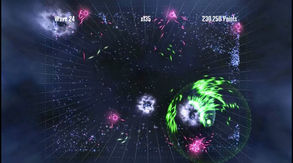
The arenas themselves are minimalist but deliberately designed to emphasize readability and flow. Bright colors, glowing effects, and stark contrasts ensure that swarm movements and collisions are easy to track even during chaotic exchanges. This visual clarity is essential, as much of the game’s challenge comes from reading your opponent’s intent through the behavior of their swarm. The aesthetic leans toward abstract and almost hypnotic, giving matches a kinetic, arcade-like energy that feels closer to a digital sport than a traditional shooter.
Gameplay modes are intentionally limited in scope, focusing primarily on head-to-head matches against AI opponents or local multiplayer rivals. AI-controlled organisms exhibit different behaviors and aggression levels, providing a gradual ramp in difficulty and encouraging players to refine their understanding of swarm dynamics. Local multiplayer is where the game’s design shines brightest, turning matches into tense duels of prediction and reaction, where outmaneuvering an opponent’s swarm is often more important than direct confrontation.
The control scheme, while simple on the surface, introduces a subtle learning curve. Directing the swarm can feel slightly unpredictable at first, especially for players expecting precise, immediate responses. Over time, however, this looseness becomes part of the game’s identity, encouraging players to think in terms of influence and momentum rather than exact positioning. This design choice can be polarizing: some players appreciate the organic feel of the swarm, while others may find it frustrating when attempting fine control in high-pressure moments.
Progression and replayability are driven primarily by mastery rather than content expansion. There is no sprawling unlock system or long campaign; instead, the incentive to keep playing comes from improving performance, chasing leaderboard positions, and refining tactics against increasingly competent opponents. Achievements and configurable rulesets add minor variety, but the core loop remains tightly focused on competitive exchanges and mechanical understanding.
One of Swarm Arena’s limitations is its longevity, particularly for solo players. With a small number of modes and a modest roster of opponents, the experience can feel brief once the central mechanics are fully understood. Online multiplayer exists in theory, but the niche nature of the game and its age mean that active matchmaking is rare, placing most of the long-term value in local play or short, focused sessions.
Despite these constraints, Swarm Arena succeeds as a focused design experiment. It prioritizes originality over scale, offering a distilled arcade experience that explores how control and strategy can emerge from simple rules. Its swarm mechanic introduces a fresh layer of decision-making to arena combat, and its visual and audio presentation reinforces a sense of speed and tension that keeps matches engaging even when content is limited.
Ultimately, Swarm Arena is best appreciated as a concise, inventive arcade title rather than a long-term competitive platform. For players interested in unconventional mechanics, abstract visuals, and quick, high-intensity duels—especially in a local multiplayer setting—it provides a memorable and distinctive experience. While its scope is narrow, its ideas are clear and confidently executed, making it a small but notable entry in the landscape of experimental indie arena games on Steam.
Rating: 6/10