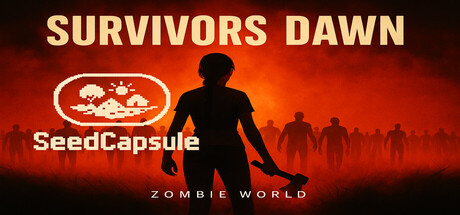
Survivors Dawn: Zombie World, developed and published by Uygar Bursalıoğlu, is an indie survival experience that attempts to stand apart from the crowded zombie genre by shifting the focus away from lone-wolf endurance and toward small-scale leadership. Instead of simply surviving as an individual, the player is tasked with guiding a group of survivors through a collapsing world, making decisions that affect not just personal safety but the well-being of an entire team. It’s an idea that carries genuine potential, even if the execution doesn’t always reach the same level of ambition.
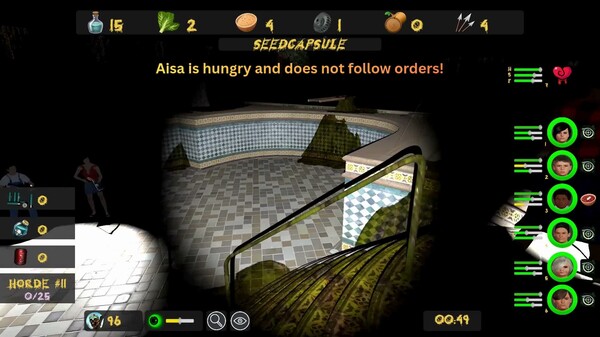
The game’s core loop revolves around balancing exploration, combat, and group management. Players venture out into hostile environments in search of supplies while keeping a close eye on their squad’s positioning and behavior. This adds a tactical dimension that distinguishes it from more straightforward zombie shooters. Rather than charging into every encounter, players are encouraged to think about formation, proximity, and timing, deciding when to engage and when to withdraw. This constant need to juggle individual action with group oversight creates a unique rhythm, where moments of calm scavenging can quickly give way to tense, reactive combat scenarios.
Combat itself blends first-person shooting with resource-conscious survival mechanics. Weapons vary in utility, from close-range melee options that conserve ammunition to ranged firearms that provide safety at a cost. This creates a persistent tension between efficiency and risk, forcing players to weigh immediate survival against long-term sustainability. Encounters with the undead are rarely trivial, especially as numbers increase, and the presence of a squad adds complexity—poor positioning or delayed reactions can quickly lead to chaos. While the shooting mechanics are functional, they lack the responsiveness and polish seen in larger productions, which can occasionally undermine the intensity of these moments.
Beyond combat, resource management plays a crucial role in shaping the experience. Supplies must be gathered, rationed, and used wisely, reinforcing the sense that every decision matters. The need to maintain the group’s condition adds an extra layer of responsibility, pushing players to think beyond immediate threats and consider long-term survival. However, these systems remain relatively straightforward, lacking the depth or nuance that might make them truly engaging over extended play. They serve their purpose in supporting the core loop, but they rarely evolve in ways that significantly change how the game is played.
One of the more compelling aspects of the game is its emphasis on decision-making under pressure. The combination of limited resources, unpredictable encounters, and squad management creates situations where players must act quickly without always having complete information. Choosing whether to press forward into unknown territory or retreat to safety becomes a recurring dilemma, and these choices help generate a sense of tension that carries through much of the experience. Even so, the impact of these decisions can sometimes feel muted due to the relatively simple underlying systems.
Visually, the game adopts a utilitarian approach that prioritizes clarity over detail. Environments are recognizable and functional, capturing the bleak tone of a world overrun by zombies, but they lack the variety and richness that would make them memorable. Character models and animations are similarly modest, reflecting the constraints of a solo-developed project. While nothing is outright distracting, there is a consistent sense that the presentation is doing just enough to support the gameplay without elevating it.
The audio design follows a similar pattern, offering serviceable sound effects that convey the essentials of combat and environmental interaction. Ambient audio helps establish a sense of isolation and danger, though it rarely stands out as a defining feature. The overall atmosphere is effective in a basic sense, but it doesn’t reach the level of immersion that stronger audiovisual direction might have provided.
Where Survivors Dawn: Zombie World struggles most is in its lack of refinement and depth. Many of its ideas—particularly the integration of squad-based tactics into a survival framework—are interesting in concept but feel only partially realized. Systems tend to plateau rather than expand, and repetition can set in as players cycle through similar scenarios without significant variation. Technical roughness and limited content further contribute to the impression that the game is still closer to a foundation than a fully developed experience.
Despite these shortcomings, there is a clear sense of intent behind the design. The game is trying to do something different within a familiar genre, and while it doesn’t fully succeed, it manages to carve out a small identity of its own. For players who enjoy indie projects that experiment with structure and perspective, there is enough here to warrant attention, particularly in the way it frames survival as a collective responsibility rather than a solitary struggle.
In the end, Survivors Dawn: Zombie World is defined as much by its ambition as by its limitations. It introduces ideas that could form the basis of a more fully realized experience, but in its current state, it feels uneven and somewhat constrained. It can provide moments of tension and engagement, especially for those willing to overlook its rough edges, but it falls short of delivering a consistently compelling survival experience.
Rating: 6/10