
Two minds. Two perspectives. One solution. Step into a cooperative puzzle experience where you and your partner see different sides of the same world. Communicate, connect the clues, uncover the truth.
Revenue comes from in-game items and microtransactions, which our price-based model doesn't estimate. The player count below is how many people own it, not what they spent.
About
Note: This is a shortened version of our upcoming game Split Echo. If you enjoy this game, consider adding Split Echo to your steam wishlist! Split Echo is a Co-op only game, two players require their own copy of the game. The game also relies on communicating with each other.
Step into an experience designed to challenge you and your partner. Progress only happens when both players actively use their brains together. The puzzles evolve from deceptively simple to deeply complex, demanding real teamwork. Expect moments of clarity, moments of chaos, and the occasional urge to blame your partner’s communication skills.
Unique path: You and your partner can choose between two distinct paths, each offering a different perspective. Combine your thinking and communicate effectively to progress through the puzzles.
Items: Look for clues in everything you see. What seems insignificant might be the key to your puzzle.
Send Items: you and your partner can send items to each other. This can be important to solving a puzzle, or simply to send them a gift.
Solve Puzzles: Puzzles will require good communication between you and your partner. Puzzles will start simple and get more complex as you progress through the game.
Genres
Stats
Languages: English*, Arabic**languages with full audio support
Engagement
Reviews
Themes across 42 recent reviews and how positive each mention is. A keyword signal, not full sentiment analysis.
Reviews
صراحة ماتوقعت الالغاز تكون بهذي القوة لعبة ممتعة اتمنى تنزل كاملة مو بس الديمو
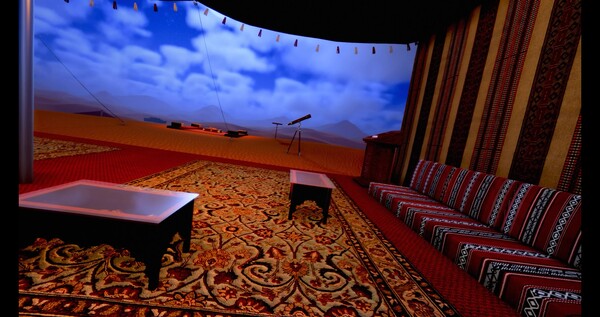
Split Echo: Demo presents a cooperative first-person puzzle adventure built around the idea that no single player has everything needed to reach the solution. Developed and published by OneMac, the game divides two participants across separate paths and asks them to overcome puzzles by sharing what they discover. Rather than treating multiplayer as an optional addition, Split Echo makes cooperation the foundation of the experience. Each participant needs their own copy, chooses one of the available paths, and encounters information that may be invisible or inaccessible to their partner. This creates an asymmetric style of puzzle solving where observation, communication, and interpretation are just as important as conventional logic. The most distinctive quality of the demo is the way it turns conversation into a genuine gameplay mechanic. Players cannot simply stand together and examine the same puzzle until somebody discovers an answer. One person might encounter symbols, objects, patterns, or environmental details that only become meaningful when compared with something found on the opposite path. Explaining those discoveries accurately becomes part of solving the challenge. Even relatively simple clues can become entertaining when two people use different terminology to describe what they are seeing. A solution that seems obvious from one perspective can sound completely confusing when communicated to someone who has never seen that side of the environment. The puzzle progression complements this concept effectively. Earlier situations establish the basic rhythm of observing surroundings, communicating information, and determining how the two perspectives connect. The challenges can then become more complicated as players grow accustomed to working together. This progression is important because the difficulty does not come exclusively from the puzzles themselves. Players must simultaneously determine what information matters and how to explain it. A small environmental detail that appears decorative to one person could potentially be the exact clue their partner needs elsewhere, encouraging both participants to inspect their surroundings carefully rather than rushing from one obvious interactive element to another. Another useful part of the cooperative structure is the ability to transfer items between players. Objects found along one route are not necessarily intended for the person who discovers them. An item may instead correspond to something on the other player's side, requiring participants to discuss their inventories and surroundings before deciding what should be exchanged. This expands the cooperative concept beyond verbally sharing clues. The two paths can effectively share resources even though their occupants remain separated. It also creates opportunities for experimentation, since discovering an unfamiliar object immediately raises the question of whether it belongs to your own puzzle or your partner's. The first-person perspective works naturally with this arrangement because it emphasizes how limited each participant's knowledge really is. Players experience their surroundings directly without receiving an all-encompassing view of what their partner is doing. The game incorporates exploration, environmental observation, hidden details, logic, mystery, and story-oriented elements into this structure. Instead of presenting every challenge as a detached puzzle screen, Split Echo encourages players to treat the environment itself as a source of information. This gives its locations a functional purpose beyond atmosphere and helps maintain the feeling that almost anything in sight might eventually matter. Choosing between two different paths also provides an interesting reason to revisit the demo. After completing one route, players can switch sides and discover what their partner had been seeing during the previous session. Naturally, already knowing the solutions reduces much of the challenge, so this is not replayability in the traditional sense. Nevertheless, changing perspectives can be surprisingly revealing. A clue that sounded impossible to understand when described verbally may suddenly appear extremely obvious once seen directly. Experiencing both sides can therefore provide greater appreciation for how the puzzles distribute information and how effectively the two routes complement one another. Split Echo: Demo is also capable of generating humor without needing dedicated comedy mechanics. Cooperative puzzle games often produce memorable moments simply because people misunderstand each other. A poorly described shape, an overlooked object, or two players confidently interpreting the same clue in completely different ways can create amusing disagreements before the correct answer finally emerges. Split Echo appears comfortable embracing this social element. Success can feel rewarding because both participants contribute to the solution, while failure often becomes part of the entertainment rather than merely an obstacle. The mandatory cooperative format is simultaneously one of the game's greatest strengths and its most significant restriction. Anyone hoping for a conventional single-player puzzle adventure will not receive that experience here. The fundamental mechanics depend on two separate perspectives, so playing with another person is essential rather than optional. Players also need to communicate effectively, making the quality of the experience partially dependent on the chosen partner. For its intended audience, however, this restriction allows the puzzles to explore ideas that would lose much of their purpose if one player could freely access both sides. It is equally important to judge Split Echo: Demo according to what it is: a limited demonstration rather than the complete Split Echo experience. Its purpose is to establish the central mechanics and provide a taste of how the cooperative formula can develop. Consequently, players should not expect the quantity of puzzles, narrative development, or overall scope associated with a finished full-length adventure. The more meaningful question is whether the demonstration provides a sufficiently interesting foundation for something larger, and in that respect it performs well. Separate perspectives, item exchanges, environmental clues, exploration, and communication provide several tools that can be combined into increasingly elaborate challenges. The presentation supports the experience without distracting from its puzzle-focused identity. Its colorful environments and first-person approach give players spaces worth investigating while keeping important objects and environmental details relevant to progression. The mystery and psychological elements associated with the game also complement the concept of incomplete knowledge. Since neither participant understands everything happening around them, there is naturally a sense of uncertainty that can make exploration more intriguing. The game does not need constant action to maintain engagement because discovering the relationship between two apparently disconnected pieces of information becomes its own reward. As an introduction to OneMac's cooperative puzzle concept, Split Echo: Demo is a promising and focused experience. Its greatest achievement is making two-player communication essential rather than superficial. Players observe different environments, exchange information and items, interpret clues, and gradually combine incomplete perspectives into complete solutions. The limited scope and inability to play alone inevitably reduce its appeal for some audiences, but those characteristics are closely connected to the design that makes it interesting in the first place. For two players who enjoy collaborative logic, environmental exploration, and the occasional communication-induced argument, the demo offers an engaging glimpse of what its broader concept can accomplish. Rating: 7/10
Media

Related
Related
Price dynamics, follower growth, revenue and sales trajectories with interactive tooltips
This and every other Pro feature is free until October 20, 2026. A free account is all it takes.
Related
| Game | Estimated lifetime revenue | Reviews | Review score | Price |
|---|---|---|---|---|
| — | 0 | — | — | |
| $54.6K | 308 | 90% | $9.99 | |
| $2K | 7 | 43% | $8.99 | |
| $0 | 5.9K | 90% | Free | |
| — | 0 | — | — | |
| $719.5K | 1.7K | 87% | $14.99 |
Hours played at review time, across 42 reviews with recorded playtime.
positive critical· bar length = how often the theme comes up
Very enjoyable game.
Actually 10/10 Bardzo dobre puzzle, ciekawy gameplay. Niektóre elementy sprawiły mi trudność, ale i tak dobrze się bawiłam. Miałam przy sobie towarzysza, który był pierwszy do wytknięcia mi, że to mój problem i sam sobie poradził x) Na koniec zwyzywał mnie od daltonów Zajebista gra, a osiągnięcia i opisy ich są stanowczo na plus. Polecam!
Enjoyed this Demo as I tried it with two different team mates so far and it was two different results. It really helps with your descriptive skills and then the challenge of understanding each other. Laugh at yourselves as you go through this puzzling challenge.
Fun game
☀️
I played through this game TWICE, and both times it broke to the point of needing to restart completely (The first time, on puzzle 1, the second, on the last puzzle). I understand that this is just a demo but I wish there was checkpoints or something. Quitting and completely restarting should NOT be your only option. 6/10, I would NOT let my pet raccoon Rocco play this.
Кооперативная головоломка с элементами приключения: два игрока видят разные стороны одного мира и должны общаться, обмениваться подсказками и совместно решать задачи, чтобы раскрыть скрытую правду и преодолеть временные барьеры. Плюсы: уникальный кооперативный геймплей — необходимость постоянно общаться и сопоставлять разную информацию создаёт необычный игровой опыт; оригинальная механика «разделённого восприятия» — каждый участник видит уникальные детали, без которых невозможно пройти уровень; атмосферный визуальный стиль — продуманное оформление локаций усиливает ощущение загадочности и погружает в мир игры. Минусы: строгое требование к наличию партнёра — нельзя пройти в одиночку, что ограничивает доступность; проблемы с подключением — в демо‑версии возможны сбои и потеря синхронизации между игроками; отсутствие чекпоинтов — при ошибке или разрыве соединения приходится начинать уровень заново. Итог: заинтересует любителей кооперативных головоломок и нестандартных механик — впечатляет идеей разделённого восприятия, необходимостью командной работы и атмосферой, но может разочаровать зависимостью от партнёра, техническими проблемами с подключением и отсутствием промежуточных точек сохранения.
Players by region
Where this game's players are, estimated from review languages.