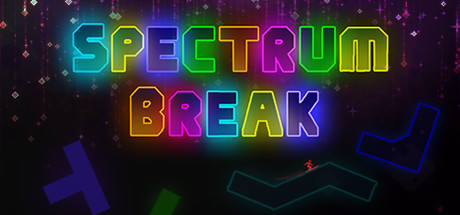
Spectrum Break is a synth-infused physics platformer, where you reshape levels with neon light. Blocks in each level float in zero gravity and can be pushed around by the player, causing them to light up in a burst of vibrant color and sound. Light up all blocks to win.
Modeled estimate, not a reported figure. How we estimate →
Media

About
Stats
All-time low is the lowest price we've recorded for this game since we started tracking it.
Languages: English
Engagement
Hours played at review time, across 23 reviews with recorded playtime.
Reviews
Spectrum Break is a FREE mobile app that's been dumped on Steam as a PAID PRODUCT, as if it was a real PC game (it's not)... it's a cash grab from greedy mobile devs. This mobile app is a minimalist platformer with a twist... the objective is not to get to the exit, but to directly or indirectly touch all the blocks in the level. Touching a block "fills" it. The quirk is that the blocks use a somewhat janky bit of physics so you can make them bump into each other, adding a puzzle element to the speedrunner backdrop. I can only imagine how badly this went down on the app stores it was designed for... it certainly didn't go down well on Steam. From a technical perspective, as a mobile app, this doesn't meet basic minimum requirements that most PC gamers expect as standard. The mobile app features extremely lazy, minimalist "art", of the type you normally expect to see in low effort Flash/browser games and mobile apps. Considering this is being evaluated as a PC game, having the graphics phoned in like this isn't going to result in a high quality, visually impressive game that PC gamers are used to seeing. The controls can't be customised, which will be an annoyance for many, but it can also render the mobile app unplayable for differently-abled gamers, left handed gamers or gamers using AZERTY or other international keyboard layouts. PC gamers will be insulted by the presence of console peasant children's toy controller prompts, despite this being on PC. Developers should try to be aware which platform they're developing for. Because this is a mobile app, it carries a number of deliberate design deficiencies. Compromises were made to cater to the iPhones that the mobile app was designed for. These are unfortunate handicaps and limitations that PC gamers shouldn't be forced to accept, but it's evident that PC was an afterthought for the iPhone developers who are to blame for this. The mobile app is deficient as a result of these choices, and would have been so much better without the handicaps that designing games for mobile phones forces upon a game. Once more, mobile devs have made gaming worse for everyone. I didn't spend thousands on building a gaming rig just so I could pretend it's an iPhone. These technical defects push this mobile app below acceptable standards for any modern PC game. Spectrum Break didn't appeal much to the people who own a copy of the mobile app, either. It has achievements, and they show us a very clear picture that the mobile app didn't really capture any interest from gamers. The most commonly and easily attained achievement is "Speedrunner", for finishing the levels under a certain time, trivial to get, but less than 20 percent of players bothered to get that far before uninstalling the mobile app. Hardly a success story, even the people who own this mobile app weren't interested in it. The poor quality of this mobile app is also reflected by how many people spent time with it. At the time of this review, SteamDB shows the all-time peak player number was only 5 players. This is a remarkably low number, and now, the only player activity occurs once or twice a month, presumably someone loading it up to see what it is then quickly uninstalling it. Considering there's over 120 million gamers on Steam and well over 100,000 games for gamers to choose from, the overwhelming lack of interest in this low quality mobile app is to be expected. So, should you buy this mobile app? Is this one of the best of the 100,000+ games on Steam? Once more we see greedy mobile devs trying to scam PC gamers. On Steam, this is $6 USD, on app stores, it's free. Mobile devs must learn PC gamers are not here to be gouged, and can't be expected to pay a premium for a free mobile app just because it's been lazily dumped on Steam. This is unacceptable disrespect for PC gamers. Because this can be played free elsewhere, and because of the other defects, it's impossible to recommend. SIX BUCKS FOR A FREE MOBILE APP. Just who do they think we are?
This game is amazing, the colours, the lights and all on 200MB. It's definitely worth a try and a fresh take on a fun genre
A refreshing physics platformer with very elegant use of particle effects! The game starts off very easy and zen like while progressing to trickier levels. After acheiving a certain level you can pick whichever level you want to replay/start at.
This is just a ton of fun. The mobile app is good too.
This is a true masterpeice. Spectrum break is beautiful game, the game has 55 levels and they get harder as you progress, the more you replay the levels the better you get while playing this wonderfully colored platformmer. please enjoy the game I HIGHLY recommend it!!!
It's a lot of fun and a good challenge. It feels like a lot of chaos trying to break loose while you just try to keep track of it enough to not die/
This game is quite fun and innovative. I can't say that I have played another game like it. The controls are tight and the game play is addicting. The game is a bit on the short side, but the gameplay is extended if you try to hunt down all of the collectibles. This is definitely worth a playthrough.
Decided to take this game for a spin. Excellent puzzle platform game with beautiful visuals.
Awesome game!!! Would recommend
Spectrum Break, developed and published by Jason Hein, is a minimalist yet entrancing physics-based platformer that thrives on simplicity and motion. It places the player in a surreal, weightless world where you manipulate floating blocks suspended in space, lighting them up through direct contact or chain reactions. The premise is deceptively simple—light up every block in a level to move on—but the execution transforms this idea into a rhythmic dance of momentum, timing, and spatial awareness. There’s a meditative quality to how it plays, as if each action is part of a larger composition. The moment you make contact with a block, it springs to life with glowing light and melodic feedback, giving every movement a sense of purpose and harmony. The game’s atmosphere feels both calming and alive, achieving a rare blend of challenge and serenity that keeps you drawn in despite its minimalist structure. The mechanics of Spectrum Break are defined by their elegance. You control a small character who moves and jumps through a series of floating geometric shapes, each governed by its own physics. These shapes react to your touch—spinning, tilting, drifting away, or bumping into each other—and it’s in these reactions that the puzzle truly lives. There’s no fixed platform or static level geometry; everything is in motion, constantly shifting with your influence. The absence of gravity amplifies the unpredictability, turning each level into a living system that evolves based on your actions. You might launch yourself off a cube only to have it spin back and collide with another, triggering a glowing cascade that completes your goal in an unexpected way. Other times, you might lose control, sending blocks scattering into directions that make recovery difficult. Every movement becomes a negotiation between control and chaos, with success hinging on rhythm and adaptability rather than precision alone. The control scheme is stripped down to its essentials: movement and jumping. This simplicity is intentional and central to the game’s design philosophy. You aren’t overloaded with mechanics or tools—instead, you’re asked to develop a feel for how the world behaves. Jumping in zero gravity requires awareness of trajectory and timing, as every push and surface interaction alters your direction. The challenge comes not from memorizing complex inputs but from internalizing the game’s physics and learning how to use the environment’s shifting energy to your advantage. The further you progress, the more the game expects of your intuition. Some stages emphasize speed and momentum, encouraging quick, fluid sequences, while others are slower, demanding measured precision and patience. Each new level builds on what came before, expanding the vocabulary of motion without overcomplicating it. The design respects the player’s ability to learn through experimentation rather than instruction. Visually and sonically, Spectrum Break creates a distinct sensory experience. The world is bathed in radiant neon colors that pulse and shimmer against deep, empty backgrounds, evoking a feeling of floating in digital dreamspace. The geometry is clean, and the lighting is dynamic, giving every movement a visual impact that feels tactile despite the abstract setting. The audio design complements this perfectly; every collision and activation produces a crisp tone that fits seamlessly into the electronic soundtrack. Over time, these sounds blend into a kind of improvised music, making the player feel like an active participant in composing the game’s rhythm. The harmony between visual feedback and sound response is so tight that it borders on synesthetic, inviting you to play not just with intention, but with flow. The aesthetic minimalism never feels cold or sterile—it feels deliberate and alive, an embodiment of the balance between structure and spontaneity. Beneath its beauty, however, lies a game that demands patience. Because the physics system is central to every puzzle, unpredictability can sometimes work against you. A mistimed jump or an unexpected collision can send blocks drifting away or spinning wildly, forcing you to restart or reorient yourself. This can lead to frustration, particularly in later stages where precision and timing become critical. Yet those same unpredictable moments also generate much of the game’s charm. The systems are flexible enough that accidents can become breakthroughs, and failed attempts often reveal new approaches. The progression across the fifty-plus levels is steady and satisfying, introducing new block types and environmental challenges at a gentle pace that keeps the experience fresh. For players who enjoy the trial-and-error rhythm of mastery, Spectrum Break rewards persistence with deeply satisfying moments of synchronicity, where motion, sound, and timing align perfectly. Ultimately, Spectrum Break is less about platforming in the traditional sense and more about interaction, movement, and rhythm. It is a game of touch and reaction, where simplicity conceals surprising depth. Each level becomes a kinetic puzzle that teaches you to think in terms of motion rather than static solutions. It doesn’t rely on narrative or explicit reward systems; instead, it’s driven by a pure, almost meditative loop of cause and effect. For those who appreciate minimalist design and games that prioritize feeling over spectacle, Spectrum Break stands out as an indie gem. It’s a reminder that complexity can emerge from the simplest systems, and that beauty can be found not in grandiosity but in motion, light, and rhythm. It’s a quiet, hypnotic experience—challenging, unpredictable, and deeply satisfying once you learn to move with its flow rather than against it. Rating: 8/10
Related
Related
Trends
Concurrent players on Steam, sampled daily since tracking started.
Momentum
Pace estimated from the game's recent review growth (our daily snapshots) at its own sales-per-review ratio — a momentum signal, not booked sales.
Audience
Estimated from the language of this game's reviews — a proxy for where players are, not official Steam demographics.
Related
| Lover's Trophy | $1.4K | 50 | 94% | $1.99 |
| Fairy Deer | $1.4K | 50 | 90% | $1.99 |
| UNDRESS! | $1.4K | 50 | 74% | $1.99 |
| 卖萌恶霸喵霸霸 Cute Bully Nyanbaba | $1.4K | 203 | 98% | $0.99 |
| Jad | $1.4K | 70 | 74% | $1.18 |
| Sausage Hunter | $1.4K | 164 | 80% | $0.99 |