Sol Divide: Sword of Darkness, developed by City Connection and Zerodiv and originally created by Psikyo in 1997, stands as one of the most unusual entries in the arcade shooter genre. Instead of following the traditional shoot ’em up formula that defined its contemporaries, Sol Divide attempts to merge the intensity of side-scrolling shooters with melee combat and fantasy role-playing elements. The result is a game that feels bold and experimental, blending swords, sorcery, and aerial duels into a single hybrid experience. While this unique approach sets it apart from the countless other shooters of its era, it also introduces an unevenness that makes it both fascinating and frustrating in equal measure.
Set in a dark fantasy world consumed by war and demonic power, the game follows three heroes—Vorg, the vengeful knight; Kashon, the swift winged warrior; and Tyora, the powerful sorceress—on their quest to defeat the resurrected emperor Ifter, whose return threatens to engulf the world in chaos. Unlike most shooters that rely solely on projectile combat, Sol Divide gives each character access to close-range melee attacks and a collection of magic spells. This fusion of mechanics is its defining trait: players must strike enemies up close to recharge their magic meter, then unleash powerful spells that fill the screen with destruction. It’s a system that rewards both aggression and timing, constantly forcing players to balance between melee and ranged tactics. The idea feels ambitious, creating a game that demands rhythm and strategy instead of mindless shooting.
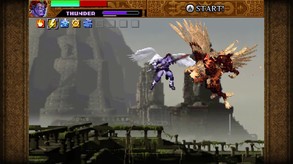
Visually, Sol Divide reflects its late-1990s ambition with a distinctive aesthetic that mixed pre-rendered 3D models and 2D sprites. The art style was reminiscent of early CGI experiments, with glossy character designs and richly textured backdrops. Though dated by modern standards, the visuals retain a certain nostalgic charm, capturing the grim tone of the world while showing Psikyo’s willingness to push beyond convention. The environments range from frozen citadels to fiery battlefields and haunted ruins, each filled with mythological enemies such as serpents, dragons, and grotesque demons. Boss encounters are often grand in scale, forcing players to juggle positioning and magic while managing the screen-filling attacks that defined arcade challenge. The soundtrack complements the visuals with dark orchestral compositions that heighten the tension, driving home the game’s epic and ominous atmosphere.
Where Sol Divide shines most is in its originality. Few shooters of its time dared to deviate so sharply from established formulas. The inclusion of magic adds a welcome layer of depth, with each spell offering unique effects—from elemental blasts to crowd-control enchantments. Experimenting with different spell combinations and character playstyles keeps the gameplay fresh for those willing to master its quirks. The branching stage system, a feature shared by other Psikyo titles, allows multiple routes and endings, giving the game replay value despite its relatively short length. In its best moments, when melee strikes connect fluidly and spells ignite the screen, Sol Divide feels exhilarating—an experience that blends the immediacy of arcade combat with the grandeur of a fantasy epic.
However, the game’s ambition is also its undoing. The fusion of genres, while conceptually intriguing, often clashes in execution. The melee combat feels sluggish and unresponsive compared to the snappy precision expected from shooters, and the inability to attack and shoot simultaneously can break the flow of action. The hit detection is inconsistent, leading to moments where attacks fail to register, and the difficulty spikes feel uneven. Sol Divide’s arcade roots mean it was designed to challenge and sometimes frustrate, with limited continues and punishing enemy swarms that can overwhelm unprepared players. For newcomers, this steep learning curve may come across as unfair rather than rewarding. The control scheme, while functional, lacks the refinement needed to fully realize the game’s hybrid vision, leaving some players struggling to adapt to its rhythm.
Despite its flaws, Sol Divide remains a fascinating artifact of experimentation in arcade game design. It represents a period when developers were still unafraid to experiment with genre boundaries, even if the results were imperfect. The modern re-release by City Connection preserves this legacy faithfully, adding useful features like adjustable difficulty, save states, and online leaderboards. These quality-of-life improvements help make the experience more accessible while maintaining the spirit of the original. Fans of Psikyo’s catalog or retro shooters in general will appreciate the preservation effort, as well as the chance to revisit a game that stood apart from its peers through sheer audacity.
Ultimately, Sol Divide: Sword of Darkness is a game that thrives on its eccentricity. It’s neither a pure shooter nor a full-fledged action RPG, but something that exists between those extremes—a bold, messy experiment that exudes personality. Its clunky mechanics and dated presentation may deter casual players, yet its strange charm and ambition make it memorable for those who appreciate innovation in classic arcade design. It’s a flawed gem that captures both the creativity and rough edges of an era defined by experimentation, and even now, it stands as a reminder that the greatest risks in game design often come from daring to do something different.
Rating: 7/10