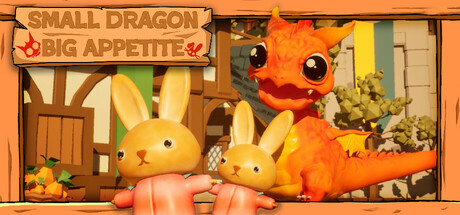
Small Dragon Big Appetite takes a simple but amusing idea and builds an energetic action roguelike around it. You control Chompie, a small dragon with an enormous hunger, and venture through a colorful kingdom populated by bunnies that are both potential meals and increasingly dangerous opponents. The objective is immediately understandable: eat as many bunnies as possible, stay alive, and build the highest score you can before the day ends. This uncomplicated foundation gives the game an arcade-like quality where learning through repeated attempts matters more than following an elaborate story.
The game was developed by Felipe Fleming, Morris Åstrand, Ralph Warrand, Katelin van Lissum, Juliya Mollen, Skye van den Reijen, Sara Hazel Park, and Johan Haubo, with Felipe Fleming and Morris Åstrand serving as publishers. The relatively small-scale production is reflected in the focused design. Rather than filling the experience with numerous progression systems, complicated inventories, or lengthy narrative sequences, the game concentrates on movement, survival, hunting, and improving your performance from one run to the next.
Chompie's appetite provides the central motivation for everything the player does. Bunnies scattered throughout the environment increase your score when eaten, encouraging aggressive exploration and efficient movement. There is also a time-sensitive quality to each attempt because the player wants to accomplish as much as possible before the current day concludes. This makes standing around costly and encourages a constant rhythm of searching, attacking, repositioning, and deciding where to go next. The resulting pace is one of the game's stronger qualities, particularly for players who enjoy short sessions with immediately measurable objectives.
The bunnies are more than defenseless collectibles. As progress continues, stronger varieties become increasingly capable of threatening Chompie. This creates a useful risk-versus-reward dynamic because dangerous prey can offer greater benefits while simultaneously increasing the possibility of ending a promising run. Successful play therefore requires more than charging toward everything in sight. Avoiding incoming attacks and judging when to pursue or retreat become increasingly important as the difficulty escalates.
Potions provide additional tactical possibilities. Effects such as increased movement speed and invisibility can dramatically alter how the player approaches a dangerous situation. Extra speed is valuable for reaching prey quickly and escaping attacks, while invisibility can create opportunities to reposition or avoid unwanted confrontations. These abilities are deliberately straightforward, but they fit the game's accessible philosophy and add some welcome variety without overwhelming the basic gameplay loop.
The roguelike structure places considerable importance on repetition and gradual mastery. A failed attempt is less about losing lengthy progress and more about understanding how the next run can be improved. Learning enemy behavior, moving more efficiently, using potions at appropriate moments, and knowing when pursuing a powerful bunny becomes too risky can all contribute to better scores. The competitive scoring component strengthens this approach by providing an incentive beyond simply surviving for another few minutes.
Presentation is deliberately playful. A hungry dragon devouring cute rabbits could easily have been portrayed with a darker tone, but the colorful visual direction keeps everything humorous and exaggerated. The contrast between the adorable fantasy setting and the relentless appetite of the protagonist gives the game much of its personality. Chompie is easy to understand as a character because the motivation is right there in the title: this dragon is hungry, and practically everything revolves around satisfying that hunger as efficiently as possible.
The simplicity does come with limitations. Players expecting the enormous build diversity, extensive permanent progression, deep storytelling, or large interconnected environments associated with more ambitious roguelikes may find the experience comparatively lightweight. Its lasting appeal depends heavily on whether repeatedly improving scores and mastering a compact gameplay system is satisfying to the individual player. Once the central mechanics have become familiar, the incentive to continue largely comes from personal improvement and leaderboard competition rather than constant introductions of completely new systems.
Steam Deck compatibility is less definitive. The game has Windows as its primary listed platform, and there is no strong basis for treating it as officially Steam Deck Verified. Because Steam Deck normally relies on Proton for Windows-only releases, the game may potentially operate through that compatibility layer, especially given its relatively straightforward single-player design and controller-oriented gameplay. However, without an official Verified or Playable classification, Steam Deck owners should regard compatibility as unconfirmed rather than guaranteed. Possible issues involving startup behavior, interface readability, performance, or Proton compatibility should therefore be kept in mind.
As an overall package, Small Dragon Big Appetite succeeds most when approached as a compact arcade-style roguelike rather than a large adventure. Its combination of frantic bunny hunting, increasingly dangerous prey, temporary potion abilities, survival pressure, and score chasing produces a clear and entertaining gameplay cycle. There is little unnecessary complexity separating the player from the core action, making it easy to understand while still leaving room to become more efficient over repeated runs.
The game's modest scope prevents it from competing with deeper roguelikes in terms of content or long-term progression, but that does not undermine what it sets out to accomplish. It offers an appealing premise, accessible mechanics, escalating danger, and enough strategic decision-making to make chasing a better score enjoyable. Players who appreciate concise indie games designed around repeated attempts are likely to get the most from Chompie's unusual culinary adventure.
Rating: 8/10