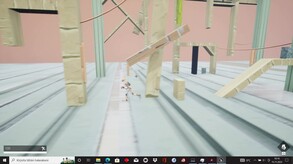
Skeleton Runner is a small-scale indie platformer created by VS Resolution and published by My Way Games. The game places players in control of a skeletal protagonist navigating a series of compact platforming stages built around careful jumping, environmental awareness, and precise movement. Rather than presenting a story-driven adventure, the experience focuses almost entirely on gameplay fundamentals. The player’s objective in each stage is straightforward: guide the skeleton safely across a collection of platforms, avoid falling into hazards or off the map, and ultimately reach a star positioned somewhere within the level. This simple structure gives the game a classic arcade-like rhythm where progress is measured through repeated attempts and improved execution rather than narrative development.
At its core, the gameplay revolves around traditional platforming mechanics that prioritize timing and accuracy. Players must judge distances carefully while jumping between platforms, often navigating narrow ledges or long gaps where even a slight mistake can result in failure. The skeleton character moves with responsive controls, but the environments are designed to punish careless movement. Each level becomes a small challenge in spatial awareness, encouraging players to study the layout before attempting risky jumps. Because falling from the platforms usually results in an instant loss, the tension of each jump becomes the main driving force behind the gameplay.
The game contains a modest collection of stages, with the challenge increasing gradually as players advance. Early levels function as an introduction, presenting relatively simple layouts that allow players to become comfortable with the movement system. These stages typically feature wider platforms and fewer obstacles, giving players space to experiment with the controls. As the game progresses, however, the level design becomes more demanding. Later stages introduce more complex arrangements of platforms, forcing players to chain together several precise jumps in succession. The increased difficulty adds some intensity to the experience, especially when a mistake near the end of a level sends the player back to the beginning.
While the mechanics remain straightforward throughout the game, the layout of each level provides small variations in challenge. Some stages require careful positioning before attempting a jump, while others demand quick reactions as the player moves across narrow surfaces. The final objective—reaching the star—remains constant, but the journey toward that goal becomes progressively more intricate as the levels introduce tighter spaces and trickier platform arrangements. This gradual escalation helps maintain a sense of progression even though the core mechanics never significantly change.
Visually, Skeleton Runner adopts a minimalist presentation that reflects the small scope of the project. The game uses a simple 3D environment combined with side-scrolling platforming gameplay, creating a style that resembles a 2.5D platformer. The skeletal character stands out clearly against the background, making it easy for players to track their movement while navigating difficult sections. The environments themselves are fairly basic in design, consisting mostly of geometric platforms suspended within stylized landscapes. While the graphics lack elaborate detail, the clean presentation ensures that the focus remains on the platforming challenges rather than visual spectacle.
The audio design is similarly modest. Sound effects accompany jumps, movement, and falls, providing simple feedback that reinforces player actions. The soundscape does not attempt to create a deep atmosphere or dramatic tone, instead serving a practical purpose within the gameplay. This stripped-down approach matches the game’s overall philosophy of delivering a straightforward mechanical experience without unnecessary embellishments.
One aspect that adds a small amount of motivation is the inclusion of achievements tied to level completion and progression. These rewards encourage players to finish the game and track their accomplishments, though they do not significantly expand the gameplay itself. Because the stages are relatively short, players can complete them quickly once they understand the layouts, which makes the game well suited for short sessions rather than extended play.
The greatest limitation of Skeleton Runner is its scale. With only a handful of levels and a single core mechanic, the experience is relatively brief. Once players master the platforming system and complete the stages, there is little additional content to explore. The absence of features such as alternate routes, collectibles, or advanced movement abilities means that replay value remains fairly limited. As a result, the game can feel more like a small experimental project than a fully developed platforming adventure.
Even with these limitations, the game still offers a functional and occasionally satisfying challenge for players who enjoy precision platformers. The emphasis on timing and careful movement can create rewarding moments when a difficult sequence of jumps is completed successfully. For players who appreciate minimalist indie games or who enjoy collecting smaller titles on Steam, the game provides a brief but focused platforming experience that prioritizes mechanical skill over complexity.
In the end, Skeleton Runner stands as a simple indie platformer built around basic but effective gameplay principles. It does not attempt to compete with larger platforming titles in terms of scope or polish, but it delivers a concise challenge that can appeal to players looking for a short, skill-based experience. Its straightforward design and accessible mechanics make it easy to pick up, though its limited content prevents it from leaving a lasting impact.
Rating: 5/10