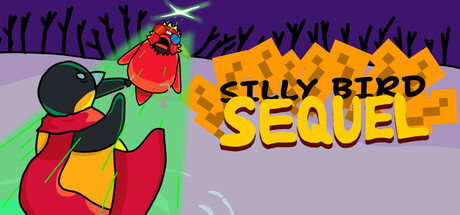
A mysterious light has pulled your friend up into the sky! Do you have what it takes to save him in this fast-paced bird-based precision platforming adventure?
Modeled estimate, not a reported figure. How we estimate →
Media

About
Silly Bird Sequel is a fast-paced precision 2D platformer.
Your friend Jared has been kidnapped by a light from the sky. You never really liked him much, but you've got nothing better to do, so you should probably go rescue him. Be prepared to meet a cast of bird-brained characters and witness a goofy, pun-filled story unfold before your eyes!
Collect various Upgrades that synergize with each other to open up countless movement opportunities. You might start out as a little fledgeling, but you'll be Sliding, Diving and Dashing over obstacles in no time!
If you yearn for difficulty, the game will teach you some high-level movement tech, requiring complex inputs and precise timing and allowing you to take full advantage of the environment. Use the knowledge you gained to conquer the optional ultimate challenge! And with mastery comes great speed.
Stats
All-time low is the lowest price we've recorded for this game since we started tracking it.
Languages: English, Russian
Reviews
Silly Bird Sequel, developed and published by no Entertainment, is a deceptively layered 2D platformer that disguises its mechanical depth behind a deliberately goofy exterior. At first glance, it looks like a light, almost throwaway indie title built around a cartoonish bird and a nonsensical premise, but the longer you spend with it, the more it reveals itself as a carefully constructed precision platformer that values mastery, experimentation, and player improvement over accessibility and hand-holding. The narrative leans fully into absurdity, following a reluctant avian protagonist who sets off on a rescue mission for a kidnapped acquaintance he doesn’t even particularly like. This intentionally unserious setup establishes the tone early, allowing the game to embrace humor, sarcasm, and playful writing without the burden of emotional weight. Dialogue and environmental details often feel tongue-in-cheek, giving the experience a personality that helps offset the inevitable frustration that comes with repeated failure. It’s not a story meant to be analyzed deeply, but it succeeds in keeping the journey entertaining and self-aware. Where the game truly distinguishes itself is in its movement system. What begins as straightforward platforming gradually evolves into something far more intricate as players unlock new abilities and learn how to combine them. Mechanics such as dashing, diving, sliding, and momentum-based traversal aren’t just optional tools—they become essential components of progression. The real satisfaction comes from chaining these abilities together in fluid sequences, turning what initially feels clunky into something precise and expressive. Over time, the controls begin to feel less like inputs and more like a language that players learn to speak. Level design plays a critical role in showcasing these mechanics. The world is structured in a semi-open way, encouraging exploration and giving players the freedom to tackle challenges at their own pace. Each new area introduces variations on movement and obstacle design, ensuring that the gameplay continues to evolve rather than stagnate. Optional routes and more demanding platforming sections provide additional layers of challenge, rewarding players who are willing to push their skills further. These segments often feel intentionally crafted to test mastery rather than simply extend playtime, which adds a sense of purpose to the difficulty. That difficulty, however, is not insignificant. The game expects precision, quick reactions, and a willingness to learn through repetition. Mistakes are common, especially in later stages where timing windows become tighter and sequences more complex. While the mechanics themselves are consistent and fair, the lack of extensive guidance for advanced techniques can make the learning curve feel steep. Players who enjoy honing their skills through trial and error will likely find this rewarding, but those looking for a more forgiving or guided experience may find it demanding to the point of frustration. Visually, the game adopts a colorful pixel art style that complements its comedic tone. Characters are expressive, environments are lively, and animations carry a sense of exaggerated charm that reinforces the game’s personality. While it doesn’t push technical boundaries, the art direction is cohesive and effective, ensuring that the visuals remain engaging without distracting from gameplay. The overall presentation reflects its indie nature, with occasional rough edges, but these rarely detract from the experience in a meaningful way. The audio design follows a similar philosophy, offering upbeat and playful tracks that support the pacing of the game without dominating it. Sound effects are responsive and clear, providing useful feedback during movement and interactions. While the soundtrack may not leave a lasting impression on its own, it works well within the context of the game, maintaining energy and reinforcing its lighthearted atmosphere. One of the more interesting aspects of Silly Bird Sequel is how it balances its approachable aesthetic with its demanding mechanics. It invites players in with humor and simplicity, then gradually reveals a much deeper system that rewards dedication and practice. This contrast can be both a strength and a weakness. For some, it creates a satisfying sense of growth as they improve, while for others, it may feel like a mismatch between expectation and reality. In the end, Silly Bird Sequel is a game that thrives on its mechanics and personality rather than scope or polish. It doesn’t attempt to be expansive or feature-heavy, but instead focuses on delivering a tight, skill-based experience that encourages players to refine their abilities over time. Its charm, combined with its demanding gameplay, makes it a memorable entry in the indie platformer space, even if it isn’t universally accessible. Rating: 6/10
有成就 没中文 《笨鸟后传》 笨鸟后传是一款快节奏的精简2D平台游戏。 你的朋友加里德被一道天光绑架了。你其实并不怎么待见他,但眼下也闲着无事,不如去救他一救。准备好结识一群鸟头鸟脑的角色,见证一个满是谐音梗的滑稽故事在你眼前展开吧! 收集各种相互配合的升级道具,开启无穷无尽的移动可能。你或许从一只雏鸟起步,但很快就能滑翔、俯冲、冲刺,越过重重障碍。 若你渴望挑战,游戏会传授你高阶移动技巧,需要复杂的操作与精准的时机,让你充分利用环境,征服那可选登顶试炼。而一旦掌握,便是风驰电掣。
Didn't play the prequel so wasn't didn't know what to expect with the sequel. Reminded me of Super Meatboy. Bird go pop. Jessica has a crush on me. WARNING: REQUIRES PATIENCE AND SKILL. Will make you say one more try.
Extremely snappy, seamless controller support, and really damn challenging. They allocated every single point into the gameplay aspect and it scratched a very specific precision platforming itch of mine and I also really dig the simple yet detailed artstyle. My expectations were definitely surpassed by a lot!
Related
Related
Trends
Concurrent players on Steam, sampled daily since tracking started.
Related
| Glasses and Girls | $315.6 | 51 | 82% | $0.49 |
| Food and Girls | $315.6 | 51 | 86% | $0.49 |
| Dances and Girls | $322 | 52 | 83% | $0.49 |
| Carnival and Girls | $334.4 | 53 | 85% | $0.49 |
| Anime Sunset Ride | $334.4 | 54 | 67% | $0.49 |
| Cosmic Journey PC Live Wallpaper | $336.3 | 52 | 71% | $0.49 |