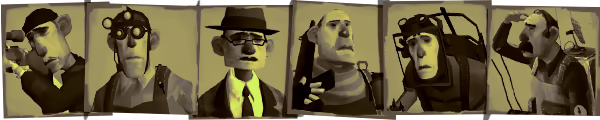
Greetings Officer-Cadet o249,Are you ready to be put to the test? If deemed worthy, you will be assigned as an officer in the shadowy halls of Facility 7C. You will remotely lead a squad of operatives on daring espionage missions to plant evidence, steal secrets, assassinate targets, and perform sabotage for the glory of the Dark Father.
Modeled estimate, not a reported figure. How we estimate →
Media

About


Stats
All-time low is the lowest price we've recorded for this game since we started tracking it.
Languages: English**languages with full audio support
Engagement
Hours played at review time, across 49 reviews with recorded playtime.
Reviews
Themes across 48 recent reviews and how positive each mention is. A keyword signal, not full sentiment analysis.
positive critical· bar length = how often the theme comes up
Reviews
Best coop experience I have had in a long time.
This is a great game with an intresting gimmick. I love the charecters! they are funny and just well made. The soundtrack! oh man! its fantastic! but what about... The game it self? well the game is very well made, its not impossible but there is a problem with comunication on what to do (or were) the thing. which makes the game a bit harder than how it realy is. but the game is not impossible. after a mission you can try a side mission, trying to discover the plot of the world you live in. all around, its a fantastic game. you should buy it.
Horrible game. Stay away.
Signal Ops - сигнал о покупке лампового ТВ получен.
A fun if simple stealth-action game. Suffers from a bit of a rocky start as the Police enemies can annoyingly arrest you in a bit of a buggy manner but if you stick with it, it works as a more stealth-focused Commandos Strike Force. I do recommend checking out the forums/my guide as the game does suffer from a handful of poorly designed missions.
Great squad based game. Puzzels, strategy, and an interesting story if you explore the base. As with all co-op enabled games bringing a friend along doubles the fun and helps a lot with finishing a mission quickly.
The gameplay seemed really interesting... but it crashes too often to actually enjoy it.
Devs abandoned it best to avoid, wont even launch anymore. Edit: Not abandoned, but incompatible with current Mac OS.
Are you a good leader or will you fail to stop the great enemies in your way?
Signal Ops, developed and published by Space Bullet Dynamics Corporation, is a strange and fascinating blend of stealth, tactics, and first-person action that sets itself apart from virtually every other game in its genre. At its core, it’s a squad-based espionage experience that places you in command of multiple agents working for a shadowy organization known as Facility 7C. Instead of embodying a single operative, you play as the unseen controller who monitors and directs missions through a bank of analog screens, each showing a live feed from an agent’s perspective. The premise immediately evokes a sense of Cold War secrecy and bureaucratic absurdity, with the entire game wrapped in a grim yet tongue-in-cheek atmosphere that feels equal parts spy thriller and dark satire. The concept behind Signal Ops is undeniably ambitious. It merges real-time first-person control with squad-based management, requiring the player to coordinate up to four agents simultaneously. Each operative has unique skills and responsibilities: one may handle heavy weaponry, another might specialize in hacking, while yet another carries the crucial radio transmitter that allows communication between the team and headquarters. The “signal” mechanic defines the entire experience—your agents can only operate within range of the transmitter, forcing you to move cautiously through levels, managing line-of-sight, signal coverage, and enemy patrols. This constant need to reposition, scout, and synchronize multiple viewpoints creates moments of genuine tension and strategic satisfaction. When the system clicks, it feels unlike anything else, combining the cerebral planning of an RTS with the immersion of a first-person stealth game. Visually, Signal Ops adopts a distinctive art direction that enhances its peculiar charm. The world is painted in muted, hand-brushed tones, giving it a surreal, almost watercolor look that emphasizes its retro-futurist aesthetic. The environments—sprawling military compounds, desolate facilities, and secret bases—are drenched in atmosphere, with dim lighting, flickering monitors, and industrial grime evoking a world perpetually on the edge of collapse. The art style reinforces the game’s themes of surveillance and control; you’re always looking through a lens, always slightly removed from the action. The sound design is equally evocative, mixing minimal ambient noise with mechanical hums, radio chatter, and the occasional eerie silence that amplifies the sense of unease. Together, these elements build a world that feels oppressive yet strangely humorous, like a dystopian parody of spy fiction. In terms of gameplay structure, Signal Ops plays out across a series of missions, each with its own objectives, layout, and challenges. The game encourages experimentation and improvisation—you can approach situations with stealth, aggression, or a mix of both, depending on your resources and preferred tactics. However, the mechanics that make Signal Ops unique are also what make it divisive. Managing multiple agents in real time can be disorienting, especially when combat breaks out or when the signal radius forces constant repositioning of the transmitter. The need to juggle viewpoints between screens while tracking enemy movement and completing objectives is demanding, and it can easily overwhelm players expecting a more traditional shooter experience. The controls, while functional, are occasionally clunky, particularly when switching between characters or interacting with environmental objects. These rough edges contribute to a sense of awkwardness that some may find immersive, while others may view it as frustration. The pacing of Signal Ops is deliberate and methodical, rewarding patience and situational awareness rather than reflexes. Each mission unfolds like a puzzle box, where success depends on understanding the layout, planning routes, and coordinating your team’s movements with precision. The satisfaction comes not from flashy combat but from pulling off a perfect infiltration, keeping your agents in range, and outmaneuvering the enemy through careful timing. That said, the game’s slower rhythm and unforgiving mechanics mean it isn’t for everyone. Players looking for immediate thrills or polished gunplay may find it cumbersome, while those who enjoy systems-driven problem-solving will appreciate the challenge. It’s a game that demands your attention and punishes complacency, but it also offers moments of clever design that feel genuinely rewarding once mastered. Signal Ops’ tone and narrative presentation add to its distinctiveness. The world it portrays is one of decaying machinery, failed ideology, and absurd bureaucracy. The writing and voice acting lean into dark humor, with characters speaking in deadpan tones that satirize military and intelligence clichés. You’re working for an organization that seems as incompetent as it is powerful, sending agents to perform morally dubious missions in a world that no longer makes much sense. This absurdist tone lends the game personality, turning what could have been a sterile tactical experience into something more memorable and thematically rich. For all its creativity, however, Signal Ops clearly shows the limitations of its indie origins. The interface can feel dated, the technical performance inconsistent, and the controls occasionally unrefined. Certain missions drag longer than they should, and the constant micro-management of signal range sometimes crosses from engaging challenge into tiresome repetition. Yet these shortcomings stem more from ambition than from lack of vision. The game reaches for something unusual—a fusion of immersive sim, real-time tactics, and noir parody—and while it doesn’t always succeed, its willingness to take risks is admirable. Ultimately, Signal Ops is a flawed but fascinating experiment that stands apart from mainstream design. It rewards players who embrace its quirks, think strategically, and appreciate its darkly humorous tone. It’s not a game for everyone; it demands patience, adaptability, and a willingness to wrestle with unconventional mechanics. But for those who can look past its rough edges, Signal Ops delivers a rare kind of experience—one that challenges how we think about control, perspective, and coordination in video games. It’s a small, ambitious gem that dares to be different, and while it may stumble at times, its creativity and atmosphere make it a journey worth taking for those intrigued by its strange and cerebral vision of espionage. Rating: 6/10
Related
Related
Trends
Modeled estimate over time, reconstructed from Steam's monthly review histogram.
Momentum
Pace estimated from the game's recent review growth (our daily snapshots) at its own sales-per-review ratio — a momentum signal, not booked sales.
Audience
Estimated from the language of this game's reviews — a proxy for where players are, not official Steam demographics.
Related
| 7 Days to Die | $425.3M | 403.5K | 87% | $44.99 |
| Mount & Blade II: Bannerlord | $309.8M | 293.9K | 88% | $49.99 |
| Don't Starve Together | $130.6M | 373.1K | 95% | $14.99 |
| Hell Let Loose | $51.5M | 148.7K | 82% | $17.49 |
| Schedule I | $144.4M | 308.4K | 98% | $19.99 |
| Squad | $166.3M | 240.4K | 81% | $39.99 |
Related
| KUNAI | $34K | 596 | 79% | $3.39 |
| Sorcerer's Choice: Angel or Demon? | $34K | 52 | 94% | $19.99 |
| Newton's Fourth Law | $34K | 221 | 95% | $4.79 |
| Fantasia of the Wind - 风之幻想曲 | $34K | 422 | 88% | $3.99 |
| Flowers Blooming at the End of Summer | $34K | 2.9K | 96% | $0.99 |
| Tears of Avia | $34K | 104 | 50% | $14.99 |