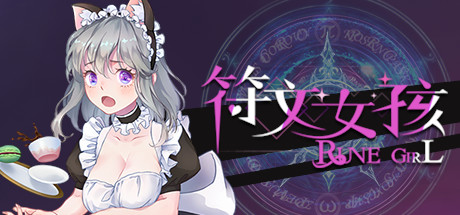
符文女孩 / Rune Girl is a small-scale, anime-inspired indie title developed by AFOG and published by DSGame that occupies a very specific niche between casual arcade play and character-focused visual content. Rather than aiming to deliver a traditional role-playing experience or a mechanically rich action game, Rune Girl positions itself as a light, low-commitment experience built around repetition, gradual unlocks, and stylized presentation. From the outset, it makes clear that its priorities lie in simplicity, accessibility, and visual appeal rather than depth or complexity.
At the core of the game is an extremely minimal gameplay loop. Players control a blue ball within a confined space, using mouse input to influence its movement while avoiding contact with a hostile black ball. Success depends on maintaining awareness, timing movements carefully, and surviving long enough to accumulate points. This basic mechanic is repeated throughout the experience with only minor variations, forming the backbone of progression. The simplicity of the controls makes Rune Girl immediately approachable, requiring almost no onboarding or learning curve, which allows players to jump in for short sessions without mental strain.
Progression is tied directly to performance in these arcade-style segments. As players reach score thresholds, new chapters unlock, introducing additional characters, scenes, and brief narrative snippets. These story elements are intentionally lightweight, functioning more as connective tissue than as a fully developed plot. Rather than telling a complex or evolving story, Rune Girl uses narrative beats primarily as rewards, encouraging players to continue engaging with the core mechanic in order to see new content. This structure reinforces the game’s loop-driven design, where repetition is expected and rewarded rather than avoided.
Visually, Rune Girl leans heavily into anime aesthetics, with character designs that are colorful, expressive, and clearly intended to be a major draw. A rotating cast of girls, along with stylized mascots such as cats and maids, forms the heart of the game’s appeal. Character art and animations are presented cleanly, and unlockable scenes add variety to the otherwise abstract gameplay environment. While the visuals are not technically advanced, they are consistent with the game’s tone and target audience, prioritizing charm and style over realism or graphical complexity.
Rune Girl also includes adult-oriented content, which plays a significant role in shaping its identity. Mature themes and nudity are integrated into the unlockable scenes, and these elements are clearly positioned as a primary incentive for continued play. While the developers emphasize that all characters are adults, the presence of sexualized content makes it clear that this is not a general-audience title. For players drawn to anime-style adult games, this aspect may be a key attraction; for others, it may feel disconnected from the already minimal gameplay foundation.
Replay value is driven almost entirely by the desire to unlock all available content. Steam achievements, score chasing, and optional downloadable content packs add incremental goals, but they do not fundamentally change how the game plays. Additional DLCs introduce more characters and scenes, extending the lifespan of the experience without expanding its mechanical scope. As a result, long-term engagement depends largely on tolerance for repetition and interest in the game’s aesthetic rather than on evolving challenges or systems.
One of the most frequently noted aspects of Rune Girl is how sharply it divides players. For some, the relaxed pacing and simplicity make it an effective time filler—a game that can be played casually without stress or commitment. For others, the lack of mechanical depth and variation causes the experience to wear thin quickly. The repetitive nature of the gameplay loop is both its defining feature and its greatest limitation, as it offers little surprise once the core mechanic is understood.
In the end, Rune Girl is best understood as a focused, niche experience rather than a broadly appealing game. It does not attempt to innovate or expand its mechanics beyond their initial premise, instead relying on visual style, character content, and accessibility to carry the experience. For players who enjoy casual, low-effort gameplay paired with anime-inspired presentation and unlockable character scenes, Rune Girl delivers exactly what it promises. For those seeking deeper gameplay systems, richer storytelling, or sustained challenge, it is likely to feel shallow and repetitive. As an indie experiment tailored to a specific audience, Rune Girl succeeds on its own terms, even if those terms limit its wider appeal.
Rating: 6/10