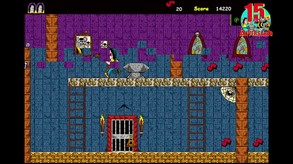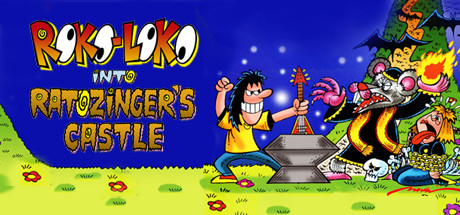
Roko-Loko into Ratozinger’s Castle is a platform-styled action game. You will explore a huge castle with several dangers, enemies and dungeons. If you succeed at rescuing the rockstars and unlocking the castle doors, you will finally face the evil boss, Ratozinger.
Modeled estimate, not a reported figure. How we estimate →
Media

About
Stats
All-time low is the lowest price we've recorded for this game since we started tracking it.
Languages: English, Portuguese - Brazil*, Spanish - Latin America*languages with full audio support
Reviews
Jogo é excelente, trilha sonora muito boa de rock, o jogo traz uma nostalgia dos games antigos de plataforma, vale muito a pena comprar, recomendo!
Roko-Loko into Ratozinger's Castle, developed by Play Systems in collaboration with SGuerra Design and published by Play Systems, is a retro-inspired 2D platformer that revives a cult comic property through classic arcade-style design. Originally conceived years before its modern re-release, the game carries the unmistakable energy of early CD-ROM platformers while embracing pixel art aesthetics and straightforward mechanics that echo the 16-bit era. Its Steam release serves not only as a playable adventure but also as a nostalgic preservation of a long-standing Brazilian comic franchise. The premise is delightfully exaggerated and rooted in rock culture parody. Players take control of Roko-Loko, a rebellious rock enthusiast who must storm the ominous castle of the villainous Ratozinger to rescue his kidnapped girlfriend, Adrina-Lina, along with several iconic rock musicians. The villain embodies an over-the-top caricature of authoritarian conservatism, creating a tongue-in-cheek narrative framework that blends satire with cartoon absurdity. Rather than delivering complex storytelling, the game relies on energetic tone and thematic flair to drive the adventure forward. Gameplay adheres closely to classic platforming fundamentals. Movement revolves around precise jumping, enemy avoidance, and hazard navigation across interconnected castle environments. Levels are structured around carefully placed traps, moving platforms, spike pits, and enemy patrol patterns that demand timing and repetition. There are no elaborate skill trees or modern progression systems; mastery comes from understanding enemy behavior and executing jumps with consistency. The castle layout gradually increases in difficulty, introducing tighter platform spacing and more punishing hazard combinations as players advance deeper into the fortress. Visually, the game embraces a bright pixel art style that reinforces its retro identity. Character sprites are expressive and animated with simplicity, while backgrounds evoke gothic castle corridors, dungeon chambers, and trap-filled halls. The aesthetic feels intentionally nostalgic rather than technically ambitious, prioritizing clarity and charm over graphical complexity. This design choice ensures that the game remains readable and accessible while staying true to its vintage inspiration. Sound design plays a key role in maintaining the rock-infused atmosphere. Energetic background tracks accompany the action, reinforcing the rebellious theme that defines the protagonist. The soundtrack, combined with the exaggerated character designs, helps establish a cohesive personality that distinguishes the game from more generic platformers. Audio cues for hazards and enemy interactions are functional, supporting gameplay without overwhelming it. Difficulty reflects its old-school heritage. Players can expect challenging sequences that require repetition and memorization. Checkpoint placement and level length may feel demanding compared to modern platformers that favor generous save systems. For genre purists, this design philosophy enhances satisfaction when overcoming obstacles. For others, it may introduce moments of frustration. The balance between challenge and fairness largely depends on the player’s tolerance for classic arcade conventions. What makes Roko-Loko into Ratozinger’s Castle stand out is its cultural origin. The characters and world stem from a comic series created by Brazilian artist Marcio Baraldi, giving the game a sense of heritage beyond its mechanics. Fans of the original comics may find additional enjoyment in seeing familiar characters translated into interactive form. Even without prior knowledge of the franchise, the exaggerated tone and rock-themed identity provide a unique flavor compared to many contemporary indie platformers. Ultimately, the game succeeds as a nostalgic homage rather than a reinvention of the genre. It does not attempt to introduce groundbreaking mechanics or modernized systems. Instead, it commits fully to delivering a straightforward, personality-driven platforming experience rooted in retro sensibilities. For players who appreciate classic 2D action, pixel art presentation, and a playful rock-inspired narrative, Roko-Loko into Ratozinger’s Castle offers a focused and energetic journey through a villain’s castle that captures the spirit of old-school platforming with a distinctive cultural twist. Rating: 6/10
Related
Related
Trends
Modeled estimate over time, reconstructed from Steam's monthly review histogram.
Momentum
Pace estimated from the game's recent review growth (our daily snapshots) at its own sales-per-review ratio — a momentum signal, not booked sales.
Related
| Chatventures | $4.5K | 179 | 88% | $1.49 |
| Shift | $4.5K | 346 | 78% | $0.49 |
| BANG! BANG! Totally Accurate Redneck Simulator | $4.5K | 270 | 93% | $0.99 |
| Rain Blood Chronicles: Mirage | $4.5K | 180 | 71% | $0.99 |
| Star Sweet | $4.5K | 99 | 60% | $2.99 |
| There The Light | $4.5K | 108 | 79% | $2.99 |