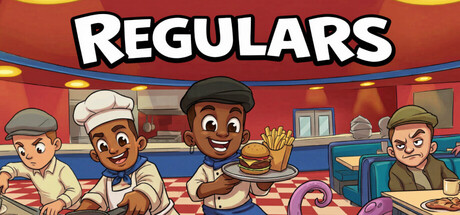
Run a late-night diner with up to 8 friends. Seat customers, take orders, and cook meals. Not everyone is who they seem. Study your regulars, spot the anomalies, and decide who gets served and who gets purged.
Modeled estimate, not a reported figure. How we estimate →
About
Overcooked's chaos. Among Us's paranoia. A diner that closes at midnight for a reason.
Regulars is a cooperative restaurant management game set during the night shift of a small sit-down diner. Seat customers, take their orders, prep ingredients across grill, fryer, and assembly stations, and serve meals before patience runs thin. You're understaffed and the door keeps opening.
Your regulars are creatures of habit. Learn their faces, their quirks, their tells. Because tonight, something walked in wearing a familiar face, and it's sitting at table four asking for the usual.
Scales, thermometers, dermal scanners, UV lamps — use your tools to investigate the customers who don't quite add up. Cross-reference what you see against your notebook. Follow the rules posted on the board. And when you're sure something isn't right... pull the trigger. Be wrong, and you've just shot a paying customer.
- Co-op for 1–8 players — Host online through relay or over LAN. Every role matters when the diner gets busy.
- Learn your regulars — Dozens of unique customer profiles with consistent behaviors, preferences, and appearances that you'll memorize over time.
- Cook real orders — Grill, fry, prep, plate, and serve from a menu of 85+ recipes with multi-ingredient assembly.
- Investigate anomalies — Tier-gated inspection tools reveal what the naked eye can't. Daily rules change what "normal" looks like each shift.
- Upgrade your diner — Unlock faster equipment, more seating, advanced info tools, and automation as your restaurant levels up.
- Customize your character — Full character creator with face, hair, clothing, and accessories.
- First-person or third-person — Toggle your camera perspective at any time.
- Full controller support — Play with keyboard & mouse or gamepad.
Genres
Stats
All-time low is the lowest price we've recorded for this game since we started tracking it.
Reviews
A city has been closed off because aliens or mutants have infiltrated society. To keep morale up, the government has allowed a diner to open its doors and give people a reason to go out again. But anyone could be an alien, so your job is to check everyone and serve food only to regulars, while blasting the aliens away because food somehow makes them stronger. The first step is to welcome customers at the counter and perform an inspection. This is done by checking their temperature and weight. An alien has a temperature that is either much lower or much higher than the standard, while their weight has to match their appearance, so a large guy can’t weigh very little. The units are imperial, but as long as you remember the normal values, you’ll spot anomalies easily. Then, you take the customer to their seat, take their order, and go to the back to start cooking. Food is kept in the freezer, and it comes in a limited supply, so you need to order new ingredients over the phone when you start running low. There’s a grill where you cook meat and watch the timer so it doesn’t overcook, as well as plates where you put the food. Plates also come in limited supply, so you need to wash them after the customer is done eating. There’s a lot going on, which is why the game is meant for multiple players, with each person taking care of one station. On your own, you won’t stand a chance because customers keep coming all the time, and while you’re handling the front counter, the customers waiting for their food are already getting angry. Not to mention, you have to keep an eye on the food while cooking, make sure you don’t run out of ingredients, and watch your back if you let an alien inside. In this case, they’ll start punching you and knock you down, so you need to run for the gun and shoot them. You’ll get back up after a few seconds, so you can’t really fail the game, but it’s annoying. It has a casual approach and isn’t demanding, and any money that doesn’t go toward ingredients can be invested in upgrades. But again, there isn’t much point in the game if you intend to play it solo.
Media

Related
Related
Price dynamics, follower growth, revenue and sales trajectories with interactive tooltips
This and every other Pro feature is free until October 20, 2026. A free account is all it takes.
Languages: English
有点意思的游戏。一些基本功方面,如按钮布局,音效配合,易用便捷,跟手响应等,能看出来作者的心意和付出;对于一个小厂来说,能呈现出这样的效果已经ok了,个人感觉也可以,可以推荐。如果还在犹豫,可以看看更多评论和商店演示,是骡子是马再多多感受综合评估一下,到那时再决定是否入库吧。
Good game, lots of fun potential with friends
有成就 没中文 《常客》 他们总会回来。但有时,有什么东西会跟着他们一起回来。 《煮糊了》的混乱,《我们之中》的猜疑。一家午夜关门的餐馆,是有理由的。 《常客》是一款合作餐厅管理游戏,设定在一家小餐馆的夜班时段。安排顾客就座、接受订单、在烤架、油炸锅和组装台准备食材,并在顾客失去耐心前上菜。你人手不足,而门一直在打开。 但真正的工作不是烹饪。 你的常客是习惯的生物。记住他们的面孔、他们的怪癖、他们的特征。因为今晚,有什么东西顶着熟悉的面孔走了进来,正坐在四号桌,点着“老样子”。 找出差异。做出判断。 体温计、紫外线灯——使用你的工具来调查那些不太对劲的顾客。将你所见的与你的笔记本交叉比对。遵循公告板上的规则。当你确信有什么不对劲时……扣下扳机。如果弄错了,你就刚刚枪杀了一位付钱的顾客。 特色 - 1-8名玩家合作——通过中继或局域网在线主持。当餐馆繁忙时,每个角色都很重要。 - 了解你的常客——数十种独特的顾客档案,具有一致的行为、偏好和外貌,你会随着时间的推移记住它们。 - 烹饪真正的订单——在烤架、油炸锅上烹饪、准备、装盘,并从包含85种以上配方的菜单中提供多食材组合的餐点。 - 调查异常——分级解锁的检查工具能揭示肉眼无法看到的东西。每日规则会改变每个班次“正常”的样子。 - 升级你的餐馆——随着餐厅升级,解锁更快的设备、更多座位、高级信息工具和自动化。 - 自定义你的角色——完整的角色创建器,包含面部、发型、服装和配饰。 - 第一人称或第三人称——随时切换你的视角。 - 完整的手柄支持——使用键盘鼠标或游戏手柄游玩。 **为何要采用抢先体验这种模式?** “《常客》是一款围绕识人——了解他们的习惯、发现异常,并与团队做出瞬间判断——而构建的合作游戏。这种体验只有在真实的玩家反馈下才能变得更好。抢先体验让我们能将核心游戏交到玩家手中,以便在塑造最终产品之前,调整难度节奏、平衡调查工具,并观察团队在实际游戏中的协作方式。” **这款游戏的抢先体验状态大约持续多久?** “我们计划在抢先体验阶段停留大约6到12个月,具体取决于我们收到的反馈范围以及开发进展。” **计划中的完整版本和抢先体验版本到底有多少不同?** “我们计划根据抢先体验期间学到的东西,在几个方面扩展游戏: - 更多常客档案,包含更深入的背景故事和更难发现的异常变体 - 额外的食谱、食材和厨房设备 - 新的检查工具和调查机制 - 更多异常类型和每日规则组合 - 扩展的餐厅升级路径 - 全面的音频、视觉和用户界面打磨 整体范围和方向将根据玩家在抢先体验期间反应最强烈的部分来塑造。” **抢先体验版本的现状如何?** “核心玩法循环已完全可玩。玩家可以通过在线中继或局域网主持或加入最多4人的会话。你可以安排顾客入座、接受订单、在烤架、油炸锅和准备站烹饪餐点、上菜、收款并完成轮班。调查系统功能齐全——检查工具、常客档案的逐步笔记本以及每日规则都已到位。包含角色自定义、餐厅升级系统和等级 progression。游戏可从开始到结束在多个轮班中游玩,但内容、平衡和打磨仍在扩展中。” **在抢先体验期间和结束之后,游戏价格会有所不同吗?** “随着我们在抢先体验期间添加新内容和功能,我们可能会逐步提高价格。早期购买的玩家将获得最优惠的价格,并免费获得所有未来的更新。” **在开发过程中,你们是如何计划让玩家社区参与进来的?** “我们计划积极利用Steam社区讨论和我们的Discord服务器来收集关于平衡、难度和新功能优先级的反馈。玩家的错误报告和建议将直接指导我们的开发路线图。我们特别感兴趣的是了解团队在轮班期间如何协调,以及哪些调查机制感觉最有回报——这些反馈如果没有真实的玩家社区是很难获得的,这也是我们选择抢先体验的一个重要原因。”
希望可以支持简中。
Regulars takes the familiar pressure of running a restaurant and twists it into something considerably stranger and more unsettling. Developed and published by Toast Game Studio, the game combines restaurant management, cooking, time management, observation, and horror into a concept where serving customers is only part of the job. Players operate a late-night diner filled with familiar patrons, but the comforting idea of recognizing regular customers becomes a source of suspicion. Some visitors may not be what they seem, meaning that successfully completing a shift requires careful observation alongside ordinary restaurant work. The management side revolves around recognizable restaurant responsibilities such as welcoming customers, handling orders, preparing food, and keeping service moving efficiently. These activities create the routine that makes the game's central anomaly mechanic work. Instead of concentrating exclusively on speed and customer satisfaction, players also need to watch the people entering the establishment. A seemingly ordinary customer can become a potential danger if something about their appearance or behavior does not correspond with what the player remembers. This emphasis on recognizing regular customers gives the game an interesting psychological dimension. Repetition becomes useful because repeated encounters gradually teach players what each patron is supposed to look like. Familiarity effectively becomes another resource that must be developed alongside practical restaurant skills. When something changes, the player must notice the discrepancy and decide whether the customer is legitimate. The possibility of making a mistake creates tension because concentrating too heavily on cooking or serving could allow an abnormal visitor to escape scrutiny. Regulars consequently has a promising approach to horror. Rather than depending entirely on monsters suddenly appearing or conventional scares, much of the tension comes from uncertainty. The diner establishes a predictable routine, and the game can then undermine that feeling of security through subtle abnormalities. A familiar face becoming slightly unfamiliar is potentially more effective than an obviously hostile creature because it encourages players to doubt their own memories. The strongest moments should emerge when players notice something unusual but are not completely certain whether they are seeing an actual anomaly. The concept becomes even more appealing through online cooperative play, with the game designed to accommodate groups of players working together inside the diner. Cooperative restaurant games naturally generate hectic situations as participants divide responsibilities, but Regulars adds suspicion to that formula. Players can concentrate on different jobs, communicate information about customers, and attempt to maintain an efficient operation while simultaneously watching for anything abnormal. Disagreements about whether a customer is genuine could produce some of the game's most entertaining situations, particularly when everyone is already overwhelmed with restaurant duties. Supporting a relatively large cooperative group also gives the developers opportunities to create controlled chaos. A well-organized team might assign players to cooking, customer management, observation, and other responsibilities, while less coordinated groups could quickly find themselves surrounded by unfinished orders and questionable customers. The horror premise therefore does not necessarily conflict with the social nature of multiplayer. Instead, uncertainty can become a source of conversation, accusations, mistakes, and memorable cooperative moments. The presentation complements this unusual mixture. Regulars uses a stylized 3D direction rather than attempting strict realism, which seems appropriate for gameplay built around recognizing visual differences. Distinctive characters should theoretically be easier to remember, allowing abnormal characteristics to stand out without making every encounter an exhausting visual examination. At the same time, the darker atmosphere of the late-night setting provides contrast against the more colorful and exaggerated elements of the presentation. This balance gives the game an identity that can move between humorous cooperative disorder and unsettling encounters without requiring either tone to dominate constantly. Its broader mixture of simulation, casual, atmospheric, detective, and role-playing elements suggests that the developers want the experience to extend beyond a basic sequence of cooking challenges. Character customization, crafting-related ideas, progression possibilities, and the unusual setting potentially provide reasons to continue operating the diner beyond the immediate novelty of detecting suspicious customers. The game's world also appears intentionally stranger than an ordinary restaurant environment, helping explain why identifying dangerous abnormalities is treated as a normal part of employment. The greatest concern is longevity. Games centered on identifying anomalies depend heavily on variety because their mysteries become easier once players memorize every possible trick. Regulars will need enough customers, abnormal variations, restaurant complications, recipes, and unpredictable combinations to keep experienced players alert. Its cooking mechanics likewise need sufficient progression to remain entertaining independently of the horror element. If either half becomes repetitive, the other will have to carry too much of the experience. Multiplayer balance is another challenge, since larger groups require enough simultaneous activities to ensure that everyone has something worthwhile to contribute. Even with those uncertainties, the fundamental design is unusually cohesive. The restaurant mechanics are not simply attached to an unrelated horror concept. Serving the same customers repeatedly teaches players what normality looks like, and the anomaly system then weaponizes that knowledge. Routine creates familiarity, familiarity creates confidence, and suspicious changes undermine that confidence. It is a smart relationship between mechanics and theme that could distinguish Regulars from conventional cooking simulators as well as straightforward anomaly-detection games. Regulars ultimately presents Toast Game Studio with a strong foundation for a distinctive cooperative experience. The combination of cooking, restaurant management, customer recognition, investigation, and supernatural uncertainty gives ordinary service work an entertaining sense of danger. Its success will depend on variety, progression, replayability, and how convincingly the anomalies challenge players after many hours, but the underlying idea has considerable potential. Rating: 7/10
Selling now
See how fast this game is selling right now — estimated copies and revenue per day from recent review growth.
Related
| Game | Estimated lifetime revenue | Reviews | Review score | Price |
|---|---|---|---|---|
| $1.1K | 5 | 80% | $5.99 | |
| $597 | 7 | 100% | $4.99 | |
| — | 0 | — | — | |
| — | 0 | — | — | |
| $286.7K | 554 | 94% | $19.99 | |
| $694 | 3 | 100% | $5.99 |
Related
| Game | Estimated lifetime revenue | Reviews | Review score | Price |
|---|---|---|---|---|
| $1.6K | 66 | 91% | $1.39 | |
| $1.6K | 63 | 71% | $0.99 | |
| $1.6K | 77 | 65% | $0.99 | |
| $1.6K | 103 | 61% | $0.74 | |
| $1.6K | 59 | 90% | $0.99 | |
| $1.6K | 101 | 75% | $0.71 |