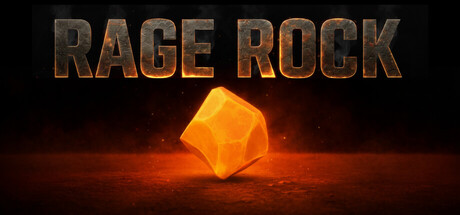
A challenging physics rage platformer where you launch a stubborn rock up a mountain.
Modeled estimate, not a reported figure. How we estimate →
Media

About
Physics-driven rage platformer about one stubborn rock trying to reach the top of a mountain, and a player stubborn enough to get it there.
Mechanics: Launch and steer the rock between platforms. Falling down can be very punishing.
Zero Hand-holding, No "easy mode." and No checkpoints. well, maybe one.
Is this game for you?
Yes, if you're a great gamer, incredibly patient or just someone who want to suffer.
Did the developer beat this game?
No.
Stats
All-time low is the lowest price we've recorded for this game since we started tracking it.
Languages: English
Reviews
Rage Rock, created by Abdulrahim Al Methiab, is a deliberately punishing physics-based platformer that fully commits to the design philosophy of so-called “rage games,” where failure is not just expected but built into the core experience. At a glance, its premise appears almost absurdly simple: guide a stubborn rock upward across a series of precarious platforms stacked into a towering vertical climb. However, beneath that simplicity lies a system that demands precision, patience, and a willingness to accept repeated setbacks as part of the journey. The gameplay revolves around launching and controlling the rock using physics-driven movement, where every action is dictated by momentum, angle, and timing rather than direct control. This creates a sense of weight that makes each jump feel significant, as even the smallest miscalculation can send the player tumbling back down. Learning how the rock behaves becomes the central challenge, requiring players to develop an intuitive understanding of how to adjust their inputs to achieve the desired trajectory. While this system can feel rewarding once mastered, it also introduces moments of unpredictability that can make failure feel frustrating rather than fair. What defines Rage Rock more than anything else is its uncompromising approach to difficulty. The game offers little in the way of assistance, with minimal guidance and a lack of traditional safety nets such as frequent checkpoints. Progress is fragile, and falling from higher sections often results in losing large amounts of advancement. This design creates a constant tension between progress and regression, where every successful landing carries a sense of relief, but every mistake has the potential to undo minutes of effort. It is a structure that thrives on emotional extremes, pushing players to persist through frustration in pursuit of incremental gains. The level design is built around vertical progression, with each new section introducing tighter platform spacing and more demanding jumps. Rather than adding new mechanics, the game increases difficulty by refining the same core challenge, requiring greater precision and control as players climb higher. This approach keeps the focus on mastery, but it also means that the experience does not evolve significantly over time. Players are constantly engaging with the same system, which can lead to a sense of repetition, especially during longer sessions or after multiple falls. Visually, the game adopts a clean and minimalistic style that emphasizes clarity. The environments are simple and uncluttered, allowing players to focus entirely on the positioning of platforms and the movement of the rock. While this design supports the gameplay effectively, it does little to create a strong visual identity. The scenery remains largely consistent throughout the climb, and there is little variation to break up the experience. This simplicity reinforces the game’s mechanical focus but may leave some players wanting a more dynamic or visually engaging world. The tone of the game aligns closely with its design, embracing its role as a challenging and often frustrating experience. There is a sense of self-awareness in how it presents itself, acknowledging that it is not meant to be relaxing or forgiving. Instead, it targets players who enjoy overcoming difficult obstacles and are willing to endure repeated failure in order to achieve success. This makes it a highly niche experience, appealing primarily to those who find satisfaction in persistence and gradual improvement. Replay value is limited, as the game does not offer additional modes or significant variations in gameplay. Once the player reaches the top, the primary motivation to return is to improve performance or complete the climb more efficiently. The focus remains on mastery rather than content, which can be appealing for some but limiting for others who prefer more variety or long-term progression systems. Despite its harsh design, Rage Rock does manage to deliver moments of genuine satisfaction. Successfully navigating a difficult sequence after multiple attempts can feel rewarding in a way that few other types of games achieve. These moments highlight the strength of its core concept, showing how a simple idea can create a compelling challenge when executed with consistency. In the end, Rage Rock is a focused and unapologetically difficult platformer that delivers exactly what it promises: a test of patience, precision, and resilience. It is not designed to appeal to a wide audience, but for those who enjoy mastering demanding mechanics and overcoming repeated failure, it offers a clear and engaging challenge. While its lack of variety and punishing structure may deter many players, it remains a solid example of the genre it represents. Rating: 6/10
Related
Related
Trends
Concurrent players on Steam, sampled daily since tracking started.
Ts Peak
Related
| Glasses and Girls | $315.6 | 51 | 82% | $0.99 |
| Bongo Quest | $315.6 | 51 | 45% | $0.49 |
| Food and Girls | $315.6 | 51 | 86% | $0.99 |
| Dances and Girls | $322 | 52 | 83% | $0.99 |
| Anime Sunset Ride | $334.4 | 54 | 67% | $0.49 |
| Carnival and Girls | $334.4 | 53 | 85% | $0.99 |