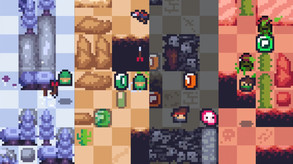
Quester is a fast-paced indie roguelike that combines retro arcade action with dungeon crawling and resource management in a way that feels both simple and surprisingly intense. Developed and published by LUJA Studio, the game throws players into procedurally generated labyrinths packed with monsters, treasure, and constant danger. While the pixel-art presentation initially suggests a straightforward retro action game, the mechanics underneath are much more demanding than they first appear. Quester thrives on pressure, forcing players to balance combat, survival, and resource conservation during every second of a run. The result is a compact but highly addictive experience that captures the spirit of old-school arcade design remarkably well.
The game’s most distinctive feature is its POWER system, which completely changes how combat is approached. Attacking enemies consumes energy, meaning players cannot simply fight endlessly without consequences. In order to keep attacking, players must gather coins and resources scattered throughout the dungeon. This creates a constant risk-versus-reward dynamic where every encounter becomes a small strategic decision. Choosing whether to spend energy fighting enemies or conserve resources for future threats adds tension to even simple battles. The mechanic gives Quester a unique rhythm because survival depends just as much on efficient movement and resource collection as combat skill.
One of the strongest aspects of the game is its pacing. Quester rarely gives players time to relax once a run begins. Enemies appear constantly, corridors become crowded quickly, and danger escalates as players push deeper into each dungeon. The gameplay loop feels heavily inspired by classic arcade titles where maintaining momentum is essential. Instead of slowly exploring levels and carefully planning every movement, players are encouraged to stay aggressive, react quickly, and adapt under pressure. This creates an exciting flow where every mistake feels costly and every successful recovery feels rewarding.
Replayability is another area where the game performs very well. Multiple characters with different abilities and upgrade paths encourage experimentation across repeated runs. Some heroes are better suited for direct close-range combat, while others rely more heavily on mobility or specialized attacks. Since levels are procedurally generated, each run unfolds differently enough to keep the gameplay feeling fresh for a long time. Character progression also adds a satisfying sense of long-term improvement as players gradually unlock stronger skills and discover more efficient strategies.
Visually, Quester embraces a minimalist pixel-art style that fits the gameplay perfectly. The graphics are intentionally simple, prioritizing readability and speed over visual spectacle. Enemy designs, projectiles, and environmental hazards remain easy to recognize even during chaotic moments, which is important given how quickly the gameplay escalates later in a run. The retro aesthetic gives the game a nostalgic atmosphere reminiscent of older arcade titles, but the smooth pacing and modern roguelike structure keep it from feeling outdated.
The soundtrack complements the action effectively by maintaining a constant sense of urgency. Music tracks are energetic enough to support the game’s frantic pace without becoming distracting, while sound effects provide satisfying feedback during combat and item collection. The audio design overall may not be especially elaborate, but it succeeds at reinforcing the tension and momentum that define the gameplay experience.
One of the most impressive things about Quester is how much strategic depth emerges from such a small collection of mechanics. The game constantly forces players to think about efficiency, positioning, and timing while under pressure from enemies and limited resources. Even seemingly minor decisions can determine whether a run succeeds or collapses completely. This balance between simplicity and depth is one of the reasons the gameplay loop remains engaging over repeated sessions.
At the same time, the game’s focused design may not appeal to everyone. Quester places almost all of its attention on gameplay systems and replayability rather than narrative or world-building. Players looking for a story-driven experience or elaborate lore may find the game too mechanically focused. Enemy variety can also become repetitive after many runs, particularly once players become familiar with the procedural layouts and combat patterns.
The difficulty level may also discourage some players. Quester intentionally captures the harsh nature of classic arcade games where mistakes are punished quickly and progress often requires persistence. Early runs can feel unforgiving, especially for players unfamiliar with roguelikes or arcade-style action games. However, the steep challenge also makes improvement feel rewarding because survival is tied directly to player skill and smarter decision-making rather than luck alone.
Despite its relatively small scope, Quester succeeds because it understands exactly what kind of experience it wants to provide. It focuses entirely on creating fast, tense, and replayable dungeon runs built around strong core mechanics rather than overwhelming players with unnecessary complexity. The combination of procedural progression, resource-driven combat, and arcade pacing creates a gameplay loop that is difficult to stop playing once it fully clicks.
Quester ultimately stands out as a highly enjoyable indie roguelike that successfully blends retro arcade intensity with modern replay-focused design. Its resource management mechanics, satisfying progression systems, and relentless pacing create an experience that remains engaging through repeated failures and victories alike. While the minimalist presentation and limited content prevent it from becoming one of the genre’s biggest standouts, the strength of its core gameplay makes it an excellent choice for players who enjoy challenging arcade-inspired roguelikes.
Rating: 7/10