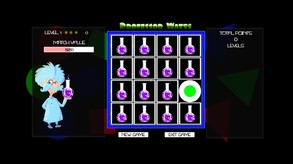
Professor Watts Memory Match: Shapes and Colors, developed and published by Ripknot Systems, is a straightforward and unpretentious puzzle game that aims to test players’ memory skills through a series of colorful, shape-based challenges. It belongs to the casual, cognitive-training niche of games that prioritize accessibility and mental exercise over complex mechanics or storytelling. The premise is simple: guided by the fictional Professor Watts, players are invited to complete a range of memory puzzles by matching shapes and colors under time constraints. It’s a classic formula executed with minimalist design principles, meant to appeal to players who enjoy short, focused bursts of puzzle-solving rather than deep strategic or narrative experiences.
The game’s structure revolves around 80 distinct puzzles, each designed to challenge the player’s recall and recognition abilities. The core mechanic is instantly familiar—flip cards, remember their positions, and find matching pairs—but the addition of time limits gives it a sense of urgency. While the gameplay never strays far from this basic loop, it’s the sort of mechanic that’s easy to grasp and naturally satisfying. The appeal lies in its immediacy: you can start playing within seconds of launching the game, without the need for tutorials or elaborate menus. Each round lasts only a few minutes, making it an ideal title for players seeking brief sessions of mental stimulation. This pick-up-and-play design philosophy defines the game’s charm but also sets the ceiling for its depth.
Visually, Professor Watts Memory Match embraces simplicity and clarity over flair. The graphics are composed of clean, well-defined 2D shapes rendered in vibrant primary and secondary colors. Every object is distinct enough to ensure visibility and differentiation, which is vital for a memory-based puzzle game. The art direction prioritizes function over form, resulting in a presentation that is neither flashy nor particularly stylish but highly legible. The minimalist aesthetic works in the game’s favor, maintaining focus on the puzzles themselves rather than on distractions. Its interface is intuitive, with smooth transitions between rounds and easily readable timers, score indicators, and visual cues. Although it lacks polish or personality compared to more visually dynamic puzzle games, its uncluttered approach makes it accessible to younger players or those unfamiliar with gaming conventions.
In terms of sound design, the experience is equally restrained. Background music is light and repetitive, contributing to the game’s casual, almost meditative tone. The audio cues for matching pairs and completing levels are crisp and functional, offering small bursts of satisfaction without overwhelming the senses. The voice of Professor Watts—who introduces the concept and occasionally offers commentary—adds a touch of thematic flavor, giving the otherwise mechanical gameplay a hint of character. While the presentation may not leave a lasting impression, it serves its purpose: to create a relaxing and distraction-free environment conducive to focus and repetition.
From a gameplay standpoint, the simplicity of Professor Watts Memory Match can be both its greatest strength and its primary weakness. On one hand, the accessibility is undeniable—there are no steep learning curves or complicated systems to master, just a steady rhythm of recognition and recall. On the other hand, this simplicity limits its longevity. Once the player becomes familiar with the game’s flow and patterns, there’s little incentive to continue beyond improving one’s score or speed. The lack of variation in objectives or mechanics means that the experience can start to feel repetitive after a handful of sessions. The game’s massive achievement count, numbering in the thousands, feels like a misguided attempt to add replay value but instead comes off as excessive and somewhat meaningless. For completionists, this might present an artificial challenge, but for most players, it feels more like a gimmick than genuine progression.
Performance-wise, the game runs smoothly even on low-end hardware. Its system requirements are minimal, demanding little more than a basic PC setup. This ensures that it can be enjoyed by virtually anyone, regardless of device capability, and aligns with its casual design ethos. It’s a game meant for accessibility, and in that regard, it succeeds. The interface is responsive, load times are quick, and the puzzles themselves flow seamlessly from one to the next. While this technical efficiency is commendable, it cannot mask the underlying lack of variety that limits the game’s staying power.
Professor Watts Memory Match: Shapes and Colors ultimately succeeds at what it sets out to do—provide a lightweight, mentally engaging puzzle experience centered on memory recall and color recognition. It’s not trying to reinvent the genre or compete with larger, more sophisticated puzzle games; instead, it offers a simple, meditative exercise in focus and short-term memory. For players seeking an easygoing, no-stress diversion, it delivers exactly that. Its flaws—repetition, limited depth, and excessive achievement padding—are balanced by its clarity, accessibility, and suitability for quick casual play.
As a whole, the game feels like a modern digital equivalent of a memory card exercise—functional, familiar, and pleasant in small doses. It’s not meant to hold attention for long periods, but for a brief cognitive workout or a calming distraction, it fits the bill. Professor Watts Memory Match: Shapes and Colors is best viewed not as a traditional game but as a simple mental pastime—a clean, straightforward way to test your mind for a few minutes at a time, and then set aside until the next time you need a moment of quiet concentration.
Rating: 5/10