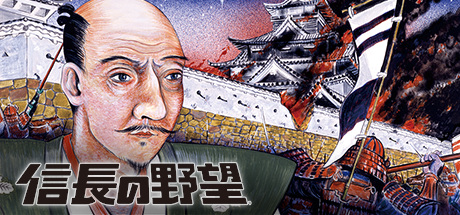
NOBUNAGA’S AMBITION is one of the earliest and most influential historical strategy games ever released, and revisiting it today feels less like playing a modern game and more like exploring the origins of an entire genre. Developed by Koei during the early years of computer strategy gaming, the title introduced mechanics and ideas that would later become standard across grand strategy and historical simulation games. Although the presentation is undeniably primitive by today’s standards, the game still manages to offer a surprisingly deep and thoughtful experience centered around conquest, politics, and resource management during Japan’s Sengoku era.
The game places players in control of a feudal lord attempting to expand territory and eventually unify central Japan during a time of constant warfare and political instability. Unlike modern strategy titles that often focus heavily on cinematic storytelling or accessibility, NOBUNAGA’S AMBITION takes a much more methodical approach. Nearly every turn requires making difficult decisions involving economics, military preparation, food supplies, diplomacy, and peasant loyalty. Success depends not only on battlefield victories but also on how effectively players manage the internal stability of their provinces.
What immediately stands out is how ambitious the design feels considering the game’s age. Even in its earliest form, the series already attempted to simulate multiple layers of leadership and governance rather than reducing strategy to simple combat encounters. Players must balance taxation, agricultural growth, troop recruitment, and infrastructure development while preparing for conflict with rival clans. Raising taxes too aggressively may increase short-term income but risk rebellion, while focusing too heavily on military expansion can weaken long-term economic growth. These interconnected systems create a strong sense of pressure because every decision carries consequences.
The strategic depth remains surprisingly engaging once the mechanics begin to make sense. Managing resources effectively becomes just as important as winning battles, and the game constantly forces players to think several turns ahead. Expanding recklessly can leave territories vulnerable to famine or economic collapse, while overly defensive play allows enemy clans to strengthen their own domains. This balance between military conquest and internal administration creates a satisfying gameplay loop that rewards patience and careful planning rather than impulsive actions.
Combat itself is relatively simple compared to modern strategy games, but it still contributes effectively to the larger campaign. Battles focus primarily on positioning, troop numbers, and preparation rather than flashy tactical mechanics or cinematic presentation. While visually basic, victories still feel rewarding because they are usually the result of long-term strategic decisions rather than luck. The game successfully communicates the idea that successful warfare depends on leadership, logistics, and preparation as much as direct battlefield action.
The historical atmosphere is one of the strongest reasons to experience the game today. The Sengoku setting gives the campaign a constant sense of political instability and territorial rivalry. Famous historical warlords compete for influence while alliances shift depending on circumstance and survival. Fans of Japanese history will likely appreciate how the game captures the struggle for unification during one of the country’s most chaotic periods. Even with limited storytelling tools, the strategic systems themselves help create immersion by forcing players to think like a daimyo attempting to maintain power in a fractured and hostile landscape.
At the same time, the game’s age creates several unavoidable challenges for modern audiences. The visuals are extremely outdated, consisting mostly of static menus, simplistic maps, and limited graphical detail. The Steam release preserves the original presentation almost entirely, which is valuable for historical preservation but also makes the experience difficult to approach for players unfamiliar with retro PC strategy games. The interface can feel clumsy and unintuitive, especially during the early hours when players are still learning how the systems interact.
Accessibility is arguably the game’s biggest weakness. Modern strategy games often include detailed tutorials, streamlined interfaces, and clear explanations for their mechanics, but NOBUNAGA’S AMBITION expects players to learn largely through experimentation. Menus can initially feel confusing, pacing is very slow, and progression often requires significant patience. Players looking for immediate action or fast-paced gameplay may struggle with the deliberate structure and heavy focus on long-term management.
Despite these limitations, the game remains fascinating because of how advanced its core ideas were for the time. Many concepts now considered standard in strategy gaming already existed here in surprisingly sophisticated form. The combination of economics, diplomacy, military planning, and province management created a level of depth rarely seen in early computer games. Even though later entries in the series would expand these systems dramatically, the original release still demonstrates how ambitious Koei’s design philosophy already was.
Replay value also remains stronger than expected. Different strategic approaches, rival clan behavior, and campaign outcomes help keep multiple playthroughs interesting. Some players may choose aggressive conquest from the beginning, while others focus on economic development and diplomatic alliances before entering major conflicts. The flexibility of the systems allows campaigns to unfold differently depending on player priorities and decision-making.
NOBUNAGA’S AMBITION is not an easy recommendation for everyone. Players expecting modern visuals, streamlined controls, or cinematic storytelling will likely find the experience frustrating and outdated. However, for fans of historical strategy games, retro PC gaming, and the evolution of grand strategy design, the game remains deeply rewarding. It is a slow and demanding experience, but one filled with genuine depth and historical atmosphere.
More than anything else, the game deserves recognition for its importance. It laid the groundwork for decades of Koei strategy titles and helped establish many ideas that would influence future historical simulations across the industry. Even today, there is something impressive about how much complexity and strategic tension the game creates using such limited technology. It may feel archaic at times, but it still succeeds as both a compelling strategy experience and an important piece of gaming history.
Rating: 7/10