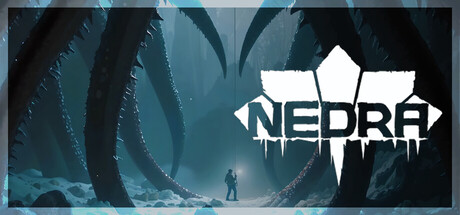
NEDRA, developed by Davit Andreasyan and published by indie.io, is a survival horror experience that ventures into the frozen emptiness of Antarctica and transforms isolation itself into a source of terror. Set in an abandoned Soviet-era research facility buried beneath endless snow, the game places the player in a desperate struggle against both the natural elements and an otherworldly presence lurking within the storm. The story begins with a rescue mission gone wrong, leaving the protagonist stranded at the desolate Aurora Station, a place haunted by the ghosts of past experiments and something far older than human science. From the first moment, NEDRA establishes a suffocating tone of loneliness and dread—the kind of fear that creeps in through silence, cold, and the knowledge that no one is coming to help.
The environment is more than a backdrop; it’s the core antagonist. The freezing temperatures constantly threaten the player’s survival, and the game cleverly integrates temperature as a key mechanic. Staying warm keeps you alive, but warmth also draws the attention of creatures that roam the storm—the Frostwalkers, nightmarish beings attracted to any sign of life. This simple trade-off between safety and visibility defines much of the experience, forcing players into tense decisions: do you risk lighting a flare to see where you’re going, or stumble through the dark to avoid detection? The interplay between heat, stealth, and fear is one of the game’s most memorable features, making the environment itself feel alive and hostile. Every step through the howling snow or flickering corridor becomes an act of risk management, and the constant need to balance survival against exposure creates a pressure that rarely lets up.
Exploration and atmosphere drive NEDRA more than combat or action. The game’s structure encourages players to scavenge for supplies, investigate abandoned laboratories, and piece together the story of what happened at the station. Resources are scarce, and every item—whether a battery, fuel canister, or bandage—feels like a lifeline. The few encounters with the Frostwalkers are genuinely terrifying, not because of sheer difficulty but because of how unpredictable they are. Stealth is almost always the better option than confrontation, and the limited ammunition reinforces that sense of vulnerability. There’s a deliberate pacing to how the world unfolds: narrow corridors open into cavernous underground ruins, and notes or recordings left by the missing researchers hint at a cosmic mystery that goes far beyond human understanding. The further you delve, the clearer it becomes that the cold is not the only force working against you.
Visually, NEDRA captures its world with a restrained but effective style. The frozen exteriors are vast and merciless, rendered in muted blues and whites that emphasize emptiness, while the interiors of the Aurora Station are claustrophobic and decaying—rusted pipes, flickering lights, cracked glass, and the constant sound of the wind clawing at the walls. The lighting design is crucial to the game’s tension; visibility is always limited, and illumination becomes both a necessity and a danger. The frost that builds on the screen, the condensation of breath, and the distortion of vision in the cold all contribute to a strong sense of immersion. The sound design is equally impactful: creaking metal, faint whispers, the dull thud of footsteps in snow, and the wind’s unending howl combine to create a soundscape that makes every moment feel oppressive. It’s not the loud kind of horror but the quiet, lingering kind that seeps under your skin.
The narrative unfolds gradually through environmental storytelling, scattered logs, and cryptic discoveries that suggest something ancient and incomprehensible beneath the ice. The story touches on themes of isolation, scientific hubris, and the insignificance of humanity in the face of cosmic forces. While the plot doesn’t always fully explore its philosophical ambitions, the fragments it offers are compelling enough to maintain intrigue. The writing occasionally stumbles in pacing, and some of the dialogue and exposition feel abrupt, but the sense of mystery remains consistent throughout. The multiple endings encourage replayability, inviting players to make different choices or explore alternate routes to uncover more about the fate of the research team and the true nature of the horror they unleashed. It’s a narrative approach that rewards careful observation rather than spoon-feeding answers, leaving much to interpretation.
Technically, the game performs well for an indie project, running smoothly on modest systems thanks to its use of Unreal Engine. The controls are tight, and the interface is simple enough not to distract from immersion. However, NEDRA does have a few rough edges typical of smaller productions. Some animations feel stiff, the enemy AI can behave inconsistently, and a few minor bugs can break tension in key moments. The repetition of certain environments also becomes noticeable over time, as several sections of the base share similar layouts and textures. Yet, these imperfections never completely overshadow the experience. The pacing and environmental design remain strong enough to keep players engaged, and the sense of dread rarely dissipates even during quieter stretches.
As a survival horror title, NEDRA succeeds in evoking the suffocating terror of isolation and the hopeless beauty of desolation. It’s not a game built on jump scares or cheap shocks but on psychological tension and environmental storytelling. Its strongest asset is its atmosphere—a bleak, haunting world that feels both alien and grounded in reality. Players looking for fast action or elaborate combat mechanics might find it slow, but those who appreciate methodical pacing, survival pressure, and worldbuilding will find it deeply satisfying. It recalls the spirit of classics like The Thing and the cosmic unease of Lovecraft’s fiction while carving out its own identity through its focus on environmental survival and existential dread.
In the end, NEDRA stands as a chilling reminder of how effective minimalism can be in horror when atmosphere and tension take precedence over spectacle. It’s an experience defined by what you don’t see as much as what you do, where every shadow, gust of wind, and flickering light feels like a warning. Beneath its icy exterior lies a well-crafted and thoughtful piece of horror design—one that lingers long after the credits roll, like the memory of a cold breath against the back of your neck in a place where warmth means death.
Rating: 7/10