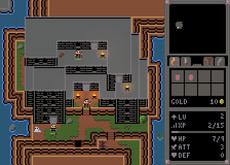
An open-ended adventure game that seamlessly blends RPG mechanics and puzzle solving.
Revenue comes from in-game items and microtransactions, which our price-based model doesn't estimate. The player count below is how many people own it, not what they spent.
About
Genres
Stats
Languages: English
Engagement
Reviews
Good little game. Just the right world size and length. Normally I'd find the backtracking a bit tedious, but in this kind of game, and more importantly a small world like this, it's great. By the time you've beat it after a few hours, you'll feel like you know all the areas pretty well. The difficulty is also spot on. It's forgiving enough to let you not worry about maximizing every little action, so you don't have to feel like you need to reset because you found a new, better sword shortly after you just spent 20g to buy one from the shop. Not too hard to beat the game with a few potions left as long as you're smart about when to level up, bow vs sword, cleaning up easier enemies once you get new gear, etc. My only suggestion is to speed up the movement, or an option for 2x move speed. It's not bad at first, but gets a bit tedious when you're running across the whole map back and forth.
Fun little magic tower like adventure game.
Media

Related
Related
Price dynamics, follower growth, revenue and sales trajectories with interactive tooltips
This and every other Pro feature is free until October 20, 2026. A free account is all it takes.
Hours played at review time, across 39 reviews with recorded playtime.
Really bad game design overall, there's a lot of forced damage setups, and the lack of a practical method to healing basically means you are forced to take deaths in order to progress at snail's pace, as you can only kill one enemy before the next one-shoots your pitiful health.
Discovered by accident, Myth Bearer turned out to be a surprisingly good game! It's actually something new to me, never really played anything like that. While it looks like a simplistic rpg from 8-bit era, it is actually a game about exploration and strategy. The mechanics are very simple, which is great, as you can focus on exploration and carefully planned strategy, so you can progress in the game. You're not really punished for dying, as there is no permadeath here, but I personally think the game gets interesting when you're trying to finish it without dying. You need to pick fights, manage the items and spells at your disposal so you can level up and get stronger. Then you can attack stronger foes. It's a bit like in metroidvania games. The game world is complex, interconnected and rich in secret areas to discover. Single save makes things additionaly difficult though, and I'd rather have couple more slots there. All in all, this is very solid, well thought indie game, with nice old-school visuals. For this price, you don't have to think twice.
The developer understands what makes RPGs tick and makes fun music! I'll leave more notes once I play it more.
Well worth the (rather low) price. It's a short adventure with no hand holding. You gain access to a fairly large area to explore very quickly and you get to explore at your own pace. The way the combat and exploration works together and how you can choose to use finite resources to push through harder areas is interesting. It shares a tiny bit of DNA with Desktop Dungeons. The music drove me nuts, but it can be turned off. I was also not a fan of the slow old school grid-like movement. You can use a mouse to move the character, but since the character is unable to path find around corners I found it mostly awkward and prone to miss clicks and you still have to use the mouse to interact with things if you switch to the keyboard for movement. With that said, I'd definitely recommend this game if you have a few hours to kill.
Simple, lots of different ways to advance the story. I wouldn't pay more than $5 for this... good thing it's free.
I really enjoyed this game! I basically played it in a day. I would say up top that I don't totally agree that it's "open-ended." It's true that you can basically choose which enemies to engage with in what order, but otherwise, as far as I can tell you have a pretty linear path through the stages of the game. The ability to largely wander around the island as you see fit (as long as you can pass the enemies) serves a lot more to create a ton of backtracking, without a ton of discovery or exploration later in the game. (Unless, of course, there were meaningful choices you could make in the narrative—but it definitely didn't seem like it.) I still found the game very engaging, although other players might find the core gameplay loop a bit repetitive; it does come down to a lot of save-scumming to figure out the most efficient series of steps, if you want to get through the game without dying (which is what I did). Despite what at least one other review said, you don't need to die to advance through the game! But pick your steps very carefully, as well as your saves. I also found the magic to be pretty underwhelming: I largely only used the heal spell until I got the barrier spell (barrier spell is just more cost-effective once it's more than 20 damage you're guarding against...for the same reason, the freeze spell was never worth double the mana cost for roughly the same effect as the barrier), with the mana drain equipped passively. I never worked out how to use the magic staff at all. Overall it's worth a shot, especially now that it's free!
Fun game that delivers exactly what it promises. Interesting strategy with a great story.
Myth Bearer is a deliberately compact fantasy RPG that gets much of its appeal from freedom, permanence, and discovery rather than spectacle. Developed and published by Moonskull Games, it presents a small interconnected world where understanding how locations, enemies, items, and objectives relate to one another becomes a major part of the adventure. Its intentionally low-resolution pixel presentation gives it the appearance of an old-school role-playing game, yet its structure is more flexible than that first impression suggests. Instead of pushing the player through a rigid sequence of quests, it encourages experimentation and rewards anyone willing to investigate unconventional routes. Exploration is arguably the heart of the experience. The world is constructed so that reaching a destination is often a problem to solve rather than simply a matter of following a waypoint. Different areas contain obstacles, enemies, resources, and opportunities that gradually make more sense as knowledge accumulates. Sequence breaking is an intentional part of the design, allowing observant players to bypass portions of the expected progression or reach objectives in unusual ways. This creates satisfying moments when something that previously appeared inaccessible suddenly becomes possible because the player has discovered a new route, acquired the right resource, or simply developed a better understanding of the environment. A particularly interesting feature is the permanence of the player's actions. Enemies do not endlessly respawn, resources are finite, and story developments can produce lasting changes. This significantly alters how ordinary RPG decisions feel. Defeating an enemy is not merely a temporary victory before the creature reappears after changing areas, while consuming a useful resource can carry genuine consequences. The game therefore rewards planning and discourages the careless assumption that everything can be farmed indefinitely. These limitations can create tension, but they also make progress feel tangible because the world retains evidence of what the player has accomplished. Combat itself is comparatively straightforward and should not be mistaken for the central attraction. The deeper strategic element comes from preparation and deciding when a confrontation is worth attempting. Equipment, character development, available resources, and exploration choices all influence how manageable an encounter becomes. A difficult enemy may effectively function as a barrier that encourages the player to investigate another part of the world before returning. In that respect, combat blends naturally with the game's puzzle-oriented philosophy, because finding a better solution can be just as important as overpowering an obstacle directly. The minimal amount of hand-holding strengthens the feeling of discovery. Myth Bearer expects players to observe their surroundings and remember useful information rather than constantly pointing toward the next destination. For players who enjoy independently unraveling game worlds, this creates an appealing sense of ownership over every breakthrough. On the other hand, the same approach can produce periods of uncertainty. Anyone accustomed to detailed objective markers, comprehensive quest tracking, or extensive tutorials may occasionally struggle to determine the intended next step. Patience and curiosity are consequently much more valuable here than simply rushing toward completion. The visual design follows a similarly restrained philosophy. Its extremely low-resolution pixel graphics are colorful and readable, but clearly prioritize function and retro character over elaborate animation or environmental detail. The aesthetic works well with the game's mechanical focus, although it will be highly dependent on personal taste. Players attracted to minimalist independent RPGs are likely to appreciate its simplicity, while those expecting cinematic presentation, detailed character models, or lavish effects will find the production intentionally modest. Control options accommodate different play styles, including mouse-based interaction alongside keyboard movement. The straightforward interface complements the compact design and avoids burdening the player with unnecessarily complicated controls. Additional features such as achievements and cloud saving add convenience, while an unlockable challenge mode provides another reason to engage with the mechanics after understanding the normal progression. Challenge-oriented replaying is particularly suitable because knowledge of routes, resources, and encounter placement can dramatically change how efficiently the adventure is approached. Steam Deck compatibility is officially categorized as Playable rather than fully Verified. Performance with the default graphics configuration is considered suitable, and the game can run successfully on SteamOS. However, handheld players should expect compromises. Some functionality is not fully accessible through the default controller configuration, touchscreen interaction or a community controller layout may occasionally be useful, and text entry can require manually opening the virtual keyboard. Some interface text may also appear small, while certain prompts can display keyboard, mouse, or non-Steam Deck controller icons. It is therefore functional on the Deck, but the experience is less seamless than a fully optimized handheld release. Replay value comes primarily from mastering the world rather than discovering an enormous quantity of new content. Once players understand how areas connect, where resources are located, and which challenges can be approached in different orders, subsequent attempts can become exercises in efficiency and experimentation. Intentional sequence breaking becomes especially valuable here because experienced players can test alternative routes that would have been difficult to recognize during an initial blind playthrough. The challenge mode further strengthens this emphasis on mechanical understanding. Myth Bearer ultimately succeeds by doing a great deal with a restrained set of ingredients. Its persistent world, limited resources, non-respawning enemies, interconnected exploration, flexible progression, and willingness to let players figure things out create an RPG that feels more substantial than its minimalist appearance might imply. Its lack of hand-holding and intentionally primitive visuals will not suit everyone, but those who appreciate compact RPGs built around exploration, planning, and experimentation may discover an unusually rewarding adventure. Rating: 8/10
Selling now
See how fast this game is selling right now — estimated copies and revenue per day from recent review growth.
Players by region
Where this game's players are, estimated from review languages.
Related
| Game | Estimated lifetime revenue | Reviews | Review score | Price |
|---|---|---|---|---|
| $0 | 16 | 94% | Free | |
| $0 | 35 | 100% | Free | |
| $154.5K | 410 | 76% | $14.99 | |
| — | 0 | — | — | |
| $5.9K | 22 | 64% | $8.99 | |
| $1.7K | 8 | 75% | $7.49 |