Muck: Humanity's Greatest Mistake
There are moments in history that define the rise and fall of civilization. The invention of fire. The wheel. The moon landing. And then, in a moment that can only be described as the universe's cruelest practical joke, Muck entered existence. At that instant, the collective progress of humanity stopped, looked directly at this digital monstrosity, and quietly asked, "Why?"
Muck is not a game. Calling it a game is an insult to games. Chess is a game. Soccer is a game. Hide-and-seek is a game. Muck is a sentient psychological weapon disguised as downloadable software. It doesn't entertain you. It studies you. It identifies your remaining fragments of happiness and systematically obliterates them with the enthusiasm of a supernova.
The moment you click "Play," your computer doesn't launch a game—it opens a portal to a dimension where common sense has been outlawed. You spawn with a rock, no explanation, and approximately thirty-seven seconds before the local ecosystem collectively decides that your continued existence is unacceptable. Every tree stands there mocking you. Every chest is bait. Every creature wakes up each morning with one singular goal: ruining your day in increasingly creative ways.
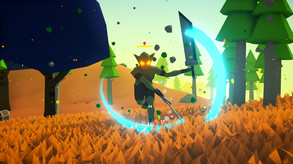
The combat system feels like it was engineered by an ancient council whose only qualification was "professional hater." You swing your weapon with the confidence of a seasoned warrior, only to discover that the enemy has somehow bent the laws of physics, ignored your attack entirely, and launched you so far into the atmosphere that commercial airlines begin asking if you'd like a window seat.
Every single enemy in Muck behaves as though you personally offended their ancestors. Goblins? They hate you. Golems? They hate you. Dragons? They hate you. Chickens? Somehow they probably hate you too. If a blade of grass could attack, it absolutely would.
Nighttime is not "hard." Nighttime is the digital recreation of the apocalypse. The sun disappears for half a second before every nightmare ever conceived simultaneously clocks in for their shift. The island becomes less of a survival game and more of a mandatory participation event in your own downfall. The soundtrack doesn't comfort you—it sounds like it's celebrating your inevitable demise.
The loot system deserves its own category of crimes against humanity. Every chest exists solely to convince you that maybe—just maybe—this time you'll get something useful. Instead, you receive the gaming equivalent of a participation trophy moments before a creature the size of a shopping mall deletes your entire health bar with one mildly annoyed swing.
And the bosses...
The bosses aren't difficult because they're well designed. They're difficult because they apparently negotiated exclusive rights to every law of the universe. They move faster than logic, hit harder than continental drift, and possess enough health to survive the heat death of the cosmos. Fighting one feels less like battling a monster and more like filing paperwork against an asteroid.
Multiplayer somehow elevates this disaster into an entirely new genre of suffering. Your friends transform from trusted allies into opportunistic goblins who will accidentally awaken ancient horrors, steal every valuable item, disappear during every boss fight, and then ask, "Bro, why did you die?" while standing safely on the opposite side of the map.
The optimization is your least concern, because by this point your graphics card has already accepted its fate. Even your PC begins questioning your life choices. Somewhere deep inside the cooling fans, a tiny voice whispers, "We were built for better than this."
If an alien civilization discovered Muck floating through space, they wouldn't invade Earth. They would assume the planet had already fallen.
The emotional damage inflicted by this game cannot be measured by science. Therapists would require therapists after hearing a complete description of a single play session. Philosophers would spend centuries debating whether Muck was created as entertainment or as a cautionary tale about unchecked ambition. Historians would erase it from textbooks out of mercy.
To recommend Muck to another human being is to betray the very concept of friendship. It is the social equivalent of replacing someone's parachute with a backpack full of bricks and saying, "You'll figure it out." It is the digital version of inviting someone to a birthday party only to reveal it is actually an active volcano.
If every copy of Muck were gathered together, launched into the center of the Sun, and then the Sun itself was fired into a black hole that was subsequently erased from existence, one could argue that the universe had only just begun repairing the damage.
In conclusion, Muck is, in this wildly exaggerated and entirely satirical essay, not merely a bad game—it is a reality-distorting anomaly, a cosmic paperwork error, an offense against joy itself, and the closest humanity has come to accidentally downloading an eldritch curse. It should not be recommended to friends, family, coworkers, strangers, historians, archaeologists, extraterrestrials, future civilizations, parallel universes, or any living organism capable of experiencing disappointment.
Should anyone ask whether they should play Muck, the only responsible response—according to this intentionally over-the-top rant—is to gaze solemnly toward the horizon, remember the fallen, and simply whisper:
"No. Save yourself."