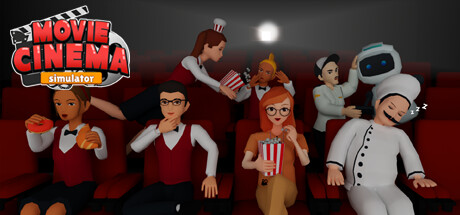
Build the most successful cinema business in the world!
Modeled estimate, not a reported figure. How we estimate →
Media

About
Genres
Stats
All-time low is the lowest price we've recorded for this game since we started tracking it.
Languages: English, Indonesian, Russian, Japanese, Portuguese - Brazil
Engagement
Reviews
Themes across 40 recent reviews and how positive each mention is. A keyword signal, not full sentiment analysis.
Reviews
I like this game! Very fun with the story and gameplay 😍❤️
JEST WKURWIAJACA NIE RAZ ALE GIT
det er godt
Related
Related
Trends
Modeled estimate over time, reconstructed from Steam's monthly review histogram.
Hours played at review time, across 41 reviews with recorded playtime.
positive critical· bar length = how often the theme comes up
This game is awesome, I highly recommend buying it.
Once you figure out how to upgrade and unlock everything, this game is so fun! Totally worth $5
game sucks
eh ok am guess
I don't know if I want to play enough to 100% the achievements like I intended when I started this game. Some of them are just tedious (like growing hundreds of plants that take about a game day each to mature). HOWEVER! This game IS worth the $4.99. It had a story line with a twist, some mini games, and tons of easter eggs to real movies and games. I just wish customizing your theater was a bit more open/less reliant on paying game dollars for loot boxes.
After playing Laundry Store Simulator I was eager to play an earlier title made by the same developer. Movie Cinema Simulator is a game with a charming artstyle, a fun story and engaging gameplay. Especially in the beginning, some of the upgrades you can buy to make your job easier are very expensive and you need to spend a lot of time saving up money to afford them and to hire employees you need to complete side quests. This makes it feel rewarding when you buy an upgrade or hire an employee. On the other hand, it does take a long time to aquire all of the upgrades and hire all employees. One annoying thing about the upgrade system is the fact that the ticket machine doesn't need any repairs on the highest upgrade level since it can't brake down anymore – which is a really cool reward! – but all other machines like the popcorn machine or the waffle iron still need to be repaired from time to time even on the highest upgrade level. That was kinda frustrating, especially for the equipment in the kitchen. When those brake down they start to burn and when you don't put out the fire fast enough they trigger a fire alarm which makes all customers run out of the cinema. This means you can't just let the game idle to farm money and achievements because you constantly need to babysit the kitchen. (I discovered way too late you can circumvent this problem by just not paying the cook and the café employee but this also makes grinding the achievement for serving 5000 customers food and drinks take way longer.) Despite its quirks I really enjoyed the game and had a great time with it. I completed the story with all upgrades in roughly 30 hours. Since I'm a completionist, I went for 100% achievements and sadly, this was not very fun. There are some very grindy achievements like the ones for the gym and the casino or for the thugs and the graffiti kids. All in all, I spend 55 hours completing every achievement. I don't mind a little grinding to finish a game 100% but in this case, some of the achievements overstayed their welcome way too much. This leaves a bitter taste to the overall yummy experience this game was. (Sadly, too grindy achievements were also a thing in Laundry Store Simulator and I hope for their upcoming game Comic Book Store Simulator the developer will take a different approach.) [b]All in all, pretty fun game but 100%'ing is not exactly recommended.[/b]
Movie Cinema Simulator, developed and published by Akhir Pekan Studio, is a heartfelt and surprisingly rich management game that blends the immersive charm of first-person life simulators with the strategy of running a small business. The game places players in the role of an inheritor of a rundown family cinema once owned by their grandfather. The task is to breathe new life into the theater—reviving its operations, restoring its reputation, and rekindling the love of film in a town that seems to have forgotten the magic of the big screen. It’s a premise steeped in nostalgia, but the gameplay structure ensures that it becomes much more than a sentimental trip. It’s a full-scale management experience built on both practical detail and personal attachment. The game’s structure unfolds through a first-person perspective, allowing players to directly interact with their cinema rather than manage it through abstract menus. This approach gives the experience a tactile sense of realism—you aren’t just clicking to assign tasks; you’re physically walking through your theater, cleaning the floors, fixing equipment, handling tickets, or greeting customers. This grounded design lends an almost slice-of-life quality to the game, transforming what could have been a dry business simulation into something intimate and satisfying. Every small action, from polishing a popcorn machine to adjusting the projector, feels meaningful because it contributes directly to the cinema’s atmosphere. Running the cinema involves balancing several interconnected systems. Players must choose which films to screen, negotiate the cost of licenses, and schedule showtimes in a way that maximizes audience turnout. Income from ticket sales and concessions becomes the foundation for expansion—allowing you to upgrade seating, improve projection quality, redecorate the lobby, or even expand to new screening rooms. The customization options extend beyond the theater itself; your character’s home can also be decorated and improved, symbolically linking your personal space to the success of your business. It’s a clever design choice that reinforces the emotional connection between player and enterprise, turning management success into something deeply personal. Akhir Pekan Studio deserves credit for injecting narrative elements into what could easily have been a purely mechanical sim. The game’s story is told through interactions with locals, optional side quests, and small discoveries scattered around the city. These moments introduce humor, tension, and even conflict into the otherwise routine flow of business. Rival characters, troublemakers, and unexpected events—like gangs causing disruptions—add dynamism and surprise to the experience. These touches ensure that your role as a cinema owner feels less like running a spreadsheet and more like living a story. The player isn’t just restoring a business; they’re becoming a community figure, tied to the theater’s legacy and the people it serves. Visually, the game carries a vibrant and inviting tone. The graphics are not hyper-realistic but stylized in a way that suits the game’s laid-back, approachable feel. Lighting plays a crucial role, especially as you see the glow of the projector or the soft ambiance of the theater lobby. There’s a cozy, handmade quality to the art design that mirrors the game’s central theme of rebuilding something old with care and dedication. The sound design complements this perfectly: the chatter of customers, the faint hum of machinery, and the rustling of popcorn all contribute to a sense of authenticity that grounds the simulation in lived experience. Yet for all its charm, Movie Cinema Simulator is not without its imperfections. Like many ambitious indie projects, it occasionally suffers from rough edges. Some players report small technical glitches—UI freezes, erratic worker AI, or inconsistencies in object placement—that can break immersion. The pacing of the economic systems can also feel uneven; early progress can be slow, especially when juggling expenses like film licenses and repairs against modest initial revenue. However, these issues rarely overshadow the game’s strengths. Instead, they come across as minor blemishes on an otherwise engaging experience, particularly since the developers’ attention to atmosphere and storytelling compensates for occasional technical stumbles. What sets Movie Cinema Simulator apart from other management titles is its sense of personality. Most simulation games focus purely on optimization—profit margins, efficiency, and automation—but this one places equal weight on emotional connection and hands-on work. It’s a game where sweeping the floors after a long day can feel as rewarding as turning a profit, because those small acts contribute to something larger: the preservation of a family legacy. This emotional resonance is strengthened by the game’s pacing, which encourages players to savor progress rather than rush toward completion. Each milestone feels earned through effort and care rather than automation. For a relatively low-cost indie title, Movie Cinema Simulator offers a surprising amount of content and depth. With over a dozen films to license, multiple upgradable facilities, various side quests, and a range of customization options, it provides hours of satisfying engagement. It’s a slow burn, but one that rewards curiosity and patience. The inclusion of achievements, a day-night cycle, and a small open-world hub adds to the replayability, giving players reasons to return to their theater even after the main story concludes. In the end, Movie Cinema Simulator succeeds not because of groundbreaking mechanics or technical innovation, but because of its sincerity. It captures the feeling of running something small, meaningful, and full of heart—something that’s as much about the people and stories behind it as it is about numbers on a balance sheet. It’s a love letter to the moviegoing experience, to nostalgia, and to the satisfaction of creating joy for others. While it may not compete with the polish of high-budget simulators, its warmth and creativity make it stand out as one of the more endearing and human management games in recent memory. Akhir Pekan Studio has crafted a modest but memorable experience that reminds players why cinema—both as art and as community—still matters. Rating: 8/10
Audience
Estimated from the language of this game's reviews — a proxy for where players are, not official Steam demographics.
Related
| Awkward | $32.4K | 103 | 72% | $11.99 |
| JETRUNNER | $32.4K | 136 | 96% | $19.99 |
| Firefly Village | $32.4K | 127 | 87% | $7.19 |
| ITORAH | $32.4K | 930 | 73% | $1.99 |
| Coffie Simulator | $32.4K | 84 | 94% | $9.99 |
| Summer Sisters | $32.4K | 126 | 72% | $9.99 |