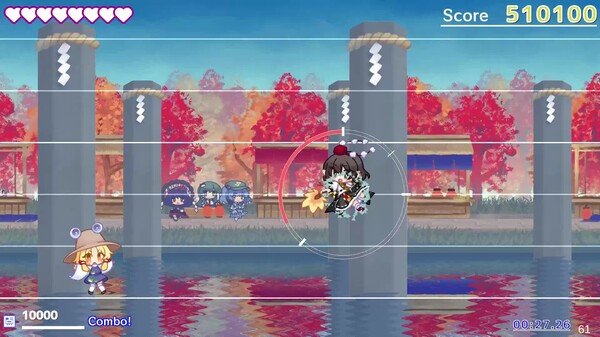
MoriyaRhythm is an indie rhythm action game that manages to combine two notoriously difficult genres into one surprisingly smooth and addictive experience. Developed and published by FriendNavy, the game blends rhythm-based timing with Touhou-inspired bullet hell gameplay, creating a fast-paced challenge where players must dodge dense projectile patterns while staying perfectly synchronized with the music. It is an unusual concept that could have easily become frustrating or overly chaotic, yet the game succeeds because its mechanics are tightly connected to the soundtrack and carefully designed around musical flow. Once the systems begin to click together, MoriyaRhythm becomes incredibly satisfying in a way that few rhythm games or bullet hell shooters manage to achieve on their own.
The core gameplay revolves around moving, attacking, and surviving in time with the beat while navigating increasingly dangerous waves of bullets. Unlike traditional rhythm games that focus mostly on button prompts or lane mechanics, MoriyaRhythm turns rhythm into part of the battlefield itself. Timing affects movement, combat, and survival simultaneously, forcing players to pay attention to both visual patterns and musical pacing at all times. The result is an intense gameplay loop where reflexes and rhythm awareness become equally important. Every successful dodge and perfectly timed action feels deeply connected to the soundtrack, making the gameplay feel almost like a dance through chaos.
What makes the game especially compelling is how naturally the rhythm mechanics fit within the bullet hell structure. Projectile patterns often move in sync with the music, creating encounters that feel choreographed rather than random. As players improve, they begin recognizing not only visual attack patterns but also rhythmic structures hidden within enemy sequences. This creates a strong sense of mastery because difficult encounters slowly transform from overwhelming chaos into readable musical patterns that can be memorized and executed with precision. The learning process can be punishing, but it is also incredibly rewarding.
The difficulty curve is one of the defining aspects of MoriyaRhythm. Early stages ease players into the mechanics with relatively manageable encounters, but the game quickly escalates into something far more demanding. Later levels require constant concentration, rapid reactions, and precise timing while multiple layers of bullets flood the screen. Some sequences feel almost impossible at first glance, especially for players unfamiliar with bullet hell games or rhythm-based precision gameplay. However, repeated attempts gradually reveal hidden patterns and safe routes, turning failure into part of the learning process rather than simple frustration.
One of the game’s greatest strengths is how satisfying improvement feels. Every stage functions almost like a musical puzzle where success depends on understanding timing, movement spacing, and attack rhythms. Completing a difficult boss encounter after dozens of failed attempts creates an enormous sense of accomplishment because victories feel genuinely earned. The game encourages replayability by rewarding cleaner runs, better accuracy, and more efficient movement, giving dedicated players strong motivation to continue refining their performance long after finishing the main content.
The soundtrack deserves enormous praise because it forms the backbone of the entire experience. The music is energetic, catchy, and tightly integrated into gameplay, ensuring that every stage feels distinct both mechanically and emotionally. Beat changes directly influence how players move and react, giving the soundtrack a gameplay function beyond simple background music. Many stages become memorable largely because of how well their musical identity connects with enemy patterns and pacing. The songs also remain enjoyable even after repeated failures, which is crucial for a game built around replaying difficult encounters multiple times.
Visually, MoriyaRhythm embraces a bright anime-inspired aesthetic that fits perfectly with its Touhou influences. Character designs are expressive and charming, while the colorful bullet patterns remain visually appealing without sacrificing readability. Despite the sheer amount of projectiles appearing on screen during later encounters, the game generally maintains enough clarity for skilled players to identify safe movement paths. The visual presentation strikes a good balance between chaotic spectacle and gameplay readability, which is essential for a bullet hell title.
The short stage structure is another smart design decision. Most levels and encounters are compact enough that retries happen quickly, preventing frustration from becoming overwhelming after failures. Players can immediately jump back into difficult sections without wasting time on lengthy loading screens or unnecessary downtime. This fast retry system supports the game’s trial-and-error learning style and keeps momentum high during intense practice sessions.
However, MoriyaRhythm is definitely not a game designed for everyone. The combination of rhythm mechanics and bullet hell gameplay creates an extremely demanding experience that may intimidate casual players. Those unfamiliar with either genre may struggle heavily during later stages, where memorization and precision become essential. The game offers limited onboarding for newcomers, and some players may find the lack of extensive tutorials or training systems frustrating during the early learning process.
Technical issues also hold the game back slightly. Some players have reported timing inconsistencies, rhythm calibration problems, and occasional control responsiveness issues that can be particularly noticeable in a game where precision timing is everything. Even small synchronization problems can negatively affect difficult stages, especially for players attempting high-level performance. While updates have addressed some concerns, the occasional technical inconsistency remains noticeable enough to impact the experience at times.
Another limitation is the game’s overall amount of content. Skilled players can complete the core stages relatively quickly, meaning much of the long-term value comes from replaying encounters for mastery rather than unlocking extensive new content. For fans of arcade-style score chasing and perfection-focused gameplay, this structure works perfectly. Players seeking longer campaigns or broader progression systems, however, may find the experience somewhat brief.
Despite these flaws, MoriyaRhythm succeeds because it fully commits to its unique concept and executes it with confidence. The fusion of rhythm gameplay and bullet hell action feels genuinely fresh, and the game constantly rewards dedication, precision, and improvement. Its combination of satisfying mastery progression, memorable music, charming presentation, and demanding gameplay creates an experience that stands out strongly within the indie rhythm genre.
For players who enjoy high-skill arcade challenges, rhythm-based gameplay, or Touhou-inspired bullet hell shooters, MoriyaRhythm offers an exciting and highly rewarding experience. It may be difficult, occasionally unforgiving, and somewhat niche in appeal, but its originality and strong mechanical execution make it one of the more memorable indie rhythm-action hybrids available on Steam.
Rating: 8/10