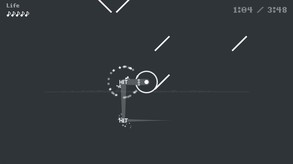
It's a rhythm game inspired by the Reflection. The ball will bounce slope to slope, You should press any key when the ball hits the slope.
Modeled estimate, not a reported figure. How we estimate →
Media
About
Genres
Stats
All-time low is the lowest price we've recorded for this game since we started tracking it.
Languages: English, Korean
Engagement
Reviews
Themes across 40 recent reviews and how positive each mention is. A keyword signal, not full sentiment analysis.
positive critical· bar length = how often the theme comes up
Reviews
Half the songs in this game are just painfully slow and boring, the other half are only difficult because the camera just randomly jumps and whips around, does a 360 for no reason making it impossible to actually "read" the song, you have to just memorize the transitions which is just boring. at that point the visual representation serves no purpose if i'm just being forced to memorize it anyways. The game also does not have any reliable way to set your offset accurately, and gives no feedback on if you are early or late. This combined with the fact that the "hard" mode of every song, is just the exact same song and chart, except your timing window to hit the notes is cut in half. Sure, base the main challenge of the game around very precise timing windows and then give no way for people to realistically set their offset accurately, makes sense. 👍 ADOFAI is virtually an identical game, but just vastly superior in terms of amount of content, OST, visuals, ability to set your offset, actually read the chart, etc.
낮은 난이도와 꽤 괜찮은 가독성 망해가는 얼불춤의 뒤를 잇는 새로운 갓겜이 되길 ㅜㅜㅜㅜ
Related
Related
Trends
Modeled estimate over time, reconstructed from Steam's monthly review histogram.
Hours played at review time, across 40 reviews with recorded playtime.
好玩好玩,我觉得读谱还是比冰与火容易多了,美术和选曲都不错,系统简洁但完善,失误0键从检查点重开,一个音游还要什么呢?
MIRAY developed by Poobool and published by PsychoFlux Entertainment is a minimalist rhythm title built around a deceptively simple premise: press a key at the exact moment a bouncing ball strikes a slope. What initially appears to be a straightforward reflex challenge gradually reveals itself as a precise timing exercise that demands concentration, pattern recognition, and rhythmic intuition. The game strips away nearly all extraneous elements, focusing entirely on accuracy and timing as its central pillars. The core mechanic revolves around a ball that continuously rebounds between angled surfaces, following predetermined rhythmic paths. The player must press any key precisely when the ball makes contact with a slope to register a successful input. Missing the timing results in the loss of one of five lives, creating tension without overwhelming punishment. Diamond-shaped checkpoints scattered throughout each stage serve as save points, allowing players to resume from recent progress rather than restarting entire levels. This structure balances challenge with accessibility, encouraging repeated attempts without excessive frustration. Stage design is where the game truly develops its identity. Beginning levels introduce the concept at a measured pace, allowing players to internalize the rhythm visually and aurally. As progression continues, patterns become more complex, speeds increase, and the timing windows narrow. Later stages require memorization and a strong sense of rhythm rather than simple reaction. The visual simplicity forces players to focus entirely on the ball’s movement and the cadence it establishes, creating a meditative yet demanding gameplay loop. The minimalist presentation is intentional. The visual style is clean and uncluttered, emphasizing clarity over spectacle. There are no elaborate backgrounds or distracting animations; instead, the design ensures that the ball and slopes remain the focal points at all times. This approach reinforces the mechanical purity of the experience, though it may feel sparse to players accustomed to visually dynamic rhythm games. The soundtrack complements the gameplay, aligning bounce timing with rhythmic audio cues that guide player input. One of the strengths of the game lies in its accessibility. Controls are straightforward—any key press suffices—eliminating the need for complicated input schemes. This simplicity allows players to jump in immediately, though true mastery requires careful attention and practice. The short stage structure makes it well-suited for quick sessions, yet the escalating difficulty encourages longer engagement for those seeking mastery. However, its stripped-down design can also be limiting. The absence of customization options, extensive content libraries, or varied gameplay modes means replayability largely depends on personal improvement and leaderboard competition. While Steam achievements and ranking systems provide incentive for perfectionists, players seeking expansive rhythm campaigns or diverse musical selections may find the scope modest. Despite these constraints, the game succeeds in delivering a focused and cohesive rhythm experience. Its challenge curve is carefully constructed, rewarding persistence and pattern recognition. The satisfaction of completing a demanding stage stems entirely from personal skill development rather than external progression systems. In that sense, it captures the essence of classic arcade design—simple to understand, difficult to master. Ultimately, the game stands as a concentrated rhythm challenge defined by mechanical precision and minimalist philosophy. It forgoes spectacle in favor of timing purity, offering a tight and engaging experience for players who appreciate reflex-based gameplay and rhythmic mastery. While limited in scope, it delivers a distinct and satisfying challenge built around a single, well-executed idea. Rating: 7/10

재미 없는 게임은 아니지만 추천을 드릴수가 없네요. 리듬게임에 좋은 노래가 있는건 이제는 당연한 일이고 난이도는 사람마다 다르기 때문에 둘 다 장점으로 보지는 않겠습니다. 그리고 노래들이 대부분 같은 파트 반복이 3~4회가 노래 안에서 2~3번씩 계속 나와서 좀 지루합니다. 카메라 연출이나 대각선으로 반사되는 재미있는 컨셉 등 장점도 있지만 단점들이 좀 더 눈에 보입니다. 1. 가시성 문제 멋있는 카메라 연출이 때로는 오히려 게임을 망치기도 하는데, 여기서는 망치는 쪽이었습니다. 회전, 줌, 플레이어에서 분리했다가 다시 부착하기 등등 정신없는 카메라 연출 때문에 앞에 뭐가 안보이는데 그냥 맞게 됩니다. 이건 노래를 처음 할 때 문제이긴 하지만 더 있습니다. 노트들이 딱히 표시가 없는 그냥 직선이다 보니 다음 노트가 무엇인지를 파악하려면 지금 방향과 지금 노트의 방향을 보고 계속 방향을 판단하고 그 방향에 있는 노트를 봐야 하는데 빠른 부분에서 리듬도 맞추면서 이걸 하기란 쉽지 않고 결국 외워서 어거지로 치는 수 밖에 없습니다. 어차피 리듬게임 최종은 외워서 치는 거긴 하지만 외우는 것 자체가 오래 걸리게 되고 외우는 과정 자체에서 스트레스를 받는데, 다음 단점과 이어집니다. 2. 실수 = 즉사 체력이 5나 있지만 후반으로 갈수록 의미가 없어집니다. 노트가 몰려나오면(특히 트릴 부분에서) 조금만 틀리게 치면 [빨리침] => [느리게침] => [빨리침] ... 이런 식으로 노트 2~3개 정도에서 실수가 연달아 나오면서 바로 죽게 됩니다. 배드 등의 판정이 뜨면서 그 노트 자체는 친걸로 판정해서 노트 1개에서 체력이 1만 깎이는 기능 등이 필요할 것 같습니다. 죽는거 자체는 별로 상관 없지만 바로 다음 단점 때문에 매우 부정적인 경험이 됩니다. 3. 너무 빠른 리스폰 죽으면 바로 체크포인트에서 3 2 1 하면서 시작되는데, 뭐에 죽은지도 모른채 다시 시작하기 때문에 뒤에서 죽었던 파트에 가면 다시 까먹어서 또 똑같이 죽고 노트를 익히지도 못하는 경우가 빈번하게 생깁니다. 1, 2, 3번 단점들 때문에 죽고 죽으면서 노트 몇개씩 더 보는 게임이 되어버렸습니다. 그밖에 단점은; 4. 불편한 메뉴 조작 메인 메뉴에서 좌/우클릭으로 양옆으로 가고 중간클릭으로 선택하는건 대체 누구 아이디어입니까... 또 ASD로 조작할 때는 S가 선택이지만 방향키로 조작핼 때는 아래 방향키가 아니라 엔터를 써야 하고 이것 자체가 안내가 안되어 있습니다. 또 일시 정지 메뉴에서 esc를 다시 눌러 이어가기가 안되서 무조건 마우스를 써야 하고, R키 누르고 있기 등으로 재시작이 안되고 이것 또한 일시 정지 이후 마우스로 클릭을 해야 되서 별거 아니지만 매우 불편합니다. 엑스트라는 안해봤지만 엑스트라 전까지 경험이 너무 안좋아서 더 해볼 엄두가 안나네요. 빡세게 해서 곡을 깨도 이겼다는 느낌 보다는 숙제를 끝냈다는 느낌이 강합니다.
이거하다 마우스 부숴먹음
할인할 때 사면 개추
rne
fads
미레이 재밋어요
Momentum
Pace estimated from the game's recent review growth (our daily snapshots) at its own sales-per-review ratio — a momentum signal, not booked sales.
Audience
Estimated from the language of this game's reviews — a proxy for where players are, not official Steam demographics.
Related
| 𝄞Gaia's Melody: ECHOED MELODIES | $6.6K | 52 | 94% | $5.99 |
| Treasure's Mine! | $6.6K | 51 | 100% | $4.99 |
| Sandy Planet - Season 1 | $6.6K | 292 | 60% | $1.09 |
| Viking Chess: Hnefatafl | $6.6K | 67 | 90% | $4.99 |
| Chocolate makes you happy 6 | $6.6K | 109 | 71% | $1.99 |
| Caveman Alive | $6.6K | 109 | 38% | $1.99 |