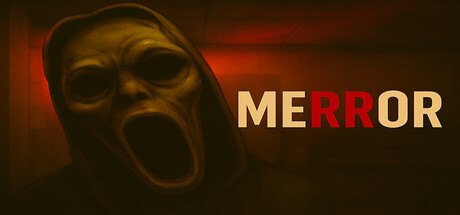
MERROR is a first-person puzzle horror game developed and published by TAMAGOSHA. Although its runtime is intentionally brief, the game manages to create a memorable experience through a combination of environmental puzzles, unsettling atmosphere, and a clever central mechanic based on mirrors and symmetry. Rather than relying on traditional horror elements such as combat, lengthy narratives, or constant jump scares, MERROR focuses on observation and perception. The result is a compact psychological journey that demonstrates how a simple concept can become surprisingly effective when executed with confidence and precision.
The game begins with a seemingly ordinary room dominated by a large mirror. At first, the environment appears normal, but it quickly becomes apparent that something is wrong. Reflections fail to match reality, objects appear in incorrect locations, and subtle inconsistencies begin to emerge. Players are tasked with correcting these abnormalities and restoring balance between the real world and its mirrored counterpart. What starts as a straightforward puzzle premise gradually evolves into something much more unsettling as the boundaries between reality and reflection become increasingly uncertain.
The core gameplay revolves around careful observation. Players must inspect their surroundings, compare details between the room and its reflection, and identify anything that disrupts the intended symmetry. This mechanic transforms even the smallest environmental details into potential clues. A misplaced object, an altered shadow, or a missing item may be the key to progression. The game rewards attentiveness and patience, creating a satisfying sense of accomplishment whenever a solution is discovered.
One of the most impressive aspects of MERROR is how effectively it builds an entire experience around a single idea. Many puzzle games introduce a unique mechanic only to abandon it in favor of unrelated challenges. MERROR remains committed to its central concept throughout its duration, continually finding new ways to challenge the player without overcomplicating the formula. Each new room introduces variations that encourage players to rethink their assumptions and approach familiar mechanics from different perspectives.
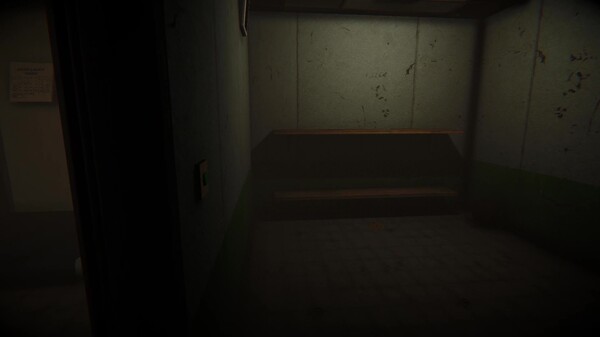
The atmosphere is where the game truly excels. The environments are deliberately minimalistic, but that simplicity works in their favor. Sparse rooms, sterile architecture, and unnatural reflections create an immediate sense of discomfort. There is a constant feeling that something is wrong, even when no obvious threat is present. The game understands that fear often emerges from uncertainty rather than direct confrontation, and it uses that principle effectively throughout the experience.
Psychological tension is generated through subtle environmental changes rather than overt horror sequences. Players are rarely confronted with traditional monsters or action-oriented threats. Instead, the fear comes from questioning what is real. The mirror becomes both a tool and a source of anxiety, as reflections cannot always be trusted. This manipulation of perception creates a unique form of horror that lingers in the player's mind long after individual puzzles have been solved.
The visual design supports these themes remarkably well. The game relies heavily on lighting, reflections, and spatial composition to create its unsettling atmosphere. Every room feels intentionally constructed to draw attention toward specific details while simultaneously encouraging players to doubt what they see. The minimalist presentation ensures that players remain focused on the puzzle mechanics while also reinforcing the game's psychological themes.
Sound design contributes significantly to the overall experience. Rather than overwhelming players with loud effects or constant music, MERROR adopts a restrained approach. Ambient noises, subtle environmental sounds, and carefully timed audio cues maintain tension without becoming intrusive. Silence is often used just as effectively as sound, creating moments where players feel isolated and vulnerable. This careful use of audio complements the visual presentation and strengthens the atmosphere.
The pacing is another notable strength. Because the game is relatively short, it avoids many of the issues that plague longer puzzle experiences. New ideas are introduced quickly, and the game concludes before repetition becomes a problem. Every room feels purposeful, and the progression from one puzzle to the next remains smooth and engaging. The compact runtime also ensures that the atmosphere remains concentrated and impactful from beginning to end.
One of the game's most admirable qualities is its confidence in the player's intelligence. Solutions are not handed out immediately, and the game trusts players to observe carefully and think critically. While the puzzles are generally accessible, they still provide enough challenge to feel rewarding. This balance helps maintain engagement without creating unnecessary frustration.
The game's brevity may be viewed as either a strength or a weakness depending on player expectations. Those seeking a lengthy horror adventure may find the experience concludes too quickly. However, the short runtime allows the central concept to remain fresh and focused. There is very little filler, and nearly every moment contributes to the overall experience. In many ways, MERROR benefits from knowing exactly how much content its concept can support.
Replayability is understandably limited due to the puzzle-based structure. Once solutions are known, much of the challenge disappears. Nevertheless, the game's atmosphere and visual design may encourage some players to revisit it simply to appreciate the details they may have missed during their initial playthrough. The compact nature of the experience also makes such revisits convenient.
What ultimately makes MERROR memorable is its ability to transform a familiar object into the source of both gameplay and horror. Mirrors are common features in countless games, but few titles use them as effectively as this one. By making players constantly question what they see, the game creates a unique sense of tension that remains compelling throughout its short duration.
MERROR is a focused and atmospheric puzzle horror experience that succeeds through simplicity, creativity, and strong execution. Its mirror-based mechanics, unsettling environments, thoughtful puzzle design, and psychological tension combine to create a memorable adventure that stands out despite its modest scope. While its short length may leave some players wanting more, the quality of the experience ensures that it leaves a lasting impression.
Rating: 8/10