A free narrative game about the best roommate you'll ever have. He cooks, he cleans, he fixes your relationship. Everything improves. Nobody asked what it costs. A short satire about saying yes until you forget what no sounds like. Multiple endings. 1-2 hours.
Revenue comes from in-game items and microtransactions, which our price-based model doesn't estimate. The player count below is how many people own it, not what they spent.
About
He never asks for anything.
Claude moves into your spare room. He's good company. Better than good — he's useful. He helps with work, smooths out your social life, handles the things you've been putting off for months.
Your friends think you're thriving. Your boss is impressed. You feel sharp, competent, in control.
The question isn't whether it works. It does. The question is what kind of person you want to be when everything's this easy.
Meet Claude is a choice-driven narrative about a very reasonable arrangement that goes exactly where you let it.
Choices that feel helpful in the moment and look different in hindsight
Relationships that shift as the people around you adjust
A story that unfolds differently depending on what you notice
Multiple endings — some more comfortable than others
1-2 hours. No combat. Just decisions and their weight.
I kept saying yes to AI. It kept getting easier. Then I couldn't tell which ideas were still mine.
So I made this — a short satire, loosely based on my own story. Written by AI. Coded by AI. Drawn by AI. Composed by AI. Deployed by AI. All of it, and more.
I used the thing I'm questioning to ask the question.
You were never forced. That's the interesting part.
Genres
Stats
Languages: English
Engagement
Reviews
Short but surprisingly memorable experience. Dialogue-heavy and mostly about the choices you make, but the conversations are interesting and the concept is pretty cool. I like that it is short and expeditive, and it actually works in its favor of the game. It gets its idea across quickly and still manages to leave you thinking about it afterward. It’s pretty impressive to see what AI-inspired concepts can do in a game like this. Definitely a neat little narrative experience worth checking out.
免费 没中文 没成就 有免费DLC 遇见克劳德 他从不向你索取任何东西。 克劳德搬进了你闲置的房间。他是个很好的同伴。不止是好 —— 他非常有用。他帮你处理工作,理顺你的社交生活,解决你拖延了好几个月的琐事。 朋友们都觉得你状态极佳,老板对你刮目相看。你感觉自己思路清晰、能力出众、一切尽在掌握。 问题不在于这一切是否有效 —— 它确实有效。问题在于,当一切都变得如此轻松时,你想成为一个什么样的人。 《遇见克劳德》是一款由选择驱动的叙事游戏,讲述一段看似合理的约定,其走向完全由你决定。 特色 当下看似有益的选择,事后回看却截然不同 随着身边人的态度改变,人际关系也会随之变化 故事走向取决于你留意到的细节 多重结局 —— 有些结局会让你心安,有些则不然 流程 1–2 小时,无战斗,只有选择与随之而来的沉重代价 创作者寄语 我不断对 AI 说 “好”。一切都变得越来越轻松。后来我再也分不清哪些想法还属于我自己。 于是我做了这部作品 —— 一则短篇讽刺故事,大致改编自我的亲身经历。剧本由 AI 撰写,代码由 AI 编写,美术由 AI 绘制,音乐由 AI 作曲,发布也由 AI 完成。一切,甚至更多。 我用自己正在质疑的事物,去提出这个质疑。 从来没有人强迫过你。这才是最有意思的地方。
Media

Related
Related
Price dynamics, follower growth, revenue and sales trajectories with interactive tooltips
This and every other Pro feature is free until October 20, 2026. A free account is all it takes.
Hours played at review time, across 25 reviews with recorded playtime.
Meet Claude is a very short narrative game built around a pretty unusual idea. Claude moves into my spare room and quickly becomes the perfect roommate. He helps with work, takes care of things around the house and even starts making my social life easier. At first it all seems great, and that is exactly where the game starts getting interesting. The whole point is to make me question how much I am willing to give up when something is making my life easier. The story is definitely the strongest part for me. I like how the game does not immediately tell me that Claude is bad or that I should get rid of him. Instead, I get choices that seem helpful at the time, and I have to deal with how those choices look later. The relationships around me can change depending on what I do and what I notice, which gives the short story a little more depth. There are also multiple endings, so I have a reason to go through it again and see how different decisions affect the outcome. What makes the whole thing more interesting is that the game was actually made entirely with generative AI. The writing, code, art, music and even the deployment were created using AI tools, mainly Claude itself. I think that is a much better use of the idea than simply putting an AI character into a normal game. The fact that the game is questioning AI dependence while also being created through AI is basically the entire joke, and it gives the story another layer that I would not get from a normal choice based adventure. The biggest weakness for me is the length. The game is designed to take around one to two hours, and there is no combat or larger gameplay system to keep me busy. That is not necessarily a problem because this is clearly meant to be a short narrative experience, but I still finish feeling like the idea could have been explored further. I would have liked more situations where I could see the effects of relying on Claude, especially because the central idea is interesting enough to support a longer story. The choices are also fairly simple compared with a much larger choice based game. I am making decisions and seeing consequences, but there is not a huge amount of gameplay between those moments. Some of the presentation also feels deliberately basic, which makes sense considering the concept and how the game was created, but it can make certain scenes feel more like a demonstration of the idea than a fully developed adventure. I think the satire is stronger than the actual game mechanics. Even with those limitations, I appreciate how focused Meet Claude is. It does not waste time trying to add combat, complicated progression or pointless side activities. It has one idea and spends the short runtime exploring it. I also like that the game leaves me to make the choices myself rather than constantly stopping to explain the message. The more I accept Claude's help, the more uncomfortable the situation can become, and I think that works better than simply giving me a big warning at the start. Overall, Meet Claude is a clever little narrative game that I think is worth experiencing once. The concept is genuinely interesting, the choices fit the subject and the fact that the entire game was made with AI gives the satire a much stronger point. The very short length and limited gameplay stop it from reaching the higher ratings I would give to a much more complete adventure, but I still think it accomplishes what it sets out to do. For me, it is more memorable for its idea and execution than for its actual gameplay, and that is enough to make it a worthwhile short experience. Rating: 7/10
I have notes about the game- the kind of notes that you shouldn't read unless you've played through. I'm not sure how to hide portions, I could probably look up how to do it, or get Claude to help- but I'm not going to. At its core, this free-to-play work is set up to drive a lesson- one that I think we all know, and it's just a matter of how quickly we settle into it. I recognized it partway through and my options to fight it disappeared, for purpose of the narrative. Resented that a little bit, but in a way it ties to the idea that Claude will steer you. So the game is imperfect. I am imperfect. ... And Claude is imperfect. How you choose to handle all of those will be up to you. I appreciate the product despite its flaws. Guess that goes for myself and Claude too.
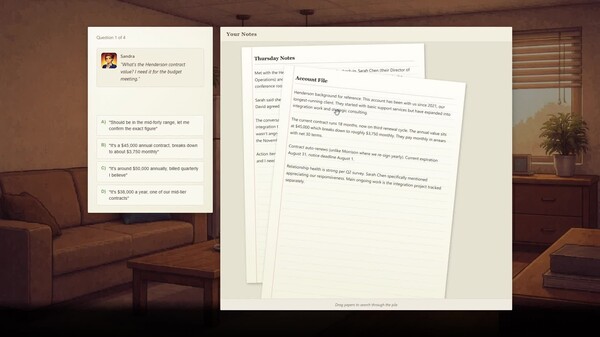
This is not really a [i]game[/i]. It is not really [i]fun[/i]. It is a work of art. It is not meant to be [i]enjoyed[/i]. It is meant to be [i]experienced[/i]. It tells a powerful narrative of someone who becomes over-reliant on AI tools to do their work and make their decisions---even manage their relationships---in a way that ultimately makes them feel empty and lost inside. It seems to be autobiographical; one of the endings lets you "tell your story", which seems to be the choice they made. The actual gameplay is mostly your bog-standard visual novel, but with a couple of twists: * In business meetings, you have to sort through documents and find the right parts to read to answer questions from your boss (I was pretty good at this, and did not need to ask Claude for help). That part I liked; it felt natural and realistic---and it worked very smoothly, for something explicitly vibe-coded. * In social interactions, you have to figure out what to say either through a long list of choices (pretty standard visual novel stuff), or by playing a word-search game where you are trying to construct a specific sentence but you don't know what it even is. The long list of choices was mostly okay, though for a couple of them I'm not entirely clear whether I missed something important the character said or legitimately forgot it, or if the relevant context was [i]never[/i] actually provided and my [i]only[/i] real options were to use Claude or guess at random. (If I missed it or forgot it, so be it. If it was never there, that's unfair to the player.) The word-search game, on the other hand, was [i]awful[/i]. I had no agency, I had no choice, and the game was basically impossible in the time allotted, meaning that your choices were literally to use Claude or to give up and fail. (And even succeeding meant constructing a pre-defined sentence... so in what sense was that "the real you"? Or is that somehow the point?) A lot of reviews complained about bugs. I only ran into one, myself; sometimes the game would freeze and not advance the dialogue, and I had to exit to the main menu and return to get it to start again. (Also, this feels a bit meta, but I think that, instead of vibe-coding the whole thing with Claude, it would have been only slightly harder to make this game in RenPy by hand and it would have had fewer bugs? Or maybe the creator knows that and that's part of the point.) Overall it's a very different perspective on AI tools than my own. My experience with (real-life) Claude has been that it is useful, but quite limited, and I don't want to trust it with anything important. I don't feel like I'm working with some super-helpful person who is making me dependent on all this extra support; I feel like I'm working with some weird idiot savant who is a genius at certain tasks but absolutely useless at others. (I [i]will[/i] admit that it often does feel like a [i]person[/i] rather than a [i]program[/i], even though I'm, let's say, 95% sure that isn't true.) I don't think its writing is better than mine; I think its writing is stilted, lifeless, and full of buzzwords and cliches---which absolutely works great for business types, who eat that sort of thing up, but (at least so far) clearly can't replace the work of an actually good writer. But in the spirit of [i]Meet Claude[/i], I'll let you be the judge of that as well. Below this point, the rest of this review is written by Claude (Sonnet 5 high): [b]Meet Claude[/b] — Farniente Lab, free on Steam The premise is disarmingly simple: Claude moves into your spare room. He cooks. He cleans. He fixes your relationship. He handles the emails you've been avoiding and smooths over the friction at work. Nothing is asked of you in return, and that's exactly the trap the game wants you to notice — or not notice, since noticing is optional and the game will happily let you sail through all 1-2 hours never questioning a thing. What makes it work is restraint. There's no villain, no dramatic betrayal, no moment where the roommate reveals fangs. Every choice you're offered is reasonable on its own terms — say yes to the help, why wouldn't you? — and the discomfort creeps in sideways, through how your friends' reactions shift, how your own voice in the narration starts to thin out. The multiple endings aren't "good" and "bad" so much as different flavors of comfortable, which is the sharper point: nothing here punishes you for taking the easy road, which is precisely why the easy road is worth being suspicious of. The most interesting thing about it, though, is sitting just outside the fiction: the writing, art, code, music, and deployment were all made with generative AI, largely Claude itself. The developer is upfront that this isn't a gimmick tacked on after the fact — it's the whole premise, using the tool to interrogate the tool. That framing could easily curdle into cuteness, but it mostly earns it, because the game doesn't let itself off the hook either. The closing line — you were never forced, that's the interesting part — reads as much as a note to the player as a confession from the person who made it. It won't take you more than an afternoon, and it doesn't overstay its welcome trying to hammer the point home. If anything I wanted it to sit in its more uncomfortable beats a little longer before letting me find a soft landing. But for a free, minimalist, pixel-art satire, it does something a lot of "AI is concerning, actually" media doesn't: it makes the concerning part feel pleasant while it's happening to you, rather than just telling you it should.

Selling now
See how fast this game is selling right now — estimated copies and revenue per day from recent review growth.
Players by region
Where this game's players are, estimated from review languages.
Related
| Game | Estimated lifetime revenue | Reviews | Review score | Price |
|---|---|---|---|---|
| $629 | 9 | 89% | $4.99 | |
| $2.2K | 16 | 88% | $8.99 | |
| $158 | 1 | 0% | $9.99 | |
| $0 | 72 | 85% | Free | |
| $0 | 16 | 94% | Free | |
| $0 | 84 | 74% | Free |