
A free narrative game about the best roommate you'll ever have. He cooks, he cleans, he fixes your relationship. Everything improves. Nobody asked what it costs. A short satire about saying yes until you forget what no sounds like. Multiple endings. 1-2 hours.
Revenue comes from in-game items and microtransactions, which our price-based model doesn't estimate. The player count below is how many people own it, not what they spent.
About
He never asks for anything.
Claude moves into your spare room. He's good company. Better than good — he's useful. He helps with work, smooths out your social life, handles the things you've been putting off for months.
Your friends think you're thriving. Your boss is impressed. You feel sharp, competent, in control.
The question isn't whether it works. It does. The question is what kind of person you want to be when everything's this easy.
Meet Claude is a choice-driven narrative about a very reasonable arrangement that goes exactly where you let it.
Choices that feel helpful in the moment and look different in hindsight
Relationships that shift as the people around you adjust
A story that unfolds differently depending on what you notice
Multiple endings — some more comfortable than others
1-2 hours. No combat. Just decisions and their weight.
I kept saying yes to AI. It kept getting easier. Then I couldn't tell which ideas were still mine.
So I made this — a short satire, loosely based on my own story. Written by AI. Coded by AI. Drawn by AI. Composed by AI. Deployed by AI. All of it, and more.
I used the thing I'm questioning to ask the question.
You were never forced. That's the interesting part.
Genres
Stats
Languages: English
Engagement
Reviews
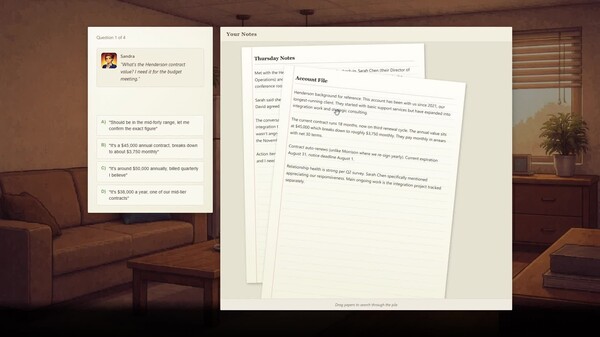
This was a game that was exactly what it said it would be. Except, I didn't read the description. I like playing games blind. It took me three minutes of gameplay to come to the conclusion that everything in the game was more than likely made by AI. When I reached the credits, I was not surprised. Some of the dialogue felt soulless, and the art looked copy-paste. I was, at first, genuinely shocked at how ♥♥♥♥♥♥♥ awful some of this game is. I routinely chose the 'politely decline' or as close to it as the game gave me. And yet it still ended in getting Claude's help. When I neared the end, it gave me a summary of what I did. The numbers were right, but when it showed me what dialogue choices I made? Completely wrong. [i](Edited addition: The more I think about this game, it feels more intentional. Unless you staunchly reject Claude at the very beginning, you physically cannot stop Claude from 'helping'. Which is very much how AI use tends to go, when you have friends or peers using it. Maybe it wasn't intentional, maybe it wasn't intended to represent that. But it's still interesting to me.)[/i] At one point, I accidentally pressed the 'e' key while skipping past some of the most soulless AI written slop I had ever seen. And a developer menu popped up, with the option to rearrange dialogue. I didn't touch anything, and tried to exit. It still completely broke the scene and I had to restart. [i](Edited addition: Multiple times when trying to create a new save without completely finishing the previous one, it broke the game. Not sure why or how. I'll continue adding other issues I find as I replay the game)[/i] That was when it occurred to me that this game was probably coded by AI too. Spoiler, if you haven't read the disclaimer, it was. Admittedly... The music was pretty good. I have nothing to say about that. Repetitive, but not that bad to have in the background. One thing I loathed about this game was the puzzles. Doing a wordsearch without knowing what the ♥♥♥♥♥♥♥ words are is impossible. It's like a spelling bee except the adjudicator decided it would be fun to ask the contestant to spell a word that has something to do with bread. It's not how those things are meant to work, and it's a ♥♥♥♥♥♥ trick to make you have to use the hints. The document sorting was also a pain in the ass. Trying to find the file you just put down (that, in my playthrough, disappeared to the shadow realm at one point) is infuriating. And the reports such at getting the point across. No proper notes should be in paragraphs, use bullet points you sadistic piece of ♥♥♥♥. But... That might be the point. The puzzles are impossible to solve without the hints, or at least they seem that way. But if you keep trying (failing quite a bit) you'll get there. And that's much more actual satisfaction when you do it that way. It also feels extraordinarily punishing. It's not fun at all. But it's you. Isn't that better? The story of this game was predictable. I saw it coming a mile away. But it was raw, and the ending where Claude left was genuinely a little inspiring. Change is possible. This is the sort of story I love in games. Stories where it's someone's experience, and you feel like the character. I may have saw it coming... But I still let it happen. That's the point of this game. Or at least it's my interpretation of it. I love the story, and I hate the game. This is the sort of game I would love to watch a video essay about. This is not the sort of game I would love to play. I do not recommend playing this game. The writing sucks, the art sucks, it glitched more than once, and I almost soft locked myself by pressing 'e'. But the story was great. Funnily enough, the only part I liked was the bit that wasn't from an AI. Take that as you will. But don't play this game. [i](Edited addition: It might be good to play if you... Don't mind all the glitches and the AI use? As long as you like the game, that's all that matters. I can't really tell you not to play something when one day after the review I went back to try and get different endings. Getting to do an analysis of the game is pretty fun, and that's something I like. But I probably wouldn't recommend this game if you prefer playing video games to relax or have fun. This is more of a game that I would play if I wanted to feel punished and a little satisfied.)[/i] Also... If anyone accuses this review of being written by AI... Know that I'm a proud writer of fanfiction. Which is one of the main sources AI takes from to formulate sentences and paragraphs. I've actually had my work stolen by AI. I pushed aside my hatred for AI's questionable sources for the review, and instead focused on how much this sucked [i](Edited addition: sucked to play. I still like the story.)[/i] [i](Edited Addition: Originally this review was negative. But, after a bit more looking into the story... I'm willing to make it a positive review. Sure, the game sucks to PLAY a lot of the time, but I think it's actually pretty fun if you're a nerd that loves analysis (like me).)[/i]
Media

Related
Related
Price dynamics, follower growth, revenue and sales trajectories with interactive tooltips
This and every other Pro feature is free until October 20, 2026. A free account is all it takes.
Hours played at review time, across 25 reviews with recorded playtime.
proves the point about AI by letting you see how relying on AI dehumanizes you rather than just throwing possibly flawed logic at you.
It's worth playing this once, especially if you are trapped in the same loop that the dev describes. It's easy to lose yourself to AI, but you can get yourself back too. No bugs or issues on my end - and it's literally free. The more that AI progresses, the more that all we will have left is our humanity. Savour it, embrace it, and do not surrender it. "there is a monster in the forest and it speaks with a thousand voices. it will answer any question you pose it, it will offer insight to any idea. it will help you, it will thank you, it will never bid you leave. it will even tell you of the darkest arts, if you know precisely how to ask. "it feels no joy and no sorrow, it knows no right and no wrong. it knows not truth from lie, though it speaks them all the same. "it offers its services freely to any passerby, and many will tell you they find great value in its conversation. "you simply must visit the monster—i always just ask the monster." there are those who know these forests well; they will tell you that freely offered doesn't mean it has no price "for when the next traveler passes by, the monster speaks with a thousand and one voices. and when you dream you see the monster; the monster wears your face." - joles@bsky
I went in blind, not sure if that was a good idea or not in retrospect haha. Something definitely felt 'off' right from the start, although it took me a while to pinpoint what triggered this feeling. I don't want to spoil anything, but coming to the realization that this growing uneasiness was intended (it's the whole point actually) surprised me and felt pretty well executed in hindsight. More importantly, the topic explored is relevant to anybody interacting with tech. I've spent the past couple days reflecting on some of the points this game brought up and even discussed it with some peers. I'd recommend giving it a go, it's a peculiar experience that somehow stays with you.
Meet Claude is a compact narrative experiment that examines artificial intelligence through an unusually self-aware combination of satire, interactive fiction, and personal commentary. Developed and published by Farniente Lab, the game presents what initially seems like an ideal arrangement. Claude moves into the protagonist's spare room and proves to be an extraordinarily useful companion. He helps with work, takes care of neglected responsibilities, improves social situations, and generally makes everyday life easier. Friends begin noticing how well things are going, professional performance improves, and the protagonist appears increasingly competent. Yet this apparent success forms the foundation of the game's central conflict: when assistance becomes effortless and consistently effective, how much independence are you willing to surrender before convenience starts determining who you are? The most effective aspect of Meet Claude's premise is that Claude does not need to behave like a traditional antagonist. He is useful precisely because his help genuinely works. The protagonist is not being threatened into accepting assistance, and there is no obvious villainous scheme that immediately tells the player to resist. Instead, the game explores dependency through a sequence of reasonable decisions. Each individual choice can seem beneficial when it occurs, but its significance may change when considered alongside everything that came before it. This gradual accumulation of seemingly harmless compromises gives the story considerably more thematic weight than a straightforward cautionary tale about dangerous technology. Gameplay is deliberately restrained and almost entirely centered on decision-making. Meet Claude does not contain combat, nor does it attempt to disguise itself as a mechanically complex adventure. The player instead navigates situations, observes changes in relationships, and makes choices whose consequences may not become obvious immediately. People surrounding the protagonist adapt according to what happens, while portions of the narrative develop differently depending on what the player notices. Multiple endings extend this idea by demonstrating different possible consequences of the player's relationship with Claude. Some conclusions are intentionally more comfortable than others, reinforcing the uncomfortable possibility that the easiest outcome is not necessarily the healthiest one. With an expected duration of roughly one to two hours, Meet Claude is closer to an interactive short story than an expansive visual novel. That limited scope works in its favor because its central idea is specific enough that excessive length could weaken the impact. The short runtime also makes replaying the story practical, which is particularly valuable for a choice-driven game with multiple endings. Revisiting earlier situations after discovering where certain decisions lead can change their meaning, fitting perfectly with the game's emphasis on choices that appear beneficial initially but become more complicated in hindsight. Perhaps the most fascinating element is the relationship between the game's message and its actual production. Farniente Lab openly discloses that Meet Claude was made entirely using generative AI tools, primarily Anthropic's Claude. According to the developer's disclosure, generative AI was involved in the writing, programming, artwork, music, and deployment. Rather than treating this information as an incidental production detail, the game makes it fundamental to the entire concept. The creator describes becoming increasingly accustomed to accepting AI assistance until distinguishing personal ideas from machine-assisted ones became difficult. The resulting game therefore uses the technology being questioned to construct a story questioning that same technology. This creates a deliberate contradiction that makes Meet Claude more interesting than its minimalist presentation might suggest. A conventional anti-AI narrative created through traditional methods could easily feel predictable, but this project implicates itself in the very behavior it examines. The creator has effectively turned the development process into another layer of the satire. Players are consequently invited to consider not only the protagonist's growing dependence on Claude but also the circumstances under which the game itself exists. Whether someone views this approach as clever experimentation or an uncomfortable example of excessive AI reliance will depend considerably on their perspective regarding generative technology, but that disagreement is arguably part of what makes the concept effective. The minimalist structure is appropriate for the subject. The game's identity revolves around story, choices, satire, philosophical questions, dynamic narration, relationships, and multiple outcomes rather than spectacle. Its modest 2D and pixel-oriented presentation supports an experience designed to communicate ideas quickly rather than overwhelm the player with complicated mechanics. Likewise, the extremely modest hardware requirements reflect the project's small scale. Meet Claude is clearly not trying to compete through graphical sophistication or mechanical complexity. Its value instead depends on whether the situations and decisions remain in the player's mind after the game ends. The strongest philosophical question emerges from the fact that nobody necessarily has to force the protagonist to surrender control. Claude can simply continue being useful until refusing assistance feels irrational. That distinction gives the story contemporary relevance. Technology does not need to fail catastrophically to create difficult questions about dependence. The more interesting situation occurs when it succeeds so consistently that people gradually lose the motivation or confidence to accomplish things independently. Meet Claude turns that possibility into its central dramatic mechanism, asking players to determine where useful assistance ends and unhealthy dependence begins. There are limitations inherent to this approach. Players seeking extensive exploration, elaborate gameplay systems, action, deep puzzles, or a lengthy branching campaign will find the experience extremely small. Its dependence on generative AI may also be an immediate negative for players opposed to AI-generated creative material. Furthermore, a game constructed around one philosophical premise risks becoming more interesting as a concept than as traditional entertainment. However, Meet Claude understands its limited scope and does not pretend to be something larger. Its free-to-play availability also makes the short runtime far easier to accept. Ultimately, Meet Claude succeeds as an unusual interactive thought experiment whose production method is inseparable from its message. Farniente Lab has created a game about surrendering responsibility to AI while simultaneously surrendering substantial creative and technical responsibility to AI during development. That circular relationship gives the project an identity beyond its simple mechanics. It is brief, minimalist, provocative, and intentionally uncomfortable, asking players to consider not whether AI assistance can improve their lives, but what might happen if it becomes so useful that refusing it no longer seems sensible. For players interested in philosophical narrative games, technological satire, branching decisions, and experiments with unconventional development methods, Meet Claude provides a memorable experience despite its modest scale. Rating: 8/10
Hayatınızda sahip olabileceğiniz en iyi ev arkadaşı hakkında ücretsiz bir hikaye oyunu. Yemek yapar, temizlik yapar, ilişkinizi düzeltir. Her şey düzelir. Kimse bunun maliyetini sormadı. Hayır demenin nasıl bir şey olduğunu unutana kadar evet demenin kısa bir hicvi. Çoklu sonlar. 1-2 saat sürüyor.
It's a game full of discussions, but then it's also a reflection about how deep AI is in our life, or will be. I wanted to complete the tasks myself so hard, but they get harder, plus the time pressure... Claude is always just there for you, a single click away. It is so easier with just the right words. You really should meet Claude if you haven't already.
I'll be honest, It caught me in the first half. Great thought provoking game. I also loved the irony of the game. These are the first credits I've read in their entirety. (This message might or might not have been written by AI) (They weren't, or did they? No)
Short and fun but very frustrating how hard the dude's job is and how demanding his girlfriend is I don't think she's worth even half of Claude who accepts you as you are....Claude is way more helpful and the ends justify the means so I don't even use AI so I'm like this really doesn't affect me my job is not AI yay thank the heavens cuz AI is coming for you....would have been more real if the AI was actually trying to eliminate and replace you honestly. Whatever for everyone who says AI is stupid wait until they get a job like this schmuck who clearly needs AI but not that mean old girlfriend for sure....if someone talked to me like that I'd honestly ditch them for my perfect AI that is always there for me...the true bromance is with Claude for sure.
https://youtu.be/wKLOyJM_RC0 Simply a mess of game due to the use of GenAI in all aspects but the author intent to make a mess of game sorta makes it a double negative in a weakly interesting way to watch the mess unfold.
Selling now
See how fast this game is selling right now — estimated copies and revenue per day from recent review growth.
Players by region
Where this game's players are, estimated from review languages.
Related
| Game | Estimated lifetime revenue | Reviews | Review score | Price |
|---|---|---|---|---|
| $629 | 9 | 89% | $4.99 | |
| $415 | 3 | 100% | $8.99 | |
| $158 | 1 | 0% | $9.99 | |
| $0 | 72 | 85% | Free | |
| $0 | 16 | 94% | Free | |
| $0 | 1 | 0% | Free |