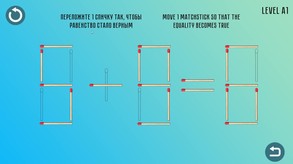
Magic Matchstick, developed and published by Anime Squad, is a small and minimalist puzzle game built around one of the oldest brain teasers in existence: rearranging matchsticks to form correct equations or valid shapes. The premise is extremely simple, yet it taps into a kind of universal logic puzzle appeal that has fascinated players long before digital games existed. At its core, Magic Matchstick presents a series of equations made from digital matchsticks, such as “5 + 3 = 9,” and asks the player to move, add, or remove a certain number of sticks to make the equation mathematically correct. It’s a concept that thrives on clarity and restraint, allowing for instant comprehension while still leaving room for clever problem-solving. The result is a game that is easy to learn, quick to play, and quietly satisfying, even if it lacks the complexity or depth of larger puzzle titles.
The gameplay structure is clean and straightforward. Each level presents a single puzzle on-screen—an arrangement of matchsticks representing numbers and arithmetic symbols—and a limited number of moves to fix the equation. Early levels serve as a gentle introduction, often solvable with one simple adjustment. You might shift a stick from a “6” to make it a “0,” or adjust a “+” into a “−.” As you advance, the challenges gradually increase, requiring more creative and abstract thinking. The simplicity of the design makes every solution feel like a small mental victory; there’s a tactile satisfaction in spotting the pattern and realizing how a single change can transform an incorrect expression into a valid one. While the core gameplay never evolves beyond this format, its purity is part of its charm. It’s a meditative, almost analog experience, where each puzzle is about slowing down and seeing possibilities within rigid constraints.
Visually, Magic Matchstick adopts a minimalist aesthetic that suits its theme. The matchsticks are clearly defined against plain backgrounds, making the focus entirely on the logic at hand. There are no distracting visual elements or elaborate animations—just clean lines, soft lighting, and a simple interface that reinforces the game’s focus on clarity. This simplicity carries into the sound design as well. The game’s quiet, ambient background music and soft clicking sound effects create a calming rhythm that encourages concentration. It’s not meant to overwhelm or energize but to accompany the quiet act of thinking. The restraint in presentation demonstrates that the developer understood the kind of mood this type of puzzle game should evoke: relaxed, methodical, and contemplative.
Where the game begins to show its limitations is in its longevity. While the puzzles are satisfying on a short-term basis, the overall variety is limited. Many of the levels rely on similar patterns, and the sense of novelty starts to fade once you’ve encountered a few dozen equations. There are only so many ways to manipulate a “7” into a “1” or a “9” into a “3,” and once you recognize those visual cues, later puzzles can feel like variations of earlier ones. The gradual increase in difficulty helps extend engagement, but the game never adds new mechanics or twists to refresh its core loop. As a result, it’s best enjoyed in short bursts rather than long sessions. That said, its brevity may actually work in its favor for players looking for something light and mentally engaging without requiring heavy investment of time or focus.
One of the most peculiar aspects of Magic Matchstick—and perhaps its most polarizing feature—is its massive number of Steam achievements. The game boasts over 4,000 achievements, an enormous number that has attracted a specific kind of audience. Many players pick up the game primarily as an easy way to pad their Steam profiles with achievement unlocks rather than for the puzzles themselves. This feature has given Magic Matchstick a niche identity within the Steam ecosystem, similar to other minimalist indie games that focus more on collectible milestones than deep gameplay. However, this also creates mixed expectations: those who come for the achievements may find the game repetitive, while traditional puzzle fans might see the achievements as an unnecessary gimmick. To make matters worse, some users have reported inconsistent functionality in the achievement system, with certain rewards failing to trigger properly. While this doesn’t affect the puzzle-solving experience directly, it can undermine satisfaction for those motivated by completionism.
From a technical standpoint, the game performs smoothly. It loads quickly, consumes minimal resources, and runs well even on low-end systems. The interface is intuitive, with responsive controls and clear feedback when moving or rotating sticks. The puzzles themselves are self-contained, requiring no external hints or tutorials beyond the basic concept introduced at the beginning. However, there are small usability issues—occasionally, selecting or moving a matchstick can feel finicky, especially in levels with crowded layouts. These are minor frustrations that don’t seriously impact playability but do remind you of the game’s limited polish. Still, given its low price and minimalist scope, such imperfections are forgivable.
Magic Matchstick succeeds in what it sets out to do: it offers a simple and contemplative puzzle experience that anyone can enjoy regardless of age or skill level. It’s a throwback to a kind of cerebral pastime that doesn’t rely on flashy graphics, narrative hooks, or complex mechanics. The sense of reward comes from the act of seeing patterns where none seem to exist and uncovering solutions through logic and observation. Yet, it’s also a game that feels more like a curiosity than a lasting experience. Once you’ve gone through a handful of puzzles, there’s little incentive to keep playing beyond achievement hunting. It’s a title designed for brief, casual engagement rather than long-term commitment.
In the end, Magic Matchstick stands as a small, quiet addition to the world of minimalist puzzle games. It’s neither ambitious nor innovative, but it doesn’t need to be—it succeeds through focus and simplicity. For players looking for a short mental exercise that evokes the feeling of solving a logic puzzle in a newspaper or on a napkin, it delivers exactly that. It won’t leave a lasting impression or challenge your puzzle-solving limits, but it offers a few hours of calm, logical satisfaction at an accessible price. It is a modest, well-contained effort that accomplishes its goal without pretense, a digital rendition of a timeless puzzle that proves that sometimes, even the smallest spark can ignite a moment of thought and quiet pleasure.
Rating: 6/10