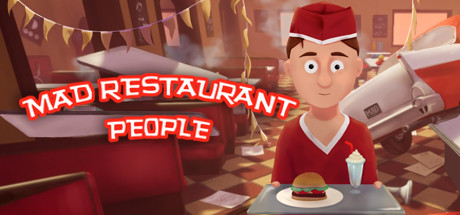
Progress your career as a server by using your keen perception, your short-term memory and your ability to decide quickly. Fancy and unique places will hire you as you master challenges, unlock perks and stay calm even in the weirdest situations. A time management memory game full of fun and chaos.
Modeled estimate, not a reported figure. How we estimate →
About


Stats
All-time low is the lowest price we've recorded for this game since we started tracking it.
Languages: English, German, Korean, Spanish - Spain, Simplified Chinese
Engagement
Hours played at review time, across 27 reviews with recorded playtime.
Reviews
Nettes einfaches Game. (auch für Kids) Perfekt um sein Kurzzeitgedächtnis zu trainieren ;) SPASS macht es zudem auch. EMPFEHLENSWERT für Kurzweil und Hirntraining.
Pra quem gosta dos jogos clássicos de restaurante (em você simula o trabalho de um garçom), Mad Restaurant é muito legal. Demorei um pouco para me acostumar com o controle do personagem (feito totalmente com o mouse), mas depois que me adaptei foi sucesso. O jogo me ofereceu aquilo que eu esperava: adrenalina, a missão de pensar "rápido" e de criar estratégias de otimização de tempo ao servir os pratos em que cada fase e layout diferente. Apenas gostaria que houvesse um modo de reaproveitar as fases existentes para jogar no "modo infinito", com novas metas, pois zerei o jogo em 2, 3 dias.
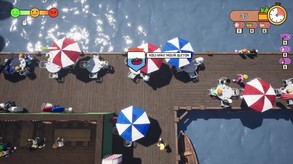
Mad Restaurant People, developed and published by SureAI, takes restaurant service and transforms it into a fast-paced arcade challenge centered around memory, multitasking, and handling escalating chaos under pressure. Instead of building restaurants or managing long-term business growth like traditional simulation games, it places players directly on the restaurant floor where every second matters. The experience revolves around serving customers efficiently while dealing with increasingly unpredictable situations that gradually turn simple restaurant work into an intense test of concentration and quick thinking. The premise begins with players stepping into the role of a restaurant employee responsible for keeping service running smoothly. Early moments introduce manageable tasks involving customer orders, food delivery, and maintaining organization within a small restaurant environment. The opening stages create a comfortable learning period where the mechanics remain easy to understand. However, that simplicity disappears quickly as progression introduces larger restaurants, greater customer volume, and increasingly absurd complications designed to challenge even experienced players. The core gameplay focuses heavily on memorization and time management. Customers place food and drink orders that players must remember accurately while simultaneously managing movement throughout increasingly crowded restaurant spaces. Unlike management games where decisions happen from a distance, Mad Restaurant People demands direct execution. Players personally handle responsibilities instead of assigning tasks to virtual employees. This creates a much more immediate sense of pressure where mistakes carry instant consequences. One of the game’s strongest qualities is how naturally it increases complexity. Additional mechanics appear steadily throughout progression without overwhelming players too early. New hazards and distractions constantly alter priorities, forcing adaptation and stronger organizational skills. Unexpected obstacles begin interrupting carefully planned routines, creating situations where flexibility becomes just as important as speed. The restaurant itself gradually becomes a source of controlled chaos. Obstacles emerge that disrupt efficiency and create unexpected problems requiring immediate attention. Certain situations challenge memory while others test movement precision and prioritization. Multiple responsibilities often demand attention simultaneously, creating a satisfying tension where maintaining control becomes increasingly difficult but never impossible. Humor also plays a major role in defining the game’s personality. The escalating absurdity helps prevent the restaurant setting from becoming repetitive. Strange events and unexpected complications create memorable moments that separate the game from more grounded restaurant simulations. The developers clearly embrace unpredictability as part of the experience, and that approach helps give the game a unique identity. Progression remains satisfying because new challenges consistently introduce reasons to improve. Performance rewards encourage players to optimize routes and develop stronger habits. Unlockable content creates additional motivation beyond simple level completion, while increasing difficulty gives long-term players opportunities to refine strategies and improve execution. The game steadily reinforces improvement through practice rather than artificial progression systems. The memory-focused design deserves particular recognition because it creates challenge without relying entirely on traditional difficulty systems. Success often depends on observation and mental organization rather than mechanical complexity. Remembering multiple customer requests while navigating hazards creates engaging pressure that feels rewarding to overcome. Improvement becomes visible through personal skill growth rather than statistical upgrades. Visually, Mad Restaurant People favors clarity over complexity. Restaurant environments remain readable even during the busiest moments, which becomes essential once customer demands and environmental distractions begin overlapping rapidly. Character presentation supports the lighter atmosphere effectively without distracting from gameplay priorities. The visual design succeeds primarily because it reinforces function while maintaining a playful personality. The pacing represents another major strength. There is very little downtime once progression accelerates. New demands appear constantly, creating momentum that keeps sessions engaging. The balance between increasing challenge and player capability remains consistent throughout most of the experience, encouraging continued improvement without making success feel unreachable. The game does have limitations. Players seeking deep restaurant management systems involving finances, staffing, or business expansion may find the design more arcade-focused than expected. The gameplay structure prioritizes execution and reflexive problem solving over detailed simulation mechanics. Certain gameplay patterns may also become familiar after extended sessions. However, the focused approach ultimately works in the game’s favor. SureAI clearly designed Mad Restaurant People around one central idea: turning restaurant service into a hectic challenge where organization and memory matter just as much as speed. Rather than overcomplicating the formula, the developers refine those core ideas and build progression around them effectively. What makes the experience enjoyable is how personal success feels. Improvement comes directly from learning better habits, remembering information more efficiently, and responding to chaos with stronger decision-making. Few restaurant-themed games create pressure this effectively while remaining approachable enough for players unfamiliar with management titles. Mad Restaurant People succeeds because it commits fully to its fast-paced identity. It transforms everyday restaurant work into a surprisingly demanding arcade experience filled with humor, escalating tension, and rewarding skill development. Players who enjoy time management games, multitasking challenges, and gameplay focused on personal improvement will likely discover an experience that remains entertaining well beyond its opening hours. Rating: 7/10
有中文 有成就
어제까지 되던 게임이 오늘 하려고 하니까 안된다.
Intro: It's a really fun point-and-click game where you bring food from the kitchen to the restaurant guests. It has 14 levels where you need to improve your performance as each level gets harder. You do earn some perks like more tray space and a hint for the last requested item by a customer. BUT the controls though: The first 11 levels take a bit getting used to but work fine. You have to continually drag your mouse across the screen and the game shows the route to that point by means of a gray line. This doesn't always work because sometimes you get stuck behind a chair or a person. Especially with longer routes the game has a harder time not letting you get stuck. But this doesn't happen in a way that it heavily impacts your performance (money earned in a limited time). LAST 3 LEVELS are especially buggy and glitchy: In the Television Tower level this so obvious and annoying that it makes me think if they have actually optimized these last 3 levels in the update or skipped them altogether. Because it has the bad old controls system. You LITERALLY get stuck in a position where you can't get out. The character will just stand anywhere and is stuck. Even if there are no objects around him, you can't get out of the locked position and will have to restart the game. Also the waiter will sometimes get stuck past a chair while that shouldn't physically be possible. And he will get stuck past people (which shouldn't be possible, except if they are drunk and make you fall). This level only works if you keep your mouse extremely close to the waiter and quickly correct or double-correct if your waiter gets stuck for no reason. Often going in the opposite direction helps, but sometimes your mouse will miraculously disappear from the screen and you will lose time 'finding' it. Then you have just lost a huge amount of time and will have to restart the level. But yeah the last three levels are kinda impossible because of this. If the player would have had very smooth controls the targets would be realistic. But not this way. Tip: Don't be too scared if not everyone is happy or if the happiness bar is not completely green. Just make sure you make enough money within the limited time. If you are above the target amount you will move on to the next level. Also don't go after single angry customers if that disrupts your flow. There is one level though that requires complete happiness. Value for money: It is a really fun game but I wouldn't get it for €8,19. Only if you love restaurant games would I pay the full price. Otherwise: just wait till there is a discount of 20%+. The fun thing is that you can always improve on yourself though so it does have replay value for the 11 achievable levels.
Während ich zuhause die Fertigware aus der TK nicht missen möchte, hat es mir der virtuelle Kochlöffel umso mehr angetan. "Mad Restaurant People" ist also für mich eine weitere Etappe auf dem Pflichtprogramm. Das Spiel ist von der ersten Aufgabe an auf jeden Fall verdammt schwer zu meistern, motiviert aber durch die schöne Grafik durchaus zum Dranbleiben. Frustrierend kann der starke Faktor Zufall sein, der hier eine Rolle spielt. Man beißt sich bei derselben Aufgabe erst zweimal die Zähne aus, während die Bestellungen der Gäste und Besucher beim dritten Mal plötzlich wie gewünscht kommen. Das gibt zwar die harte Realität der Gastronomie gut wieder, für die Langzeitmotivation ist der Umstand aber sicherlich weniger förderlich. Ganz sicher als nervig empfinde ich die Point-and-Click-Steuerung. Das Spiel würde sicherlich mit Controller auf dem Sofa mehr begeistern. Empfehlung? Es fällt mir immer schwer, ein Spiel nur mit 👍/👎 zu bewerten - hier komme ich nach dem ersten Eindruck vorerst ganz knapp auf ein Ja für Liebhaber des "Genres", wohingegen es für Einsteiger bessere Titel gibt.
Related
Related
Trends
Modeled estimate over time, reconstructed from Steam's monthly review histogram.
Momentum
Pace estimated from the game's recent review growth (our daily snapshots) at its own sales-per-review ratio — a momentum signal, not booked sales.
Audience
Estimated from the language of this game's reviews — a proxy for where players are, not official Steam demographics.
Related
| たんぼ | $2.7K | 80 | 72% | $1.99 |
| Through The Fragmentation | $2.7K | 232 | 97% | $0.99 |
| ReplayBellSuikaSlotLikeGame | $2.7K | 79 | 91% | $2.22 |
| OMICRON: Coronavirus Battlegrounds | $2.7K | 54 | 78% | $2.99 |
| Spin Time | $2.7K | 98 | 95% | $1.99 |
| Toree's Panic Pack | $2.7K | 133 | 56% | $0.99 |