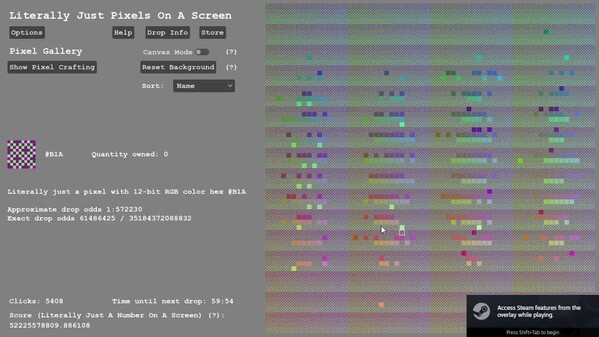
Literally Just Pixels On A Screen is a deliberately minimal idle collecting game that turns one of the simplest elements of digital imagery into its entire progression system. Developed and published by pixelsonascreendev, the game was released on January 31, 2025 as a free-to-play title. Rather than surrounding its concept with unnecessary mechanics, it delivers exactly what its name suggests: players collect individual colored pixels. The result sits somewhere between an idle game, a digital collectible experiment, and a playful commentary on the value people attach to virtual objects.
The core gameplay requires almost no active involvement. While the game remains open, the player receives a randomly generated pixel roughly once per hour. These are not simply cosmetic entries stored inside a private collection screen. Each acquired pixel becomes a Steam inventory item, allowing it to participate in Steam's broader trading ecosystem. Pixels can be exchanged between players and bought or sold through the Steam Community Market. This gives an otherwise extremely basic collectible an unusual degree of permanence and makes obtaining uncommon colors considerably more interesting than simply filling another entry in an in-game catalog.
There is a small crafting system that provides a use for pixels players no longer want. Ten existing pixels can be consumed to produce one random pixel. Although this mechanic is intentionally simple, it introduces a meaningful choice into the collecting loop. Players can retain their existing colors, trade them, potentially sell them, or sacrifice a group for another randomized opportunity. Crafting therefore prevents duplicate or undesirable drops from feeling entirely pointless while reinforcing the game's central obsession with probability.
The most distinctive aspect is the mathematics behind pixel rarity. Colors use a 12-bit RGB system represented by three hexadecimal digits, with individual red, green, and blue values ranging from 0 to F. Pixel generation essentially simulates 45 coin flips divided into three groups of 15. The number of heads within each group determines the corresponding RGB component. Consequently, colors near the more statistically probable outcomes appear much more frequently, while values requiring extreme results become extraordinarily difficult to obtain.
This system creates some comically rare collectibles. Pure black, represented by #000, and pure white, represented by #FFF, each have a stated drop probability of 1 in 35,184,372,088,832. Several other extreme combinations, including #00F, #0F0, #0FF, #F00, #F0F, and #FF0, share that rarity. Realistically, this makes naturally completing the entire collection an enormous challenge. The absurd probability is part of the joke, but it also gives dedicated collectors something genuinely elusive to pursue.
There is very little conventional gameplay beyond this system, and prospective players should understand that limitation. Literally Just Pixels On A Screen is not an incremental game filled with complicated upgrades, automated production chains, character development, exploration, or strategic challenges. Waiting and collecting constitute the main experience. Its appeal comes from anticipation rather than mechanical engagement. Each hourly drop is essentially another attempt at obtaining something unusual, making the game better suited to players fascinated by rarity and digital collections than those seeking constant interaction.
The presentation follows the same philosophy. Its minimalist and pixel-oriented appearance is entirely appropriate because elaborate visuals would arguably undermine the concept. The game turns the smallest practical visual unit into an object of interest. In doing so, it also works surprisingly well as a parody of digital-item economies. A tiny colored square can become desirable simply because mathematics declares it rare and a marketplace allows people to assign value to it. That underlying idea gives the project more personality than its intentionally primitive premise initially suggests.
Steam integration is consequently one of its strongest features. The game supports single-player play, Steam achievements, Steam Cloud, and in-app purchases, while its inventory and trading functionality forms an essential part of the experience. There is only a very small achievement component, so players primarily interested in extensive achievement hunting will find limited material. Instead, the real long-term progression comes from building an inventory and chasing increasingly improbable colors.
Its hardware requirements are appropriately lightweight. The game asks for only modest processing power, 1 GB of memory, basic graphics capability, broadband internet, and approximately 1 GB of available storage on Windows. Versions are also available for macOS and Linux. Such accessibility fits an application designed to remain open for long periods while waiting for drops rather than demanding significant computational resources.
Literally Just Pixels On A Screen ultimately succeeds because it fully commits to an intentionally ridiculous idea. Judged as a conventional game, it is extremely limited because meaningful active gameplay is almost nonexistent. Judged as an idle collecting experiment, however, it has a surprisingly coherent design. Random hourly drops, mathematical rarity, Steam inventory integration, trading, market functionality, and crafting all contribute toward the same uncomplicated objective.
Developer pixelsonascreendev and publisher pixelsonascreendev have created something that will clearly not appeal to everyone, but its narrow focus is also part of its charm. Players who enjoy passive collection systems, rare digital items, probability mechanics, and Steam inventory trading may find it strangely addictive. Those wanting action, narrative, strategy, or substantial interaction will have little reason to remain engaged. As a free, self-aware collecting curiosity built around turning colored pixels into coveted objects, however, it accomplishes exactly what it sets out to do.
Rating: 7/10