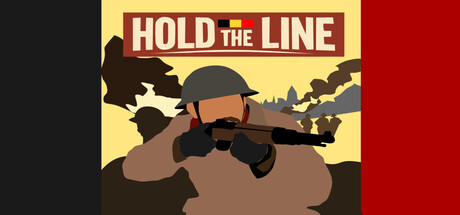
A strategic tower defense set in World War I. Defend Belgian trenches, manage your soldiers, their supplies and fatigue. Every choice matters. This is not about conquering — it’s about holding the line.
Modeled estimate, not a reported figure. How we estimate →
Media

About
Hold the Line is a strategic tower defense game set during World War I, in the heart of the Belgian trenches.
The enemy advances. The lines are collapsing. You play as an officer tasked with defending a key sector of the front with limited resources and exhausted soldiers.
Each soldier has individual statistics:
Range
Fire rate
Experience
Fatigue
A hungry, thirsty, or exhausted soldier will be less effective in combat.
Between assault waves, you must:
Reorganize your positions
Manage supplies (water, food)
Recruit or replace losses
Increasingly intense enemy waves
Constant fatigue management
Difficult choices with limited resources
Strategic decisions impacting the survival of your line
Soldiers gain experience during combat, improving their effectiveness. Unlock new defensive capabilities and adapt your strategy against ever-growing pressure.
Inspired by historical events, the game emphasizes human management over overwhelming power, the constant pressure of the front, and the daily sacrifice of Belgian soldiers.
This is not about conquering.
It is about holding the line.
Genres
Stats
All-time low is the lowest price we've recorded for this game since we started tracking it.
Languages: English, French, Italian, German, Spanish - Spain, Simplified Chinese, Russian
Reviews
Hold the Line is a tactical defense and survival strategy game developed and published by Adrien De Nève that places players into desperate battlefield scenarios where survival depends entirely on discipline, positioning, and the ability to withstand overwhelming enemy assaults. Unlike many modern strategy games that focus heavily on expansion, large-scale empire management, or cinematic storytelling, Hold the Line takes a far more focused and grounded approach. The game revolves around defending vulnerable positions against relentless waves of attackers while managing limited resources and maintaining fragile defensive structures under constant pressure. This concentrated design philosophy gives the experience a uniquely tense atmosphere because players are never truly placed in a position of comfort or dominance. Instead, every battle feels like a desperate attempt to delay collapse for just a little longer, and that constant pressure becomes the foundation of the game’s identity. One of the strongest aspects of Hold the Line is how effectively it creates tension through defensive gameplay. Many strategy games reward aggressive momentum and offensive expansion, but Hold the Line is almost entirely about endurance and survival. Players are placed into situations where resources are limited, enemy numbers are overwhelming, and every defensive decision carries significant consequences. The battlefield constantly feels unstable, forcing players to think carefully about troop placement, defensive priorities, and how to respond to enemy breakthroughs before situations spiral out of control. This defensive focus gives the game a very different emotional tone compared to traditional conquest-focused strategy titles because victory rarely feels absolute. Even successful battles often feel exhausting and hard-earned, reinforcing the atmosphere of constant desperation. The gameplay loop revolves around preparing defensive positions, deploying units strategically, reinforcing vulnerable areas, and surviving increasingly aggressive enemy attacks. At first, the mechanics appear relatively straightforward, but the game gradually reveals surprising tactical depth as enemy waves become larger and more unpredictable. Defensive lines that initially seem secure can suddenly collapse under concentrated attacks, forcing players to improvise quickly and stabilize dangerous situations before the entire battlefield falls apart. The game does an excellent job of escalating pressure naturally because each successful wave simply leads into another, more difficult challenge that demands greater efficiency and sharper tactical awareness. Positioning plays an enormous role in survival. The placement of units, defensive structures, and firing lines directly determines how well players can contain enemy advances. Poor positioning decisions often lead to catastrophic chain reactions where a single breach allows enemy forces to overwhelm multiple defensive layers rapidly. This creates a gameplay structure where every decision feels meaningful because the battlefield can shift dramatically within seconds once pressure builds. Protecting choke points, rotating defensive units, and deciding where reinforcements should be sent become constant concerns throughout every encounter. The game rewards patience and thoughtful planning far more than reckless experimentation, which helps strengthen the tactical identity of the experience. One of the most satisfying aspects of Hold the Line is the sense of accomplishment that comes from surviving impossible-looking situations. The game regularly places players under overwhelming pressure, forcing them to manage multiple threats simultaneously while maintaining fragile defenses across different sections of the battlefield. There are moments where collapse feels inevitable, only for players to narrowly stabilize the situation through careful repositioning and efficient resource management. These moments create some of the game’s strongest emotional payoffs because success genuinely feels earned. The tension generated by barely surviving overwhelming enemy attacks gives the gameplay a level of intensity that many larger strategy games struggle to replicate. The pacing is particularly effective because it constantly alternates between preparation and chaos. Before major enemy assaults, players have brief opportunities to reorganize defenses, repair damaged positions, and prepare for incoming attacks. However, once combat begins, the battlefield often descends into frantic survival management where players must react quickly to changing conditions and enemy breakthroughs. This contrast between controlled preparation and desperate defense keeps the gameplay engaging because players are constantly shifting between strategic planning and emergency response. The game succeeds at making every battle feel dynamic even though the overall structure remains relatively focused and straightforward. The visual presentation adopts a minimalist military-inspired style that prioritizes readability and atmosphere over visual spectacle. Units, defensive structures, and enemy movements remain easy to identify during chaotic combat situations, which is extremely important in a game where tactical awareness directly affects survival. Explosions, battlefield destruction, and weapon effects provide enough visual feedback to make combat feel impactful without cluttering the screen with excessive effects. While the graphics themselves are relatively modest compared to larger-budget strategy games, the clarity helps maintain focus on battlefield management rather than visual distraction. The environments also contribute to the atmosphere effectively, often creating the impression of isolated warzones where defenses are constantly on the verge of collapse. Sound design is another area where Hold the Line performs surprisingly well. Gunfire, explosions, warning alarms, and battlefield ambience combine to create a constant sense of tension during combat. Audio cues are especially important during intense enemy assaults because players often rely on sound to identify breaches or incoming threats while managing multiple sections of the battlefield simultaneously. The soundtrack itself remains relatively restrained, allowing the sounds of warfare and battlefield chaos to dominate the atmosphere naturally. This understated audio approach works well because it reinforces the game’s grounded and survival-focused tone rather than attempting to create artificial cinematic spectacle. Hold the Line is ultimately a tense and rewarding tactical defense game that combines survival-focused battlefield management, strategic positioning, and relentless enemy pressure into a consistently engaging experience. While repetitive mission structure, limited narrative depth, and modest production values prevent it from competing directly with larger strategy franchises, the game’s strong atmosphere and satisfying defensive gameplay make it a worthwhile experience for players who enjoy tactical survival challenges built around endurance and battlefield control. For fans of strategy games that emphasize resilience and high-pressure decision-making rather than conquest and expansion, Hold the Line delivers a focused and memorable survival experience that thrives on tension, discipline, and tactical persistence. Rating: 7/10
je n'y ai jouer que quelque minute t il y a un problème de taille. quand on perd, on est rediriger sur steam et nom l'écrant d'acceuil. merci de corriger ça
Bonne base, cest sympa, mais ca serrait cool que quand on doit attribué leau et la nourriture on puisse voir qui a soif et faim, car cest un peu compliqué de retenir les prenoms, a part ca cest cool, peut etre changer la police d'écriture des dialogue et du carnet
Related
Related
Trends
Concurrent players on Steam, sampled daily since tracking started.
Momentum
Pace estimated from the game's recent review growth (our daily snapshots) at its own sales-per-review ratio — a momentum signal, not booked sales.
Related
| Again? | $430.9 | 58 | 36% | $0.49 |
| Tails and Pines | $432.2 | 63 | 71% | $0.49 |
| SEARCH ALL - STEAMPUNK | $432.6 | 58 | 91% | $0.59 |
| Elems | $434.8 | 52 | 67% | $0.99 |
| 101 Cats in Barcelona | $427.3 | 51 | 84% | $0.49 |
| 4 Seasons Girls | $425.1 | 62 | 77% | $0.99 |