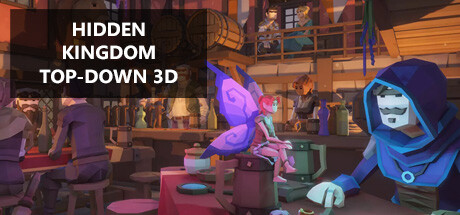
Hidden Kingdom Top-Down 3D is a minimalist hidden-object experience that commits fully to its core idea: slow, careful observation in compact, top-down 3D environments. Developed by Top-Down Games and published by Hede, it strips the genre down to its essentials, offering a series of self-contained scenes where the primary challenge is simply learning how to see. There is no overarching narrative, no character progression, and no mechanical twists layered on top of the formula, which makes the game feel intentionally modest but also very clear about what it wants to deliver.
The gameplay loop is straightforward and instantly understandable. Each level presents a fixed 3D environment viewed from an overhead perspective, along with a list of objects that must be found within the scene. Items are placed directly into the environment rather than floating unnaturally on top of it, often blending into architecture, props, or decorative clutter. Success depends on scanning patiently, recognizing shapes and colors, and mentally separating meaningful objects from background detail. The absence of timers or penalties creates a relaxed pace, encouraging players to take their time rather than rush toward completion.
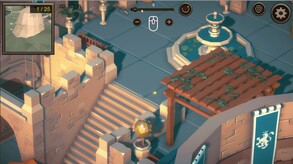
The use of a top-down 3D perspective is one of the game’s defining features. Unlike traditional 2D hidden-object games, depth and spatial arrangement play a larger role in how objects are concealed. Items may be partially obscured by geometry, tucked along edges, or visually merged with similar textures in the environment. This perspective gives scenes a diorama-like quality, making each level feel like a small model world to be examined from above. While the camera remains fixed, the added depth helps differentiate this experience from more flat, illustrated hidden-object titles.
Visually, the game is functional rather than expressive. Environments are built with enough detail to support object concealment but rarely aim for visual spectacle. Textures, lighting, and props are serviceable and consistent, creating readable scenes without overwhelming the player. This restraint works in the game’s favor, as overly elaborate visuals might obscure the core objective. The lack of animation or environmental interaction reinforces the static, puzzle-like nature of the experience, keeping attention squarely on observation rather than immersion.
Mechanically, Hidden Kingdom Top-Down 3D does very little to complicate the formula, which will be a positive or negative depending on player expectations. Controls are limited to basic mouse input, with clicking being the sole interaction method. There are no power-ups, hint systems with trade-offs, or alternate modes that significantly alter play. This simplicity makes the game extremely accessible, but it also means that the experience remains largely the same from the first level to the last. Any sense of progression comes from the player becoming better at spotting patterns rather than unlocking new mechanics.
Replay value exists primarily through object randomization and player self-improvement. While environments themselves do not change dramatically, object placement and selection can vary between sessions, allowing familiar scenes to feel slightly different on repeat visits. However, the appeal of replaying levels depends heavily on how much enjoyment a player derives from visual search alone. Those who find satisfaction in honing attention to detail may enjoy revisiting stages, while others may feel they have seen everything the game has to offer after a single pass.
Audio design is minimal and unobtrusive, serving more as background presence than as a defining feature. Sound effects provide basic feedback when objects are found, reinforcing success without drawing focus away from the visuals. Music, where present, is understated and repetitive, matching the calm, low-pressure tone of the gameplay. This restrained audio approach complements the game’s overall design philosophy, which prioritizes quiet concentration over stimulation.
Community reception reflects the game’s narrow but clear appeal. Players who enjoy hidden-object games often appreciate its simplicity, low commitment, and relaxed pacing, especially as a short diversion rather than a long-term engagement. Criticism tends to focus on repetition, lack of variety, and the absence of deeper systems or narrative motivation. These concerns are valid, but they stem more from the game’s deliberate minimalism than from poor execution.
Ultimately, Hidden Kingdom Top-Down 3D is a game that succeeds by not overreaching. It does not attempt to redefine the hidden-object genre or blend it with complex mechanics, instead offering a clean, focused experience built around visual awareness. For players looking for a calm, uncomplicated way to test their observational skills, it provides exactly that. For those seeking story, innovation, or mechanical depth, it may feel too barebones. Within its chosen scope, however, it delivers a consistent and quietly satisfying experience that knows its audience and stays true to its intent.
Rating: 5/10