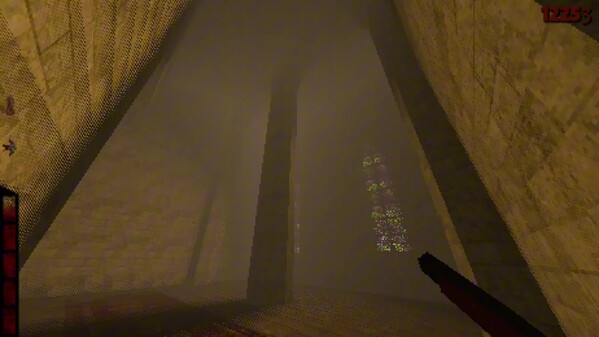
Hepatomancy, developed and published by Etrusca Games, is an indie first-person roguelike shooter that embraces repetition, uncertainty, and atmosphere as its defining strengths. From the moment players step into its shifting temple complex, the game establishes a sense of ritualistic descent, where each run feels like both an experiment and a test of endurance. Rather than guiding the player through a tightly scripted journey, Hepatomancy thrives on unpredictability, asking players to learn its systems through repeated failure, adaptation, and gradual mastery.
The core gameplay loop revolves around procedurally generated temple floors that rearrange themselves with every run. Rooms connect in unfamiliar ways, secrets appear or vanish, and enemy placements ensure that no descent unfolds exactly like the last. This structure gives the game a strong roguelike identity, encouraging players to treat each attempt as a temporary expedition rather than a linear campaign. Progress is measured less by narrative milestones and more by mechanical understanding—learning enemy behaviors, recognizing room patterns, and deciding when to push forward or retreat. The constant tension between curiosity and survival gives exploration a meaningful weight, as every choice carries potential consequences.
Combat is fast and reactive, leaning into classic first-person shooter fundamentals rather than complex ability systems. Movement, positioning, and aim are critical, especially as enemy encounters become denser and more aggressive deeper into the temple. Weapons and items discovered along the way can drastically alter how a run unfolds, introducing temporary advantages or risky trade-offs that demand on-the-spot decision-making. Some runs feel empowered and fluid, while others are defined by scarcity and desperation, reinforcing the roguelike philosophy that adaptation matters more than consistency. Death, while frequent, rarely feels pointless, as each failed run contributes to the player’s growing familiarity with the game’s rhythms and dangers.
Aesthetically, Hepatomancy leans into a dark, esoteric atmosphere that complements its mechanical design. The temple environments feel ancient and oppressive, blending gothic architecture with surreal elements that suggest forgotten rituals and arcane practices. While the visuals are not highly detailed by modern AAA standards, they are cohesive and purposeful, creating spaces that feel ominous rather than generic. Lighting, shadow, and environmental repetition are used intentionally, reinforcing the sense that the player is trapped in a place governed by strange, unknowable rules. The soundtrack and ambient audio further enhance this mood, providing an understated but persistent sense of unease that accompanies each descent.
Narratively, the game takes a restrained and indirect approach. Lore and thematic context are implied through environment, enemy design, and item descriptions rather than explicit storytelling. This makes the world feel mysterious and open to interpretation, but it can also leave players craving clearer narrative anchors. Those who enjoy piecing together meaning from fragments will appreciate the subtlety, while players seeking a more structured story may find the experience emotionally distant. The emphasis remains firmly on atmosphere and mechanics rather than character development or plot progression.
Despite its strengths, Hepatomancy shows signs of its indie scale. Certain rooms and encounters can feel uneven in pacing or challenge, and some mechanics—particularly movement-related actions—can feel inconsistent or underpolished. These rough edges occasionally disrupt the otherwise engaging flow, reminding players that the game is still refining its identity. However, these issues rarely undermine the core appeal, especially for players already accustomed to the imperfections common in experimental roguelike titles.
In the end, Hepatomancy is a game built for players who enjoy learning through repetition and embracing uncertainty. Its blend of first-person shooting and procedural design creates a loop that is tense, demanding, and often rewarding, especially for those willing to invest time into understanding its systems. While it may lack the narrative clarity or polish of larger productions, it compensates with atmosphere, replayability, and a clear design vision. For fans of action-focused roguelikes who value emergent experiences over scripted progression, Hepatomancy offers a compelling descent into the unknown.
Rating: 6/10