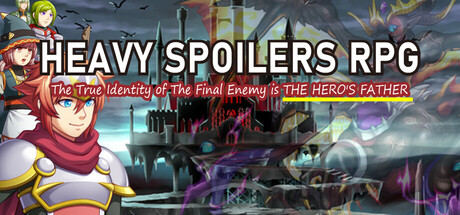
People across the kingdom are vanishing. Young hero Harold Sageblood is ordered by the king to defeat the mastermind behind it all. Joined by the loyal mage Martha Bethraeor, the hero sets out—seeking answers about his missing father and the truth behind the disappearances.
Revenue comes from in-game items and microtransactions, which our price-based model doesn't estimate. Copies below reflect the player base, not paid sales.
Media

About
A smash-hit RPG with over 25 million Let's Play views is finally coming to Steam!
A story so moving you’ll be moved to tears even though the characters and dialogue try to spoil the story!
Flip your expectations on their head in this narrative-driven RPG!
Story-focused! Even with massive spoilers, the emotional impact hits hard.
Unforgettable Characters! Meet the mage Marcia Uragir and the ominous Demon Lord Yu Sha-No-Chiichi, who both have very obvious secrets!
An Adventure You Can’t Put Down! You might think you figured everything out, but the emotional journey will keep surprising you.
People across the kingdom are vanishing without a trace.
The young hero, Harold Sageblood, is ordered by the king to find and defeat the mastermind behind the disappearances.
Joining the hero is the ever-loyal mage Marsha Betraeor—who promises she’ll definitely never betray Harold.
Also, what happened to Harold’s father after he set off on his own journey?
Surely there’s no connection to the disappearance of Harold’s father and the man the king claims is responsible?
The shocking truth revealed at the climax will leave you speechless!
Players who love story-driven RPGs
Those looking for both laughter and tears
Fans of unexpected twists and emotional payoffs
Anyone curious about a game where spoilers make the journey even better!
Embark on this unforgettable adventure today!
Genres
Stats
Languages: English, Japanese*, Korean, Spanish - Spain*languages with full audio support
Engagement
Reviews
Themes across 44 recent reviews and how positive each mention is. A keyword signal, not full sentiment analysis.
Reviews
コテコテギャグすき
Heavy Spoilers RPG: The true identity of the final enemy is the hero’s father is a comedy RPG that sounds like a joke long before the game even begins, yet somehow manages to become far more emotionally engaging and cleverly written than its absurd title suggests. The game openly reveals what would normally be the biggest twist in a traditional role-playing story, constantly spoils future events, and repeatedly mocks familiar RPG clichés from the very start. Despite this, the experience still succeeds at creating emotional investment, memorable character moments, and genuine suspense. What initially appears to be nothing more than a parody slowly transforms into a surprisingly heartfelt adventure that understands storytelling far better than many more serious RPGs. The story follows Harold Sageblood, a young hero setting out on a classic fantasy journey involving disappearances, dangerous enemies, mysterious conspiracies, and world-threatening conflict. Accompanying him are companions whose names and dialogue practically reveal their secrets before players even spend time with them. The game constantly spoils itself through exaggerated foreshadowing, obvious hints, and direct references to events that would normally remain hidden until the climax. However, this becomes the central joke and also the game’s greatest strength. Instead of building tension through surprise revelations, the narrative focuses on emotional context, character motivations, and the journey leading toward those already-revealed outcomes. What makes the writing surprisingly effective is the sincerity hidden underneath the nonstop humor. The game constantly pokes fun at traditional JRPG storytelling conventions, but it never feels cynical or mean-spirited toward the genre it parodies. In fact, the developers clearly have genuine affection for classic role-playing games. The comedy works because it comes from understanding these tropes intimately rather than simply mocking them from a distance. As the story progresses, several emotional moments land unexpectedly well because the characters gradually become more than simple punchlines built around exaggerated names and obvious twists. The central concept also becomes far smarter than expected. Players initially assume the joke will lose its impact quickly since the game openly reveals major story information in advance. Instead, the narrative constantly finds creative ways to subvert expectations. Knowing the ending does not remove emotional tension because the game shifts focus toward understanding why events happen rather than simply waiting for plot twists. In many ways, the experience becomes a commentary on storytelling itself, proving that emotional investment depends more on character development and execution than surprise alone. Gameplay follows a familiar RPG Maker formula with turn-based battles, dungeon exploration, equipment management, and party progression. Mechanically, the systems are intentionally straightforward and inspired heavily by classic Japanese RPG design. Combat is simple during the early portions of the game, allowing players to focus primarily on dialogue and story progression. However, later encounters and optional battles introduce more strategic complexity, requiring proper skill management and party preparation. While the gameplay systems themselves are not revolutionary, they remain polished and satisfying enough to support the narrative effectively. The pacing is another major strength. Heavy Spoilers RPG avoids becoming bloated by keeping the adventure relatively short and tightly focused. The humor remains fresh because the game continuously introduces new variations on its central gimmick rather than endlessly repeating the same joke. Emotional scenes, comedic dialogue, and gameplay progression are balanced well enough that the experience rarely feels repetitive despite its heavily self-aware premise. Visually, the game embraces classic RPG Maker aesthetics without trying to disguise its inspirations. Pixel-art environments, familiar interface design, and traditional overhead exploration all contribute to the nostalgic atmosphere. Instead of feeling cheap or lazy, the presentation works because it complements the parody perfectly. The game constantly references old-school fantasy RPG conventions, and the retro visual style helps reinforce that connection naturally. The soundtrack and voice acting also add a surprising amount of personality to the experience. Music shifts effectively between comedic energy and emotional sincerity depending on the tone of each scene. Several voice performances help elevate the humor considerably, especially during moments where characters dramatically react to situations that players technically already know will happen. These performances help the cast feel more memorable and expressive despite the intentionally exaggerated writing style. One of the most impressive aspects of the game is how attached players can become to the characters despite the constant meta humor. Several relationships evolve naturally over the course of the adventure, and by the later portions of the story, certain emotional moments carry genuine weight. The game never abandons its comedic identity, but it also understands when to slow down and allow character interactions to feel sincere rather than purely satirical. The game is not without flaws, however. Players who dislike RPG Maker presentation or traditional turn-based combat may struggle to enjoy the gameplay systems. The humor also relies heavily on meta commentary and repeated spoiler jokes, which may not appeal to everyone equally. Some players may find the pacing uneven during longer dialogue-heavy sections, while others could feel the combat lacks depth compared to larger modern RPGs. Certain late-game battles also become unexpectedly difficult compared to the relatively casual tone of the earlier adventure. Even with these issues, Heavy Spoilers RPG succeeds because it fully commits to its bizarre concept while still delivering a surprisingly genuine emotional experience underneath the parody. The game constantly jokes about storytelling conventions while simultaneously proving why those conventions remain effective when handled with sincerity and strong character writing. Heavy Spoilers RPG: The true identity of the final enemy is the hero’s father is far more intelligent and emotionally engaging than its ridiculous title initially implies. Beneath the constant jokes, obvious spoilers, and exaggerated self-awareness lies a genuinely charming RPG filled with memorable characters, heartfelt moments, and clever commentary about storytelling itself. It succeeds both as a parody of classic RPG traditions and as a legitimately entertaining adventure in its own right. Rating: 9/10
Related
Related
Trends
Concurrent players on Steam, sampled daily since tracking started.
Hours played at review time, across 44 reviews with recorded playtime.
positive critical· bar length = how often the theme comes up
For a game that spoils final reveal in it's title, it still managed to have plenty of unexpected moments. It's really entertaining story, even if it's quite short. Characters were great. I also really enjoyed humour, it made me giggle on multiple occasions. Even if it was paid game, I would buy it. Highly recommend.
플롯 짜임새가 좋다 ㅋㅋ 전투는 좀 쓸데없이 지루했음. 전투가 중요한 게임이 아닌데, 똑같은 패턴으로 5분씩 반복하고 앉아있자니 힘들더라.
There is not really too much to say. This game has a fun idea is both great in its execution and in putting a twist on the concept. The gameplay itself is very standard RPG-Maker combat, so completely serviceable. I can't really say more without spoiling (yes, I know) it. Just get it. It's free and like 2 hours long.
Tremendo, me alegra no haberme spoileado este juego
top ten games of all time
Este juego merece tener una versión novelizada, un anime, una película y que el autor se lleve un muchillón de dineros para que siga haciendo obras maestras como esta.
정말 잘 만든 이야기였다... 이야기를 잘 쓴다는건 이런걸 두고 하는 말이구나...
全程配音很生草,完全想象不到的神展开,而且居然还有第二部!
Audience
Estimated from the language of this game's reviews — a proxy for where players are, not official Steam demographics.