Math and Mayhem: A Love Letter to Graphwar II
I first heard about Graphwar II from my friend Simon W, who I’ve known since high school. Simon’s a great guy, he’s the kind of friend who’d help you move without asking for pizza in return. But when it comes to math, well… let’s just say he’s as mathematically gifted as a goldfish attempting calculus.
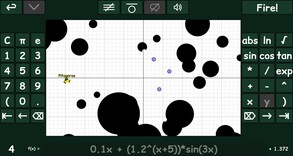
Simon and I spent countless hours playing the original Graphwar, an underrated gem of an artillery game. It became our go-to when we were looking for something quick, challenging, and genuinely fun. The premise was deceptively simple: take aim at your enemies by plotting mathematical functions and use your brainpower to dodge obstacles and rain destruction upon your foes, all in a 2D Cartesian plane. For math enthusiasts, it was like eating candy, but for Simon, it was like taking a trigonometry test with no calculator. Still, he loved it.
Then Graphwar II dropped. Naturally, I bought it immediately, and it wasn’t long before Simon and I dove headfirst into the new campaign mode. To say that this sequel is an upgrade would be the understatement of the century. The modern UI alone makes the experience much smoother and more polished. Gone are the days of awkward controls and clunky interface designs. This time around, everything feels intuitive and sleek, almost as if the game itself is a finely tuned mathematical equation that solves for fun.
First Impressions: A Game for Both Veterans and Newcomers
Simon, bless his mathematically-challenged heart, was initially wary of Graphwar II. He remembered all too well the frustration of trying to hit an enemy tank with an errant parabola that sent the missile into the sky instead. But right from the start, we noticed something: Graphwar II does a brilliant job of catering to both veterans of the series and complete newcomers. The tutorials are well-paced and offer easy entry for someone like Simon, who still thinks “sine” is what you do when you want to leave a restaurant early. The new “Beginner” game mode gently introduces core mechanics without sacrificing the joy of calculating your perfect shot.
The deeper campaign mode was a revelation. The original Graphwar was more like a playground for creativity and strategy, but Graphwar II took it a step further with a full single-player campaign. You go up against progressively difficult maps, each with increasingly complex obstacles and terrain to navigate. Each level is like a puzzle, one that’s as satisfying to solve as nailing a wristshot top shelf where your mother keeps the peanut butter, but with the added bonus of blowing something up at the end.
And the customizability? Man, don’t get me started. Graphwar II lets you deck out your character in a ridiculous number of ways. Want a top hat on your artilleryman? Done. Want to dress them up like a math professor with glasses and hair like Einstein? Done and done. Simon, ever the goofy one, made his character look like Albert Einstein. I, of course, went with a more elegant look, like a regal general surveying the battlefield. The ability to customize adds a layer of personality to the game that the original never quite captured. It’s a small but delightful detail that keeps me invested in every battle.
The Replays: Watching Our Glorious (and Hilarious) Failures
Now, let me tell you about one of Graphwar II's best new features: replays. Oh boy, this has added so much to our game nights. Every victory, every catastrophic failure, every near-miss, all of it can be watched again and again, like sports highlights for nerds. And Simon? Oh, he’s become the star of our replays.
One memorable match had Simon calculating the arc of his shot for what felt like an eternity. He’d input a hyperbolic tangent function, completely unaware that he’d forgotten to adjust for the wind. I watched as his missile went flying straight up, only to come crashing down directly onto his own tank. The replay was like a slow-motion car crash, painful, but impossible to look away from. We must have watched that replay 20 times, and every single time, Simon muttered, “I don’t know what happened.”
I know, Simon. I know.
But the thing is, even though Simon regularly fumbles with functions, he never gets frustrated. And that’s a testament to the charm of Graphwar II. The game strikes the perfect balance between learning and chaos, precision and pure dumb luck. Even when you screw up (which, let’s be honest, happens a lot in a game where you’re literally writing equations), it’s still fun.
Multiplayer Madness: The True Test of Friendship
Now, let’s talk multiplayer. Graphwar II has really stepped up its game in this area. Whether you’re playing against friends or strangers online, the matches are quick, strategic, and often hilarious. Simon and I joined a 4-player match with two other friends, and the sheer unpredictability of it made every round feel fresh.
One of the new features we really enjoyed was the option to form teams. Naturally, Simon and I were put together. The goal? Defeat our opponents while avoiding friendly fire. I can’t count the number of times Simon “accidentally” aimed a projectile straight at me instead of the enemy, blaming it on some “weird cosine thing.” But that’s part of the charm, every shot is a gamble, and every mistake is a new lesson (and usually good for a laugh).
Despite his frequent mathematical blunders, Simon slowly started getting the hang of it. He learned how to adjust for the environment, tweak his angles, and even incorporate the wind into his calculations. I was genuinely proud of him. It wasn’t long before he landed a perfect sine-wave shot that arced beautifully over a hill and exploded right on target. The look of triumph on his face when we watched that replay? Priceless.
The Verdict: A Sequel That Delivers and Then Some
By the time we’d logged our first 20 hours in Graphwar II, it was clear to me that this game was something special. It takes everything that made the original great and builds upon it with smart new features, a more polished interface, and greater accessibility for players like Simon, who might not know their sine from their cosine but still want to blow things up with math.
But Graphwar II is more than just a math game. It’s a perfect blend of strategy, creativity, and pure fun. Whether you're a seasoned veteran looking for a challenge or a newcomer just dipping your toes into the world of graph-based artillery, this game has something for you. The replayability is off the charts, literally and figuratively and the new campaign mode offers hours of solo entertainment if you prefer to play alone.
For Simon and me, Graphwar II has become a new obsession. Sure, he still occasionally lobs a projectile at his own team, and I still mock him mercilessly for it, but there’s something so delightfully human about our experience with the game. It’s a testament to how video games, even ones with Cartesian planes and mathematical functions, can bring people together through laughter, frustration, and those rare moments of victory.
So, if you’re thinking about picking up Graphwar II, do it. Whether you’re a math whiz or someone like Simon, who still has nightmares about high school algebra, you’ll find something to love in this charming, quirky, and endlessly fun game. After all, who knew math could be so explosive?