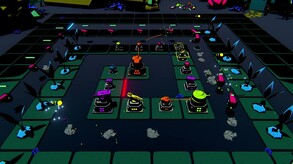
Test your luck in an off-world colony where farming meets tower defense. Protect your homestead with randomized turrets while you fish for resources, complete quests, and grow crops while carefully selling them as prices shift each wave.
Modeled estimate, not a reported figure. How we estimate →
Media

About
In GILTSTEADER, you must adapt and survive against an uprising of rogue agricultural drones. Each turret you deploy or upgrade is a roll of the dice, so you will be battling against chance as you face 40 waves of increasingly formidable enemy drones. Strategically choose where you place your turrets, which ones you keep, and which ones you upgrade.

Test your ability to time the market as you grow and sell crops to afford better defenses. Prices fluctuate every wave, and selling too soon or too late could cost you everything. Will you hedge your bets with different crops, or master one to boost its sell value?

There's never a dull moment in this colony. Complete quests and summon test drones to earn seeds for your crops, go fishing in the serene rivers for various resources, and invest and grow your money in a 401K for the final boss, all while trying to survive. No two games are the same, and it's up to you to overcome the odds.

Controller support
Six replayable maps
An interactive tutorial
Ultrawide support
38 Steam achievements
Crowd Control integration
Stats
All-time low is the lowest price we've recorded for this game since we started tracking it.
Languages: English
Engagement
Hours played at review time, across 23 reviews with recorded playtime.
Reviews
This game is a great way to challenge yourself and enjoy a solid tower defense game with a great artistic style highly recommend!
https://www.youtube.com/watch?v=cf7wfuf1VhM&ab_channel=HiddenGemsIndieRetroGamer https://store.steampowered.com/curator/44794427-Tower-Defense-games-rated/
This is slot machine: the tower defense. So much of this game is based on random chance that it's incredibly hard to develop any kind of strategy. Two of the same type of towers combining into a random upgraded tower means suddenly a tower that was doing well can be turned into something completely useless. The only way to move towers to try to fix this is at max rank and is so expensive it's not even worth it. How much things sell for changes every round so there's the illusion of strategizing money, but really it just means you get random money every round and can't plan towers well. I think a script that randomly places and upgrades towers would do about as well as I could, and if automating randomness is just about as effective, what's the point in playing?
Really fun! Definitely a unique take on the age-old tower-defense genre. I think it brings interesting opportunities to what would otherwise be a pretty boring mid-game (like you typically associate with TD games). Instead of just kind of sitting there waiting for the wave to be over, you have some simple tasks to complete with rewards for your efforts. The little changes in the economy also reward you for leaving the speed a bit lower and paying closer attention to everything that's happening, which is a refreshing change to TD games where you're usually just wishing for like a 16x fast forward button. Further, I think the random towers thing is a divisive but smart choice for this game. With other TD games you often feel like you're either making all of the WRONG choices when you're losing, or like you're kind of cheesing the game when you find a winning strategy. I think that choosing to take that choice out of the player's hands forces the player to not spend every moment trying to strategize 10 choices ahead, and instead roll with the punches and plan where possible. All in all I think it's a very novel remix of a very old formula, that ultimately makes the genre feel cool and refreshed. Nice work!
Too random to be much fun. There is a such thing as overdoing a gimmick, and this game is a prime example. It is also a great example of over complicating things for no reason. Just a small example: Get the tower you want? Well, you better not like it too much because it randomly changes every time you upgrade it as well. Those 10% damage bonuses? Don't go crazy buying them b/c the chances of you having those towers at T6 when you need them are slim to none. Go back to the drawing board. Remove the reroll of tower types when you upgrade, get rid of the seed mechanic and the fishing entirely, and just focus on making a fun tower defense game.
[b]Un defensa de torres cortico y disfrutable[/b] [i]Por el momento el juego me ha gustado bastante, y más su aspecto visual simple; aún no le veo estrategia alguna ya que cuenta mucho con factor suerte, también tiene algo de gestión de recursos y un poquito de farmeo. Por el momento el juego esta totalmente en inglés, lo que para algunos es un problema a la hora de jugarlo pero si logras entender el tutorial ya sabrás lo básico de como jugarlo y pronto empezar a colocar torretas a lo loco.[/i]
Basically Random Farm TD from Dota 2.
The randomness is not fun there is no strategy involved here
Farming and TD in one. :)
GILTSTEADER is a genre-blending strategy title developed and published by Lessermore that sets out to fuse tower defense, farming simulation, and economic management into a single, distinctly experimental experience. Set on a hostile off-world colony, the game casts players as settlers attempting to protect their homestead from waves of malfunctioning agricultural drones while simultaneously managing crops, markets, and long-term financial decisions. Rather than offering a conventional or tightly controlled strategic framework, GILTSTEADER leans heavily into uncertainty and adaptability, asking players to juggle planning, improvisation, and risk management at every stage of play. At its core, the game revolves around defending your base against recurring enemy waves, but the way it approaches tower defense is deliberately unconventional. Instead of carefully curated tech trees or predictable upgrade paths, turrets and their upgrades are largely randomized. Each placement and enhancement is something of a gamble, forcing players to make decisions with incomplete information. This design choice fundamentally changes the nature of strategy: success is less about executing a perfected plan and more about reacting intelligently to what the game hands you. When a powerful turret roll aligns with smart positioning, the result feels exhilarating; when luck turns against you, survival becomes a tense scramble that tests adaptability rather than rote optimization. Running parallel to the defensive gameplay is a surprisingly involved farming and market system. Players grow crops not simply for passive income, but as a key strategic resource that must be sold at the right time. Crop prices fluctuate between enemy waves, turning the market into a risk-reward puzzle of its own. Selling too early may deprive you of funds needed for emergency defenses, while holding out for better prices risks being overwhelmed without sufficient firepower. This economic layer adds genuine weight to decisions outside of combat, making preparation between waves just as important as turret placement during an attack. Beyond crops and turrets, GILTSTEADER layers in additional systems that further complicate long-term planning. Side activities such as fishing offer alternative resource streams, while optional quests and upgrades provide small but meaningful advantages. One of the more unusual mechanics involves long-term financial planning, culminating in a climactic encounter tied to how well players have managed their resources over the course of a run. These systems reinforce the game’s central theme: survival is not just about firepower, but about managing an entire ecosystem of decisions that compound over time. The game unfolds across multiple maps, each with its own layout and defensive challenges. Terrain, chokepoints, and available space all influence how turrets can be deployed and how enemies approach your base. Because so many systems are randomized, each playthrough feels distinct, even on familiar maps. This variability significantly boosts replay value, particularly for players who enjoy experimenting with different approaches and learning how to mitigate bad luck through positioning and timing. However, it also means that some runs can feel dramatically more difficult than others, depending on how randomness unfolds. Visually, GILTSTEADER adopts a stylized sci-fi aesthetic that blends pastoral farming imagery with industrial defense technology. The contrast between peaceful crop fields and hostile mechanical invaders reinforces the game’s thematic identity as a frontier survival story. The art style prioritizes clarity over extravagance, ensuring that critical information about enemies, turrets, and resources remains readable even during hectic moments. Sound design complements this balance, shifting between calmer tones during farming and sharper, more urgent cues during combat waves. The pacing of the experience can feel uneven, but this is largely by design. Quiet planning phases encourage careful thought and risk assessment, while enemy waves arrive as sudden stress tests of those decisions. For some players, this ebb and flow creates a compelling rhythm that keeps tension high; for others, the reliance on randomness may feel frustrating, particularly when a well-planned strategy collapses due to unfavorable turret rolls or market fluctuations. The game makes no attempt to fully smooth these edges, embracing unpredictability as a defining feature rather than a flaw to be corrected. Community reception reflects this divisive but intriguing design philosophy. Many players praise GILTSTEADER for its originality and the way it forces them to think across multiple strategic layers at once. Others are more critical of the randomness, arguing that it sometimes undermines skill and planning. Both perspectives highlight the same truth: this is not a traditional tower defense game, and it demands a mindset willing to accept uncertainty as part of the challenge rather than an obstacle to mastery. Ultimately, GILTSTEADER stands out as an ambitious and unconventional strategy experience that refuses to play it safe. By blending farming economics, randomized defense systems, and long-term planning into a single loop, it creates moments of genuine tension and satisfaction that feel different from more predictable genre offerings. While its experimental nature means it won’t appeal to everyone, players who enjoy adaptive strategy, risk-laden decisions, and systems that interact in surprising ways will find a thoughtful and memorable experience beneath its rougher edges. Rating: 5/10

Related
Related
Trends
Modeled estimate over time, reconstructed from Steam's monthly review histogram.
Momentum
Pace estimated from the game's recent review growth (our daily snapshots) at its own sales-per-review ratio — a momentum signal, not booked sales.
Audience
Estimated from the language of this game's reviews — a proxy for where players are, not official Steam demographics.
Related
| Cities: Skylines | $203.5M | 290.9K | 93% | $29.99 |
| Planet Coaster | $109.4M | 72.1K | 91% | $44.99 |
| Bloons TD 6 | $88.4M | 391.8K | 97% | $13.99 |
| Jurassic World Evolution | $74.6M | 55.2K | 87% | $44.99 |
| Jurassic World Evolution 2 | $71.1M | 46.8K | 90% | $59.99 |
| House Flipper | $58.4M | 92K | 94% | $24.99 |
Related
| Knight's Retreat | $3.7K | 98 | 91% | $2.99 |
| BandRoll | $3.7K | 104 | 87% | $1.99 |
| Shy Dogs Hidden Orchestra | $3.7K | 53 | 98% | $4.99 |
| Do You See the Waving Cape | $3.7K | 53 | 75% | $4.99 |
| Arcane Golf | $3.7K | 64 | 97% | $2.99 |
| WarDogs: Red's Return | $3.7K | 55 | 87% | $2.99 |