
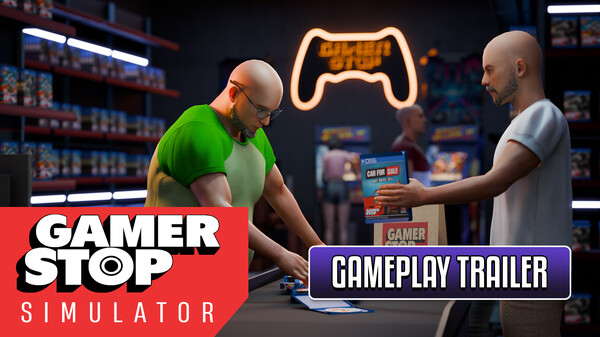
Gamer Stop Simulator is a simulation game where you manage a video game store. Buy games and consoles from customers, repair broken devices, test games, and add rare items to your collection. Negotiate prices, expand your store, and grow your business in this exciting retail experience!
Revenue comes from in-game items and microtransactions, which our price-based model doesn't estimate. The player count below is how many people own it, not what they spent.
About
Gamer Stop Simulator: Prologue is the first step in your journey, starting with just a few old games and limited cash. In this preview version, you’ll begin restoring a forgotten shop, stocking shelves, and making your first sales. Advanced features will be available in the full version.
Host garage sales, take part in collector events, and decide your store’s future: will it be a massive marketplace, or a boutique museum of gaming history?
Deal with collectors, bargain hunters, and nostalgic gamers. Some just want a cheap game, others bring in boxes of hidden gems for you to inspect. Negotiate hard or miss out on rare finds.
Use your diagnostic tools to find and fix hardware issues. As your skills grow, you’ll identify deeper problems, lower repair costs, and boost resale value. Everything from cosmetic damage to deep internal failures awaits your expertise.
Open and close your store manually. Clean, organize, and decorate your space to attract more customers. Expand your business, unlock new areas like repair zones or testing stations, and customize your store layout.
Whether you prefer hands-on retail gameplay or earning passive income through online sales and rentals, Gamer Stop Simulator supports your style. Just don’t neglect your store—dusty shelves and unhappy customers mean bad reviews and lost revenue.
Shop Management
Inventory and Product Management
Customer Interaction
Negotiation and Pricing System
Repair and Testing Mechanics
Financial Operations and Expense Tracking
Decoration and Store Expansion
Add to Your Wishlist Now and Be Among the First to Play!
Add Gamer Stop Simulator: Prologue to your wishlist now and be among the first to experience it!
Genres
Stats
Languages: English, Italian, Spanish - Spain, Simplified Chinese, Korean, Polish, Russian, Turkish, Ukrainian, Japanese, French, German
Engagement
Reviews
Themes across 48 recent reviews and how positive each mention is. A keyword signal, not full sentiment analysis.
Reviews
konsol oyun oki doki dostlar
Dość mało contentu, powtarzalny, gra pobugowana
great game for graphics, timepass, and asthetic
Media

Related
Related
Price dynamics, follower growth, revenue and sales trajectories with interactive tooltips
This and every other Pro feature is free until October 20, 2026. A free account is all it takes.
Hours played at review time, across 48 reviews with recorded playtime.
positive critical· bar length = how often the theme comes up
иишное говно, оптимизация говна, задумка норм
прикольная игрушка чисто пофанится топ но надо ее развевать и не забрасывать разработки
Gamer Stop Simulator: Prologue offers a focused introduction to the fantasy of owning and developing a video game store. Developed and published by Red Axe Games, this free prologue starts players with a modest amount of money, a neglected shop, and only a small selection of products. Instead of immediately handing over a thriving business, it makes progress something that must be earned through buying, selling, repairing, organizing, and gradually improving the store. The limited starting conditions work well because even relatively small upgrades feel meaningful during the early stages. The strongest aspect is the variety packed into its central retail loop. Customers can arrive looking to purchase products or sell their own games, consoles, and collections. Negotiation makes these encounters more involved than simply clicking a predetermined purchase button. Players must consider whether an asking price leaves enough room for profit and whether a potentially rare item is worth taking a financial risk. Collectors, bargain hunters, and nostalgic customers also fit the gaming-store theme nicely, helping the shop feel more specialized than a generic supermarket simulator. Repairing hardware gives the economy another enjoyable layer. Damaged consoles and devices can potentially become profitable investments after they are diagnosed, repaired, and tested. As diagnostic abilities improve, more complicated faults can be discovered while repair costs become easier to manage. This creates a satisfying connection between technical work and business management. Buying a damaged product cheaply, restoring it, and eventually selling it for a better price can be more rewarding than simply purchasing ordinary inventory and placing it on a shelf. Store management provides plenty of smaller responsibilities to keep the player occupied. Shelves need to be organized, products managed, prices considered, and the shop kept clean. Players manually control the opening and closing of the business while decorations and layout adjustments allow some personalization. Expansion promises additional areas such as repair zones and testing stations, making improvements useful rather than purely cosmetic. Poor maintenance can also hurt the business, since dirty shelves and unhappy customers can negatively affect reputation and revenue. There is also a pleasant collecting element beneath the financial simulation. Rare games and unusual pieces of gaming hardware can become part of a personal collection rather than simply another source of cash. Garage sales and collector-oriented activities reinforce this direction and suggest two different philosophies for developing the business. A player might concentrate on building a large commercial store designed around maximum sales, while someone else may prefer creating something closer to a boutique filled with gaming history. This flexibility gives the basic economic mechanics more personality. The game also tries to accommodate different approaches to progression. Players who enjoy constant interaction can spend their time dealing with customers, negotiating, repairing equipment, rearranging merchandise, and improving the shop. More passive systems such as online sales and rentals provide alternative income opportunities. Financial management remains important because expansion and purchasing decisions require sensible use of limited resources. Spending aggressively on questionable merchandise can slow progression, while carefully chosen investments can make the business increasingly profitable. Its presentation complements the subject matter effectively. The first-person perspective makes inspecting products, moving around the shop, and physically maintaining the business feel more immediate. Colorful merchandise and gaming-related objects gradually transform an initially unimpressive location into a more convincing specialty store. Watching shelves become populated and previously unused areas gain a purpose creates the visual progression that management simulators benefit from. The most significant drawback is simply its status as a prologue. It demonstrates the foundation of a potentially deeper simulator rather than providing the complete range of features associated with the full game. Players who enjoy the early progression may therefore find themselves wanting more advanced expansion, management, collecting, and repair options. Some activities can also become repetitive because much of the experience depends on repeating familiar retail tasks. Nevertheless, the free entry point makes its restricted scope reasonable and allows players to experience the fundamental gameplay before deciding whether the broader concept appeals to them. Steam Deck compatibility is currently best regarded as Unverified. The Steam listing does not provide an official Steam Deck Verified or Playable classification, and the game is officially listed for Windows. Its first-person interactions and relatively modest PC requirements suggest that experimentation through Proton may be possible, but performance, controls, interface readability, and overall stability should not be treated as officially guaranteed. Players specifically purchasing or playing for Steam Deck use should therefore expect that configuration or troubleshooting may be necessary. Overall, Gamer Stop Simulator: Prologue combines retail management, bargaining, collecting, hardware repair, customization, and gradual business expansion into an appealing introductory package. Its individual systems reinforce one another particularly well, since buying products leads into repairs or collecting, repairs create resale opportunities, sales generate money for expansion, and expansion gives the player more ways to develop the store. Its limited prologue scope prevents it from achieving the depth of a fully developed business simulator, but the foundation is entertaining and provides a satisfying preview of the larger concept. Rating: 7/10
Super Laggy!!!
3.8 ч. за последние две недели / 3.8 ч. всего Написать обзор продукта Gamer Stop Simulator : Prologue Пожалуйста, опишите, что вам понравилось или не понравилось в этой игре, и порекомендовали бы вы её другим. Будьте вежливы и придерживайтесь правил и рекомендаций.
oyun güzel ama orjinal oyun bi tık pahalı olmuş yani beş dolar yerine 220 tl yerine bi üç dolar falan 140 tl olabilirmiş ama değmezmi değer geliştirmetye açık ve iyi bi oyun yapanın eline sağlık
оптимизация говно а так имба я бы хотел чтоб оптимизацию добавили нормальную ну и теперь про саму механику она имба все выгладит прикольно
Selling now
See how fast this game is selling right now — estimated copies and revenue per day from recent review growth.
Players by region
Where this game's players are, estimated from review languages.
Related
| Game | Estimated lifetime revenue | Reviews | Review score | Price |
|---|---|---|---|---|
| $142.3K | 324 | 72% | $12.99 | |
| $19.1K | 80 | 64% | $5.99 | |
| $0 | 1.6K | 65% | Free | |
| $0 | 464 | 88% | Free | |
| $0 | 112 | 59% | Free | |
| $0 | 759 | 89% | Free |