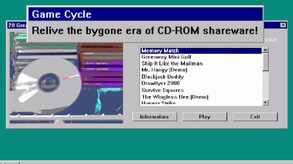
Relive the bygone era of CD-ROM shareware! As a recently-contracted games analyst, you are tasked by the CEO of Best Value Games to make sure the games set to be included in their upcoming release are up to code. How much you get paid depends on how much ground you cover!
Modeled estimate, not a reported figure. How we estimate →
Media
About
Stats
All-time low is the lowest price we've recorded for this game since we started tracking it.
Languages: English
Reviews
First off, I'd like to say I enjoyed playing this game. It's short and sweet, has a certain charm, and I had a good time. That being said, here's a review of every single mini-game on the computer from the point of view of the main character. Memory Match: A simple memory match game. And by simple, I mean SIMPLE. The images are near visual gibberish. Challenge Completion: I had to take a photo of each square to complete the first puzzle flawlessly. Overall: 3/10 Greenway Mini Golf: Oh, cool; a videogame! This time we're on the green, shouting "Fore!" and all that other stuff golfers do. Fun little game. Challenge Completion: Getting under the total par wasn't a big deal, but getting inside the castle, as far as I can tell, is impossible. I've tried it from multiple angles, and it isn't budging. Overall: 7/10 Ship It Like The Mailman: Are you ready for suffering? Because that's all this game has to offer you. Complete with touchy controls, unforgiving lives, unfair difficulty, and music that's so repetitive that it'd give a goldfish deja vu. Challenge Completion: This game's challenge is merely to complete it, which tests my patience just as much as my skill. Overall: 1/10 Mr. Hangy (Demo): If this is the demo, there's no need to purchase the entire game, as I've had my fill. A simple game of hangman with common phrase answers. Challenge Completion: Hardly difficult compared to the previous three games' challenges; you have to find all the solutions. Overall: 5/10 Blackjack Buddy: A gambler's fantasy, except this time, no money or stakes. Play a round of blackjack with an unknown dealer, or spam the various buttons until you win, whichever you prefer. Challenge Completion: So far, this is the only game where the required game time of 3 minutes is the tricky part, where the challenges can be achieved easily in the first minute of playing by mashing "HIT ME." Overall: 2/10 Drawifyer 2000: Be the artist you always dreamed you could be! Brush up on your painting skills with a wide variety of 9 colors on a white background. Click the erase button really fast if you feel a bit of eye strain could add to the fun. Challenge Completion: The only real challenge here is overcoming the bug that is "Use all colors to make a drawing." When this has happened, the challenge isn't marked as complete. Overall: 5/10 Survive Squares: Do you want to play a claustrophobic game of unforgiving hit detection as a triangle running away from squares only guided by the cold, uncaring hand of randomness? Well, I can tell you firsthand that Survive Squares is that game. Challenge Completion: It's not too hard to get more than 15 points if your dodges are good enough and your luck is blessed (My high score is 23). Overall: 6/10 The Wingless Bee: This is easily the most in-depth game thus far, as it has higher-quality music, all kinds of enemies, and even a boss battle, which caught me by surprise. The only complaint I have with it is that you can't move the bee as fast as you can tap the inputs. Challenge Completion: The completion marks weren't much of a challenge here, as it just asked to beat the game and pick up all the collectibles you see. Overall: 9/10 Hunger Strike: Ever wanted to play a game of Pac-Man where the ghosts didn't fight fair? Your wish has been granted. In this game, you'll be clipped around corners, spawn trapped, surrounded, and more. There is no sanctuary or solitude to be found here, no punches pulled. Completion Challenge: The point challenge was not that bad, and by the time I got 6000 points, I thought the game was fun. HOWEVER, I refuse to complete this game due to how awful it gets and how wonky of a port of Pac-Man this is. Legitimately made me more frustrated than Ship it Like the Mailman. Overall: 2/10 Number Crawler: A grid of numbers assigned randomly from 1-9; you pick a tile adjacent to you and slide across the board in that direction that many times and if you go off the board or a space you've been on, you lose. I'd rather play minesweeper. Challenge Completion: The point goal wasn't particularly tough to reach. Overall: 5/10 Balls at War 2: Install an auto clicker and click on some balls. A truly ballular experience to be had. Challenge Completion: I'm not sure if the auto clicker counts as cheating to get the best-ending text, but I don't care at this point. Overall: 8/10 Joseph's Plate Smasher: Toss your hat at plates. Avoid the red ones if you want a positive score, and only hit the red ones if you wish to have a negative score. If only Joseph and his hat could move a little more quickly. Challenge Completion: Both point goals weren't difficult to hit with a few tries. Overall: 6/10 Cascading Blocks: I hope you're ready for a version of Tetris with the most touchy, disagreeable controls you've ever experienced. Challenge Completion: Get a Tetris, and then play marathon mode for an unnecessarily long time. Overall: 4/10 Fifty Zeroes: Are you a mathematician who also happens to be a tire enthusiast? This game is for you. Count the number of zeroes in the numbers listed in scientific notation and jump over various obstacles. What fun. Challenge Completion: The challenge is to beat the game. Not much more to say here. Overall: 7/10 Slither: The simple game compilation wouldn't be complete without a version of Snake. And what a version it is. This version is so stripped back and simple that it would put the Nokia version to shame. Completion Challenge: Score 25 points. What else am I supposed to say? It's Snake. You've played it before. Overall: 5/10 Color Invasion: Oh no! Humanity is under attack by odd-shaped, primary color space ships! The only way you take them out is to shoot them with a matching color shot. It's as if Space Invaders required conscious thought while playing. Challenge Completion: You have to shoot 25 red and yellow ships. I had it done before the required 3 minutes were up. Overall: 6/10 Desktop Tank: It made me out of breath with laughter and made Greenway Mini Golf 5x more fun. Challenge Completion: The challenge is just to use it in different places, and I sure did. Overall: 10/10 Cowboy Lance: Episode One: I really like this one. The dialogue is hilarious, and so are the various things that happen. Super great; I wouldn't mind seeing a full game like this. Challenge Completion: The challenge is essentially completed just by finishing the chapter. And dodging some cacti. Overall: 10/10 Simply Smashing: Arkanoid with two MAJOR differences; when you lose a ball, the level resets entirely, and you have little to no control of the ball's direction. Challenge Completion: Beat the whole thing; you get the gist by now. Overall: 7/10 Crack the Code: Guess numbers randomly until you find the correct four-digit code. Very little to this one and an odd game to end on. Completion Challenge: Crack three codes. Nothing more is required. Overall: 3/10

ENG: Basically we have 20 days to try 20 little games, which are mostly Windows 95/98 style arcade games. It has some interesting stuff and may cause nostalgia in some old guy over 30 like me. I'm not going to review each game, in the trailer you can appreciate them well, although I have to mention that Cowboy Lance seemed to me the best one. Recommended if you see it cheap. ESP: Básicamente tenemos 20 días para probar 20 jueguitos, que son mayormente arcades estilo Windows 95/98. Tiene sus cositas interesantes y puede llegar a causar nostalgia en algún viejito +30 como yo. No voy a hacer review de cada jueguito, en el trailer se puede apreciar bien los mismos, aunque mencionar que Cowboy Lance me pareció el mejor. Recomendado si lo ves baratito.
My family got a fancy PC in 1993, which came with a stack of cool Aztech shareware discs. I played through a ton of the games over the years, always noticing the lone individuals credited and the registration information. Although I never did register any of those games, they really stuck with me. Hugo's House of Horrors, Corn Cob, The Last Half of Darkness, and hundreds of other small, independently developed games shaped my earliest experiences on a computer. This nostalgia piece really struck home. Like any real shareware disc, some games are better than others, but most were engaging enough to get me pushing for the optional achievements. While Cowboy Lance was easily the most entertaining, I enjoyed wrapping my head around Fifty Zeros and getting wrecked by Hunger Strike. Feel free to ignore the unfocused hot tub story sequences, but stay for the dev's understanding of what made shareware discs so cool!
Game Cycle is one of the more creative indie experiments to appear on Steam in recent years, blending retro nostalgia, interactive storytelling, satire, and a collection of intentionally strange minigames into an experience that feels surprisingly personal. Developed and published by Ryan Silberman, the game presents itself as a fictional shareware compilation from the late 1990s, placing players in the role of a game tester working for a bargain-bin software company called Best Value Games. What initially looks like a goofy parody of old PC gaming culture slowly evolves into something much more reflective and emotionally layered. Beneath the retro presentation and humor is a surprisingly thoughtful commentary about routine, creative burnout, and the relationship people have with games themselves. The structure of the game revolves around testing more than twenty different retro-inspired games, each designed to imitate the awkward and experimental feel of classic shareware software. Some are simple arcade shooters, others focus on puzzle-solving or platforming, and a few become intentionally bizarre in ways that constantly keep players guessing. The constant shift between genres is one of the game’s greatest strengths because it creates a sense of unpredictability that mirrors the experience of exploring old CD-ROM collections filled with random unfinished projects and forgotten indie creations. Every new game feels like opening another strange file discovered on an old computer. What makes Game Cycle stand out is how effectively it uses these small games as part of a larger narrative. Outside of testing software, players spend time inside an apartment complex, interacting with neighbors, managing work responsibilities, and reflecting on daily life. These quieter sections gradually reveal a more melancholic side to the experience. The game explores themes involving repetitive work, exhaustion, escapism, and the emotional emptiness that can come from treating creativity like an endless corporate obligation. None of these ideas are delivered in a heavy-handed way, but they slowly emerge through conversations and environmental details until the game becomes far more introspective than expected. The retro presentation is handled with an impressive level of authenticity. Menus, graphics, sound design, and even the fake software packaging perfectly recreate the atmosphere of late 1990s and early 2000s PC gaming culture. The low-resolution visuals and colorful pixel art are not simply used for nostalgia alone; they actively contribute to the illusion that players are interacting with a forgotten piece of gaming history. The game clearly understands the weird charm of old shareware collections and captures that atmosphere remarkably well. Small interface details and intentionally awkward game designs help strengthen the illusion even further. The soundtrack also deserves praise because of how effectively it shifts between moods depending on the situation. Some minigames feature upbeat and energetic tracks that resemble classic arcade titles, while the quieter apartment sequences lean toward more reflective and atmospheric music. This variety helps each section develop its own identity while also reinforcing the emotional changes happening beneath the surface. The audio design quietly supports the game’s themes without drawing unnecessary attention to itself. One of the most impressive aspects of Game Cycle is how naturally it balances humor and sincerity. The game constantly jokes about low-budget development, corporate work culture, and retro gaming trends, but it never feels cruel or cynical toward the things it references. Instead, there is a clear affection for weird indie creativity and forgotten gaming history throughout the experience. The parody works because it comes from a place of genuine appreciation rather than mockery. That authenticity gives the game warmth and personality that many experimental indie projects struggle to achieve. At the same time, the intentionally uneven design of the minigames may not appeal to everyone. Some are genuinely entertaining, while others feel awkward or simplistic on purpose in order to imitate low-budget shareware software. This inconsistency is clearly intentional, but it can still make pacing feel uneven because not every game remains equally engaging. Players expecting a polished collection where every minigame reaches the same level of quality may become frustrated by the deliberate roughness of certain sections. The slower narrative moments may also divide audiences. Some players will appreciate the reflective atmosphere and subtle storytelling, while others may simply want more arcade gameplay and less downtime between minigames. The experience constantly shifts between comedy, nostalgia, and emotional introspection, creating a rhythm that feels unusual compared to traditional indie game collections. However, that unpredictability is also part of what makes the game memorable. Despite its flaws, Game Cycle succeeds because it feels genuinely original. It captures the chaotic spirit of retro PC gaming culture while simultaneously telling a surprisingly emotional story about work, creativity, and escapism. Rather than relying on technical spectacle or deep mechanics, it leaves an impression through atmosphere, personality, and clever presentation. The game constantly feels like a passion project created by someone with real affection for forgotten corners of gaming history. Ultimately, Game Cycle is a strange, nostalgic, and unexpectedly heartfelt indie experience that uses retro shareware culture as a framework for storytelling and experimentation. Its collection of bizarre minigames, reflective narrative, and authentic presentation combine into something far more meaningful than a simple parody collection. While the intentionally inconsistent gameplay and unconventional pacing will not appeal to everyone, players who enjoy experimental indie games and retro gaming nostalgia will likely find it deeply memorable. Rating: 7/10
Related
Related
Trends
Concurrent players on Steam, sampled daily since tracking started.
Momentum
Pace estimated from the game's recent review growth (our daily snapshots) at its own sales-per-review ratio — a momentum signal, not booked sales.
Related
| SEARCH ALL - SEASHELLS | $372.8 | 50 | 90% | $2.99 |
| Dupio | $371.4 | 50 | 58% | $0.49 |
| Cavegirl Adventures | $371.4 | 60 | 58% | $0.49 |
| Assassin Girls | $370.4 | 54 | 80% | $0.99 |
| I commissioned some bees 13 | $370.4 | 54 | 94% | $0.99 |
| 恶灵退散 Go Back to Hell | $377.7 | 61 | 87% | $0.49 |