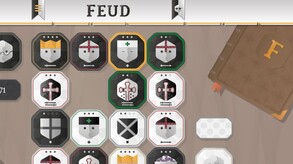
Feud is a turn-based strategy game. Swap pieces on a four-by-four grid to isolate your opponent's pieces, or go straight for their King. Hone your skills against three AI characters with distinct play-styles, then challenge your friends online or on the same screen.
Revenue comes from in-game items and microtransactions, which our price-based model doesn't estimate. Copies below reflect the player base, not paid sales.

About

Genres
Stats
Languages: English, Italian, Romanian, Simplified Chinese, French, German, Japanese, Spanish - Spain, Polish, Russian, Swedish, Ukrainian
Engagement
Reviews
Themes across 41 recent reviews and how positive each mention is. A keyword signal, not full sentiment analysis.
Reviews
⠀
On a 4x4 grid, your task is to win against your opponent through a variety of means in a computerized abstract strategy board game called [b]Feud[/b] by the developer [b]Bearwaves[/b]. Computerized board games are tough to review because there are no story lines. There are no quests (main or side). Although graphics and sound effects are a factor, they aren't significant ones. In the end, a board game rises or falls on how much fun it is to play. And while all games (computer and otherwise) abide by that metric, board games do not have the advantage that other game categories enjoy. A FPS game that has lousy combat mechanics might be buoyed by having an excellent soundtrack; An RPG game with a mediocre main quest could be salvaged by it's story or setting. Yet board games live or die by how much 'fun' they actually are. Create an innovative computerized board game (such as Minesweeper) and you could go down in history (or, at the very least, be really popular). Create one that isn't so fun or innovative and you are soon forgotten and ignored. Explaining the rules for 'Feud' is extensive and it's best if the developers explain their own game in detail. In summary, though, you have six different pieces: Knights, archers, a king, a wizard, a shield and a medic. Each of these pieces has a different ability and different "hit points" (either 3 or 4). Knights can attack two pieces in one turn, archers can attack pieces from a distance (but not over shields), the king needs to live if you want your side to win, the wizard can switch with any other piece, the shield can neither attack but also can't be moved by the opponent & the medic can heal other units. Each turn consists of switching the places between two adjacent pieces and then attacking your opponent. Pieces that are alone lie dormant and can't be used. The game itself allows players to play against either human or computer opponents. There is an extensive tutorial (since you obviously need to learn how to play the game sufficiently) that demonstrates all of the basic mechanics of the gameplay although strategy is left for the player to figure out on their own. The game itself is well presented, with the graphics being completely adequate for the job. The sound effects were also perfectly fine. During my evaluation, the game never crashed. The 'setting' was medieval given that the pieces were depicted as knights, archers, a wizard and a shield. With a little modification, the setting could easily have been science fiction or modern-day combat with little consequence. Yet... Was the game fun? There are many ways of winning the game and this is where the confusion begins. Killing the king is an obvious way of winning the game but there are many others. For instance, if you "isolate" all of the pieces, you can also win. And then there's a third way of winning which is if your opponent can only switch places but doesn't perform an attack for three turns in a row. That's a lot of different ways to win. And, in this game, you can also play the game into a draw (for instance, if a player makes a move where both sides isolate all of their pieces). Huh. The ability of the wizard is a bit confusing. It's claimed that it can switch places with any other friendly piece but that ability is an [b]ACTION[/b] and not a part of a switch itself since the wizard can also be switched normally. So why have what amounts to be a modified switch also be an action? Couldn't the wizard do anything else for their action? Suppose, for instance, that the wizard's current action was it's switch ability and for it's unique action, it could, perhaps switch the hit points between two enemies who are adjacent to one another? And, in what limited time that I played, there doesn't seem to be a mechanism in place to prevent repeated patterns. For instance, I was able to constantly switch the medic and the king, constantly healing the king from the damage it took an opposing archer with each action. I could have performed this pattern indefinitely, functionally putting the game into a never-ending loop. Granted, a human opponent would have eventually tried another tactic but the fact that a never-ending loop was even possible denotes that the gameplay could be refined to eliminate this possibility. I suppose that the game is fun for others and that's fine. Different people have different standards for what is fun for them. However, board games aren't played for their looks or their soundtrack. They can't be "modded" such as with games like 'Elder Scrolls V: Skyrim' or 'Total Annihilation.' They can't rely upon a good story or a memorable character to bail it out. A board game has to be a good game. And, in the case of "Feud," it can't even rely upon luck to give the game some randomness, such as with a dice roll or a stack of cards to select from. People who create abstract strategy board games, whether those games are computerized or not, should be recognized for their talent. It's hard work and the rewards are often little more than a pat on the back and some modern-day version of an "Atta boy!" Yet did I have fun? The answer is "No." There are too many ways to win (and lose), at least one of the pieces have some questionable characteristics and I found a situation within only a few games that created an infinite loop. Other abstract strategy board games may have those same features as well but I'm not reviewing them; I'm reviewing this one. And I don't even know if the game has been studied for other abstract strategy pitfalls, such as first- or second-player bias or "Runaway syndrome" where, once one player gets an advantage over the other, there's no chance for the opponent to stage a comeback and win. I have no problem if other people enjoy this particular game; To each their own. Yet I can't recommend this game for anyone other than diehard abstract strategy board game enthusiasts and that's just not enough to recommend it for everyone else.
Related
Related
Trends
Concurrent players on Steam, sampled daily since tracking started.
Hours played at review time, across 41 reviews with recorded playtime.
positive critical· bar length = how often the theme comes up
Here I will leave the cat, friends who pass by can pet it and give it a thumbs up (i need steam points) /> フ | _ _ l /` ミ_xノ / | / ヽ ノ │ | | | / ̄| | | | | ( ̄ヽ__ヽ_)__) \二つ
█▀██▀█▀██▀█▀█▀█▀█▀▀▀█▀▀▀▀█▀██▀█ █░▀▀░█░██░█░█░█░██░██░██░█░▀░██ █░██░█░██░█░█░█░██░██▀▄▄░█░██░█ █▄██▄██▄▄██▄▄▄▄▄██▄██▄██▄█▄██▄█
Feud sıra tabanlı bir strateji oyunudur. Rakibinizin taşlarını izole etmek için dörde dörtlük bir ızgarada parçaları değiştirin veya doğrudan Şahlarına doğru ilerleyin. Farklı oyun tarzlarına sahip üç AI karaktere karşı becerilerinizi geliştirin, ardından çevrimiçi olarak veya aynı ekranda arkadaşlarınıza meydan okuyun.
I didn't know that one - I'm glad I do now. 10/10, especially against a human player.
It's a short game for solo (a bit longer for all achieves), but it's still a lot better than some of the paid games here.
It's an okay game of switch and attack. I got stuck in a stale mate and a never ending option to switch. Game should automatically call a stale mate, but it doesn't know better. I wish the board was bigger with more options. With more aggressive players, it's more fun.
还可以,就是玩的人少,匹配约等于没有
El juego tiene buena pinta. Pero lamentablemente no nos funcionan bien los turnos. Una pena.
Momentum
Pace estimated from the game's recent review growth (our daily snapshots) at its own sales-per-review ratio — a momentum signal, not booked sales.
Audience
Estimated from the language of this game's reviews — a proxy for where players are, not official Steam demographics.
Related
| House Flipper | $65.8M | 110.8K | 94% | $24.99 |
| Rhythm Doctor | $13.9M | 26.7K | 98% | $19.99 |
| Awesomenauts | $8.3M | 26.9K | 85% | $19.99 |
| Emberward | $2.3M | 3.8K | 97% | $19.99 |
| Sub Rosa | $1.8M | 3.4K | 69% | $19.99 |
| Journey to the West | $774.2K | 1.7K | 81% | $19.99 |