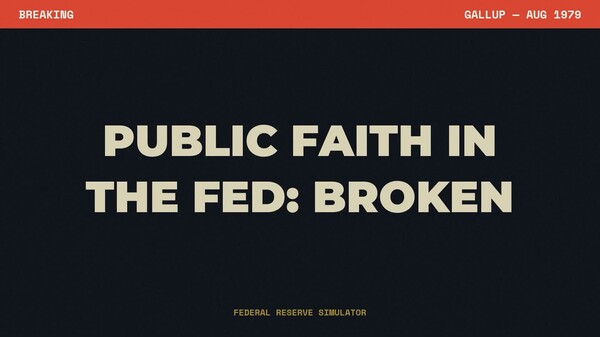
Can you beat inflation without crashing the economy? Run the Federal Reserve through real crises, political pressure, AI bubbles, and market panic. Set rates, deploy QE, manage expectations, and engineer the perfect soft landing. Featured on Marketplace with Kai Ryssdal.
Modeled estimate, not a reported figure. How we estimate →
Discounts
Every price cut of more than 20% we have observed, in each market that quoted one, with this game's chart position on either side of it. These are episodes, not a model: a sale is one event, and one event cannot tell you what the next one will do.
Reviews, worldwide (the counter carries no country): 0/day in the week to Sep 13 → 0/day in the week after.
Reviews, worldwide (the counter carries no country): 0.43/day in the week to Aug 7 → 0.29/day in the week after.
For scale, across Steam · Top Sellers · Brazil over the last 30 days: the 25 chart moves that followed a price cut of more than 20% went a median of 10 places towards #1, and the 2,413 moves with no price cut behind them went 2 away. One store, one chart, one country — it is the only place we have enough observations to say even that.
Prices outside the United States have been collected since 6 August 2026 and chart positions since 19 July 2026, so a cut older than that has no market to compare and a market that joined later has no history yet. Nothing here is converted between currencies.
About
Federal Reserve Simulator is a turn-based economic strategy game that puts you in charge of the world’s most influential central bank.
Set interest rates, deploy quantitative easing, manage market expectations, and guide the economy through inflation, unemployment, financial panic, and political pressure. Every decision has consequences—and the effects of today’s policy may not arrive for four quarters.
Featured on the Marketplace podcast, where Kai Ryssdal played on air.
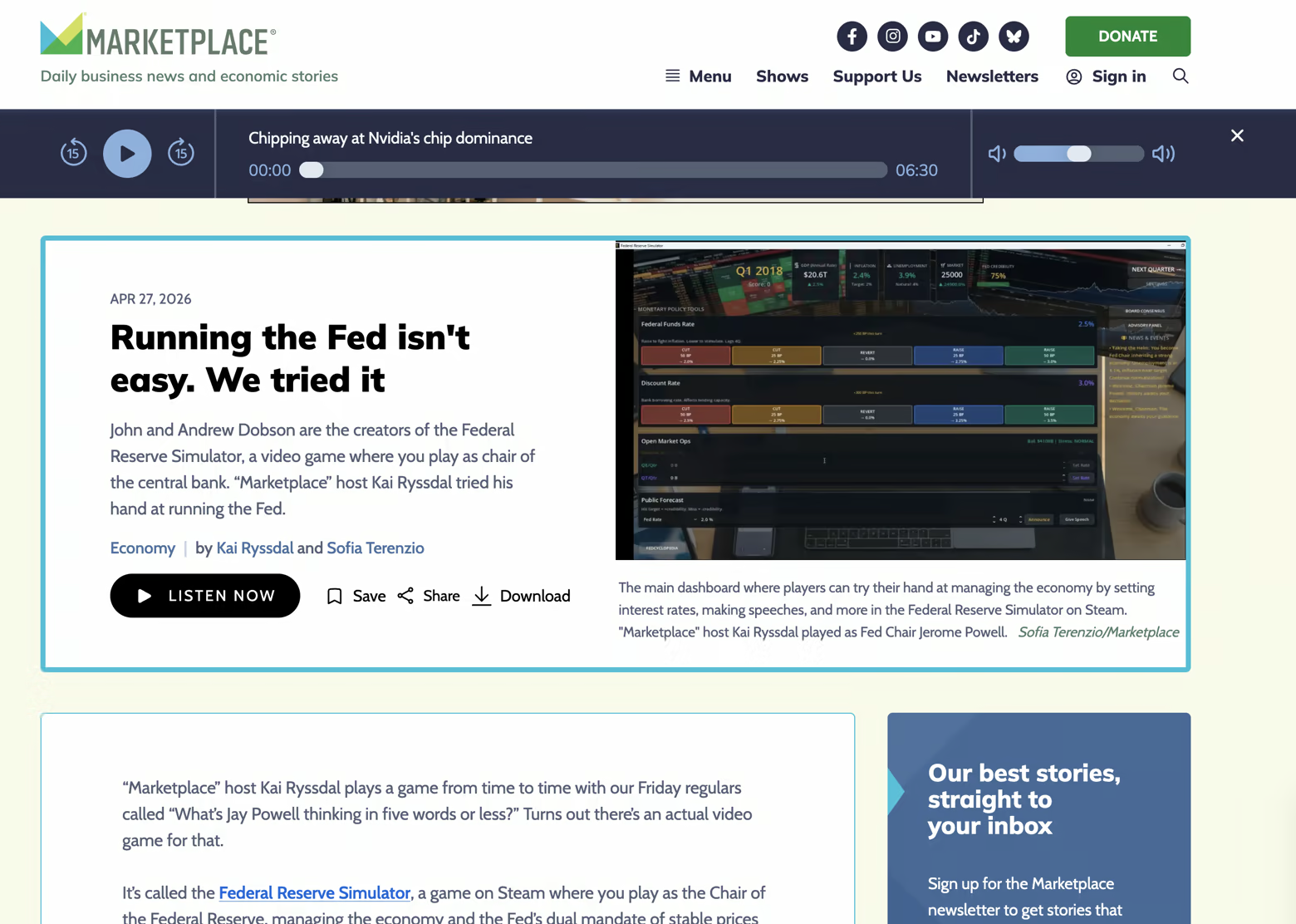
Control the Federal Funds Rate, Discount Window, reserve requirements, QE, QT, public forecasts, and forward guidance.
Your policies operate with delays. Raise rates too aggressively and you may cause a recession. Cut too quickly and inflation may return. Lose credibility and even the right decision can fail to calm the markets.
Balance inflation, employment, growth, and financial stability
Build credibility with markets and the public
Anticipate delayed policy effects
Respond to crises before they spiral out of control
Navigate disagreements inside the FOMC
Take control during some of the most consequential periods in modern economic history:
Paul Volcker: Break 14% inflation without destroying the economy
Alan Greenspan: Survive Black Monday, the dot-com crash, and 9/11
Ben Bernanke: Confront the Global Financial Crisis and deploy QE
Janet Yellen: Normalize policy without derailing the recovery
Jerome Powell: Navigate the pandemic and the return of high inflation
Your performance is measured against the historical record. Follow history—or prove that you could have done better.
Take the oath in 2026 as Kevin Warsh, with inflation still elevated, markets obsessed with AI, and the White House demanding immediate rate cuts.
The Independence Pendulum forces you to balance pressure from both sides. Defy the President for too long and face a federal investigation. Sacrifice price stability for political approval and Jerome Powell may lead the Board into open revolt.
Use the AI Impact setting to determine whether the technology disappoints, transforms productivity, or creates a jobless market boom followed by a historic equity crash.
Custom Mode lets you build a scenario around stagflation, deflation, financial collapse, or another economic emergency. Add wildcards such as war, an energy shock, or an automation boom—and discover whether your strategy survives conditions you designed yourself.
For a harder test, enable Prestige Mode for tighter scoring, stronger crises, and much smaller margins for error.
At the end of each term, receive a grade from A to F based on inflation, employment, growth, credibility, and financial stability.
Compare your results with the real historical record, unlock achievements across every era, and use the in-game Fedcyclopedia to understand the monetary-policy tools behind your decisions.
The economy is waiting for your guidance. What’s your next move, Chair?
Engagement
Reviews
Themes across 52 recent reviews and how positive each mention is. A keyword signal, not full sentiment analysis.
Reviews
im saving the economy while the president is tweeting mean stuff at me and opening investigations. 10/10 realism
WE ARE JEROME POWELL
We are Jerome powell
Media

Related
Related
Price dynamics, follower growth, revenue and sales trajectories with interactive tooltips
This and every other Pro feature is free until October 20, 2026. A free account is all it takes.
Genres
Stats
All-time low is the lowest price we've recorded for this game since we started tracking it.
Languages: English, German, Spanish - Spain, Portuguese - Brazil, Simplified Chinese, Spanish - Latin America
Hours played at review time, across 52 reviews with recorded playtime.
positive critical· bar length = how often the theme comes up
A fun, pretty realistic depiction of US monetary policy. So good that I want more! Ideas include some slider settings to make custom scenarios harsher, and more graphs of variables (for instance, as you play rather than at the end of a scenario), and an endless mode that features random shocks to the economy so we can keep on playing foreverrrrr. I hope to see more updates in the future, but as-is the price is a steal for anybody with at least a passing interest in modern macroeconomics. A one-of-a-kind game!
Federal Reserve Simulator from Billmeade Gaming is a niche but thoughtfully designed strategy simulation that turns the abstract world of monetary policy into a slow-burning, decision-driven experience. Instead of relying on conventional gameplay hooks, it places the player in a role defined by responsibility and uncertainty, asking them to guide an entire economy through cycles of growth, instability, and recovery. The game’s strength lies in how it transforms complex economic concepts into a system that feels both approachable and demanding, without sacrificing the sense of realism that defines its core. The structure revolves around turn-based progression, where each decision represents a slice of economic time. Players are given control over key policy tools such as interest rates and monetary interventions, but the true challenge comes from how these decisions unfold over multiple turns. Outcomes are rarely immediate, and the effects of a single action may only become clear much later. This delayed feedback creates a unique kind of tension, forcing players to think ahead rather than react impulsively. It also means that mistakes can compound in subtle ways, making recovery just as important as prevention. Scenarios play a central role in shaping the experience, offering both historically inspired challenges and customizable situations that allow for experimentation. Some scenarios place the player in the middle of economic crises, requiring careful balancing of inflation, employment, and market stability. Others provide more open-ended conditions where players can test different strategies without strict constraints. This variety helps keep the experience engaging, as each scenario introduces a different set of priorities and pressures that must be managed simultaneously. One of the more compelling aspects of the game is its emphasis on credibility. Decisions are not evaluated solely on their immediate outcomes but also on how they influence long-term trust in the system. Maintaining consistency and making measured choices becomes essential, as erratic actions can reduce the effectiveness of future policies. This adds a layer of psychological strategy, where players must consider not only what actions to take but how those actions will be perceived over time. Visually, the game adopts a minimalistic approach that prioritizes functionality over style. The interface is dominated by charts, graphs, and data readouts, all designed to present information clearly rather than impress visually. While this makes the game easy to navigate once familiar, it may feel dry or uninviting to players expecting a more dynamic presentation. The lack of visual flair reinforces the game’s focus on systems and decision-making, but it also limits its ability to create a more immersive atmosphere. The audio design follows a similarly restrained path, offering little beyond basic feedback and subtle background elements. This simplicity does not detract from the gameplay, as the experience is driven almost entirely by its mechanics, but it does contribute to an overall tone that feels analytical rather than engaging on an emotional level. Players are encouraged to focus on numbers and outcomes rather than atmosphere or narrative. Pacing is deliberate and often slow, reflecting the nature of the systems it represents. Progress unfolds over long stretches of in-game time, and significant changes rarely happen instantly. For players who enjoy careful planning and long-term strategy, this can be deeply satisfying. However, those who prefer faster feedback or more dynamic gameplay may find the experience too gradual, especially during extended sessions where progress feels incremental. Despite its understated presentation, the game succeeds in making complex ideas accessible. By linking decisions to visible outcomes, it provides a practical understanding of how monetary policy operates and why it is so difficult to balance competing goals. This educational aspect emerges naturally from the gameplay, offering insight without feeling like a formal lesson. At the same time, the game’s narrow focus is both a strength and a limitation. It delivers a cohesive and well-executed simulation for players interested in economics and strategy, but it does little to broaden its appeal beyond that audience. The lack of variety in gameplay systems means that enjoyment depends heavily on an appreciation for its subject matter and its methodical approach. In the end, Federal Reserve Simulator is a carefully crafted experience that excels within its niche. It offers a thoughtful and challenging take on economic management, rewarding patience, foresight, and disciplined decision-making. While its minimalist presentation and slow pacing may not suit everyone, it provides a compelling experience for those willing to engage with its systems and embrace its deliberate style. Rating: 8/10
Pros: - Puts you in the Fed cockpit. Educational as to what policy levers are available to the Fed and how they affect economic outcomes. - You get a real sense of historical tension at times, as world events cause the economy to spiral out of control. - I love how they compare your record to the historical record, it gives you something to shoot for. Cons: - Not much gameplay in the traditional sense of the term. This is more of an educational product than a game. - Audio and visuals are pretty bare bones. - I would have liked more feedback about your decisions (newspaper articles, opinion pieces, complaining board members, etc.) beyond just the GDP, unemployment, and inflation numbers. That kind of feedback could not only add to the drama, but it could be educational as to how people view different policy levers. If the developers had the time and budget, I would recommend them to: - Add music that goes along with the era and the feeling. Calm music when things are calm, tense music when things get tense. - Add some political drama into the mix, even if it's just in the form of newspaper headlines criticizing or praising the Fed. - Add more Fedcyclopedia entries, especially about the Fed in different eras and under different chairmen. - Add some FOMC drama into the mix too. In the game, you set the policy, but in reality it's the FOMC that sets it by a vote. What if you have to deal with recalcitrant board members? Conclusion: Worth a try if you want to experience what it's like to pilot the Fed, and learn a bit about monetary economics.
WE ARE JEROME POWELL WE CARRY THE LINE
Good afternoon...
From someone who loves studying monetary policy and simulators, very well made game!
I am ready Mr. President, appoint me. Unironically a very fun game that makes you panic when you're too late. Also very educational and helps you learn not only fiscal policy tools but historic crises and their effects on the economy.
Selling now
See how fast this game is selling right now — estimated copies and revenue per day from recent review growth.
Players by region
Where this game's players are, estimated from review languages.
Players also reviewed
The games this title's players most often review too — audience affinity.
Related
| Game | Estimated lifetime revenue | Reviews | Review score | Price |
|---|---|---|---|---|
| $2.2K | 4 | 75% | $13.99 | |
| — | 0 | — | — | |
| $157.6K | 542 | 86% | $5.99 | |
| $18.2K | 29 | 45% | $14.99 | |
| $16.8K | 29 | 83% | $14.99 | |
| $1.3K | 4 | 100% | $7.99 |
Related
| Game | Estimated lifetime revenue | Reviews | Review score | Price |
|---|---|---|---|---|
| $10.9K | 231 | 84% | $1.99 | |
| $10.9K | 59 | 58% | $3.39 | |
| $10.9K | 312 | 63% | $1.99 | |
| $10.9K | 112 | 62% | $2.99 | |
| $10.9K | 241 | 67% | $1.99 | |
| $10.9K | 54 | 93% | $7.99 |