
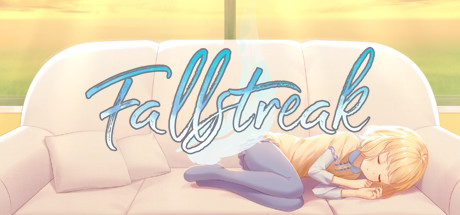
A golden dream, and a closed world. A spiral staircase into the garden of the mind. What lies beyond gilded wonderland?
Revenue comes from in-game items and microtransactions, which our price-based model doesn't estimate. Copies below reflect the player base, not paid sales.
Media
About
Genres
Stats
Languages: English
Engagement
Reviews
Themes across 40 recent reviews and how positive each mention is. A keyword signal, not full sentiment analysis.
Reviews
Fallstreak, developed and published by Centicerise Productions, is a visual novel that commits fully to storytelling as its primary vehicle, stripping away nearly all traditional gameplay elements in favor of a dense, carefully constructed narrative. Set within the enigmatic land of Socotrine—a place shrouded by a strange, ever-present mist—the game follows Adelise Cotard, a young girl whose dreams and memories appear to be entangled with a devastating past event. From the beginning, it establishes a tone that is equal parts melancholic and unsettling, inviting players into a world where beauty and horror coexist in a fragile, uneasy balance. What immediately defines Fallstreak is its complete lack of player agency in the conventional sense. There are no branching choices, alternate endings, or gameplay systems to master; the experience unfolds in a strictly linear fashion. Rather than feeling restrictive, this approach allows the narrative to maintain a strong sense of cohesion and pacing, presenting itself more like a novel than an interactive game. The story builds gradually, layering its worldbuilding and character development in a way that requires attention and patience. It doesn’t hold the player’s hand, instead expecting them to piece together meaning from dialogue, imagery, and thematic cues. The writing leans heavily into contrast, juxtaposing moments of quiet introspection with sudden shifts into darker, more disturbing territory. Themes of trauma, loss, and the erosion of innocence are explored with an unflinching tone, creating an experience that can be emotionally taxing but also deeply engaging. The narrative doesn’t rely on simple shock value; instead, it uses its more intense moments to reinforce its central ideas about human fragility and the consequences of suffering. That said, the weight of these themes means the story is not universally approachable. Its willingness to delve into uncomfortable subject matter may alienate some players, particularly those expecting a more conventional or uplifting narrative. Visually, the game supports its storytelling with a distinctive anime-inspired art style that ranges from serene to deeply unsettling. Character expressions are carefully rendered, conveying subtle emotional shifts that enhance the impact of the dialogue. Backgrounds play an equally important role, often reflecting the psychological state of the narrative rather than simply serving as static environments. The use of lighting, color, and visual transitions helps reinforce the dreamlike quality of the world, giving the impression that reality itself is unstable. Complementing this is a subdued but effective soundtrack that underscores the emotional tone without overpowering it, allowing key moments to resonate more strongly. Despite its strengths, Fallstreak is not without its challenges. The pacing can feel uneven, particularly in its early sections where the volume of information may overwhelm players before the narrative fully takes shape. The story occasionally leans into abstraction, presenting ideas and events in ways that are open to interpretation but not always immediately clear. This ambiguity can be intriguing, but it can also lead to confusion, especially for players who prefer more direct storytelling. Additionally, the lack of interactivity means that engagement depends entirely on the player’s willingness to immerse themselves in the narrative, which may not appeal to those looking for a more active experience. What ultimately makes Fallstreak stand out is its ambition. It aims to be more than a simple story, instead presenting a layered exploration of psychological and emotional themes within a richly imagined world. While it doesn’t fully resolve every thread it introduces, this openness contributes to its lingering impact, leaving players with questions and interpretations that extend beyond the final scene. It is a work that prioritizes atmosphere and introspection over clarity and accessibility, resulting in an experience that feels both unique and demanding. In the end, Fallstreak is a visual novel that succeeds by committing wholeheartedly to its narrative vision. It offers a haunting, thought-provoking journey that will resonate strongly with players who appreciate slow, introspective storytelling and are willing to engage with its darker themes. While its linear structure and heavy subject matter may limit its appeal, it remains a memorable and distinctive entry within the genre. Rating: 8/10
Related
Related
Trends
Modeled estimate over time.
Hours played at review time, across 40 reviews with recorded playtime.
positive critical· bar length = how often the theme comes up
In a time when pure eloquence is often preceded by the sole urge to just ’come up with a gripping story’, Centi’s prose serves as a towering display of literary finesse. Beautifully composed, the writing balances masterfully between the tranquil, the mischievous and the dejected. A way to describe Centi’s storytelling is that of a reminiscence. The scenes come to life with the sweetness of a distant allure. Sombre at times, heartwarming at others, but always with a call of yearning. However, as with all reminiscence, Fallstreak evokes its themes with thick brushstrokes little disjointed, as opposed to meticulously crafted fine lines – there are indeed unanswered/unexplained story elements thrown into seemingly out of nowhere. The plot itself also takes a radical turn half-way through (as noted by the previous reviews). At first, it sets the ground for some overarching philosophical deliberations, only to then devolve into an almost comically brutish killing spree of a split-personality-esque escapade. The additional novel found in the Fan Pack may mitigate these rough edges (mostly by providing glimpes into the underlying elements of Soccotrine), albeit criticism still stands. And yet, in a fashion true to the dream-like world of our protagonist Ade, the story retains the sense of purity that’s embedded in the flowery prose. A story that seeks to be more than a thrilling plot. It doesn’t just tell its theme, it invokes them: the pensive and the serene, lost to dream and time. Therein lies the enduring charm of Fallstreak.
While the writing style and art are very beautiful, there are many drawbacks to this virtual novel as well that makes Fallstreak difficult to recommend: the POV is often unclear and shifts frequently and jumps timelines in a way that's hard to keep track of; while there's a trigger warning for extreme violence, the story often goes from super light-hearted and child-like to highly descriptive gore that doesn't appear to have a clear driving purpose and is quite jarring; and while having a strong theme connecting between shorter allegorical stories about a girl whose tears gift a town with water, a rainbow bird whose feathers gift a town with fire, and one of the characters, Mallory, and the Fire of Collapse, it feels like the story itself tries to accomplish a lot and gets distracted by itself, ending suddenly without any real conclusion. 4/10
I feel like this is two different visual novels stitched together with an alien's understanding of human nature and a heavily highlighted thesaurus. The tone is all over the place and that issue isn't helped by the sheer level of naval gazing happening. I've never seen a game say so much and so little all at the same time.
무료 비쥬얼노벨. 따로 선택지 없이 직선적으로 진행됩니다. 무료게임이라 생각이 안 들정도로 디테일이 좋게 나왔습니다. 상당히 잘 만든 수작이에요. 도중에 나오는 보드게임. 그거 플레이 시켜줄 줄 알았는데 그냥 확 지나갑니다... 무료라 리뷰상 추천합니다.
I wouldn't say this visual novel is **bad**, but i simply cannot recommend it The pacing did not feel good, with the tone that's practically all over the place It is not fulfilling and feels more like an intro to its world, that visual novel feels useless on its own at the very least I like the world-building, but the VN ends abruptly with many questions unanswered With how it is, the VN feels like it had another VN inside it that took roughly 2/3 of my playtime But anyway, the art is good, really good for a free game The music is also good, although very slightly repetitive So, put shortly, I'm just disappointed, the game made me expect more than it actually delivered and I don't feel like I've got much of anything out of it
Altın bir rüya ve kapalı bir dünya. Zihnin bahçesine çıkan sarmal bir merdiven. Yaldızlı harikalar diyarının ötesinde ne var?
This is a divisive one. It definitely has flaws, but I found them worth overlooking, while others might (and, oftentimes, did) not. Let me start with this game's one unequivocal strong point in my eyes: The art. It's clearly had a lot of work put into it, and it shows. All the character designs are well-done, the expressions convey emotions wonderfully, and it's overall just very nice to look at. For a free product, it's amazing, but it's very good even outside of that metric. Now, one of the most commonly cited weaknesses of the novel is its diction. The prose is often considered to be a bit too purple, and Adelise in particular to be unrealistically articulate. Personally, I was engrossed enough in the story that the writing flowed well for me, and I believe that Adelise's speech patterns are a deliberate literary device used to show [spoiler]her much greater subjective age due to time spent in the golden dream[/spoiler]. Still, it can be a bit much to chew on, and there are some rather annoying grammatical errors sprinkled throughout the script, chiefly missing commas. As for the darker elements of the game: without spoiling too much, I believed them to be overall solid at their core, and with definite emotional weight, but I think that some scenes and events were a little gratuitous, or simply described in more detail than we really needed. I think that giving a few especially skin-crawling details without going into everything in between would produce a much more effective horror punch, and I'm pleased to see the somewhat terser and more minimalistic prose of the sequel go in that direction. Finally, my biggest criticism by far is that the novel ends far too abruptly. It has a solid cliffhanger, but there is no sense that the novel is coming to an end before that comes, so one gets the sense that it simply stops halfway through. In fact, I actually checked several times to see if my game was somehow broken when I came to it, believing that it wasn't the actual end. This probably won't be an issue for those reading whenever a direct continuation of the story is released, but for the time being it's quite jarring. Still, given that this game doesn't ask for your money, I would say that it is probably worth your time. If nothing else, I recommend reading it as a companion piece to its sequel, which is a deeply excellent visual novella in its own right, improves greatly on every flaw of this one, and very much earns its price tag in my opinion.
免费 没中文 没成就 陨焰 索科特林大陆 —— 一片被扭曲现实的迷雾环绕的隐秘秘境。 《陨焰》讲述了少女艾德利丝・科塔尔的故事,她一旦入睡,便会踏入一场永恒的金色梦境。 她的梦境,与十年前那场名为 “坍缩之火” 的神秘灾难究竟有何关联?那场灾难中,七彩烈焰从天而降,倾泻而下。而这一切,又与她最终的目标 —— 逃离封闭的索科特林世界,有着怎样的联系? 《陨焰》是一款线性视觉小说,将传统叙事手法与现代黑暗奇幻、心理惊悚元素相结合,打造出独一无二的故事体验。 特色内容 文本:8 万字完整剧本 角色立绘:13 个独特角色立绘 场景背景:30 + 张原创背景 剧情插画:12 张事件 CG 原创原声:23 首配乐
[h1] VERDICT: 4/10 [/h1] [h1]The tl;dr version:[/h1] [b]Pros:[/b] [list] [*] Decent overarching plot and worldbuilding [*] Cool settings [*] Beautiful art [*] Good piano compositions [/list] [b]Cons:[/b] [list] [*] Story appears to get cut off at the end [*] Inconsistent pacing - flip-flops too much between lighthearted and dark [*] Needs actual chapter titles [*] Frequent and unclear POV switches [*] Overly flowery dialogue [*] Awkward/unrealistic interactions (on occasion) [*] Repetitive (and sometimes annoying) soundtrack [/list] [hr][/hr] [h1] The (very) long version: [/h1] Perhaps I've been spoiled by the countless classic novels I've read over the years, which have made me extremely picky about writing style, but I feel the same rules should apply to any text that aims to tell a story. Don't get me wrong, the premise behind this game is wonderful. The concept of an endless dream world, juxtaposed with the real world which has endured countless horrors and still fights against the mysteries that surround it, is something I'm always willing to read about. However, the execution just felt flawed in places and hence I couldn't give this game the resoundingly positive review that it would otherwise have deserved. There were several key points that didn't quite work for me, which I'll break down below, along with the things I did like. I can get very long-winded when it comes to anything writing-related, so consider yourself warned. [b]WRITING:[/b] [list] [*] The author has an elegant writing style, which is both a blessing and a curse for this game. There were certain lines that I simply had to screenshot, because they were just that beautiful and powerful and told undeniable truths about humanity. These I can never get enough of. However, the game makes the mistake of using that same writing style with basic interactions between different characters, even very young ones, which makes their exchanges seem overly flowery and unrealistic. I wouldn't expect children/young teens from 10-15 years old to talk to each other like they're quoting from a book, unless a convincing explanation is provided, which it unfortunately wasn't. As a result these parts of the story became a chore to read and I found myself skimming through them at top speed. [/list] [b] PACING/PLOT: [/b] [list] [*] Again, some things are done right while others appear glaringly flawed to me. The overarching plot and the ideas behind it are original and strong - especially when it came to the darker parts of the story, which threw me for a loop at first, but I'd always rather read something depressing that reminds me to appreciate and think more deeply about life. But apart from that, the pacing just feels so disjointed, jumping back and forth between lighthearted and sad way too often, as well as switching POVs without warning which creates unnecessary confusion. [*] For instance, starting out in the dream world with its endless loneliness gave me the early impression that this story could get dark, but then we skip to cheerful and pointless interactions between children who sometimes talk like well-read grad students. (And a lot of them talk the same, which doesn't really make them seem like distinct characters.) They do little kid things like pulling random pranks, tickling each other, and playing games at school, but because we suddenly jump to their depressing pasts, the happy stuff just feels like a cheap device to hit us with some contrast and shock value later on. And then, after some dark background has been covered, we switch right back to the kids doing random kid things. Perhaps a case can exist where this sort of plot device could be used skillfully, but because it's used so often, I simply couldn't warm up to it. [*] The frequent POV switches also got off-putting after a point, since it would take me a minute to realize I was in one kid's flashback or other, or had jumped even further back in time to when their parents were younger. It might have helped if some consistent visual transition had been used, along with labeling new character names right off the bat. (All we get is an image of a random character against a black background before the switch, which doesn't help much.) Once again, not sure if this is an intentional plot device, but it simply doesn't work with the format of this game. Perhaps it would have been better suited for a novel, where chapters are clearly separated so that the switch doesn't feel so jarring. [*] Finally, the revelations about each of the characters seems to be done in an arbitrary order. I had so many questions about the MC - mostly why she spent half her life in a dream world and why she doesn't behave like other children. But then for some reason every side character's past is covered before hers, and it's almost like MC has been forgotten for the time being, fading into the background like she herself is now unimportant. That was particularly annoying since the beginning made it seem like the entire story was framed through her POV, and that she had some special ability which would be crucial later on. Probably another thing that a novel would have done better. [/list] [b]MUSIC:[/b] [list] [*] Really loved most of the piano soundtracks, but the happy ones that played during the kids' cheerful everyday routines were so repetitive that they began to grate on my nerves. And then we had excessive goofy sound effects from when the kids engaged in tackling/tickling/cheek-pinching/you name it. It just detracted from the serious parts of the plot that were intended to send a real message, and so I ended up muting the sound partway through the game. This might also have been why I didn't enjoy those particular story sequences - music can make or break any story or game that intends to make you think and feel. [/list] [b]ART:[/b] [list] [*] No complaints here. I always love the anime art style, and the watercolor-esque depictions of the cities and countryside were beyond beautiful. Even the violent, dark, and depressing scenes were done very well, though they did refrain from showing a lot of actual gore. Included here is the formatting of the game - loved the font and the little borders used for the text boxes. [/list] [b]MECHANICS:[/b] [list] [*] The UI is appropriately user-friendly. I liked that there were options to speed up the text, which saved me from quitting this game cold-turkey when I was trying to skip through the boring and annoying sequences. Other than that, not much to say here, since it's a text-based game. [/list] I guess, long story short once again, I wouldn't exactly recommend this game because it either rushes too much or drags on in points, which can be off-putting when you're there for a good story. However, it does have some redeeming qualities, so if you have the time and patience for the occasional gem it has to offer, you might still have a good time. As I'm a completionist when it comes to games, I'll still see this one through to the very end, and take away from it some life lessons as well as how best (and how not) to write a story. [hr][/hr] [h1] Final Edit: [/h1] (with something resembling spoilers) "Finished" this game about 10 min after my last save point, and I can't believe this is supposed to be an ending. Replayed from my save twice just to make sure I wasn't tripping - I was at the point where Callia had just made up with her father. Suddenly, skip to Evighet's Garden with an image of Tris just standing there, red marks all over his face reminiscent of his mother in her fits of madness. And then.... you just get taken back to the home page. No "The End," "To Be Continued," or anything. The story just stops there. No loose ends wrapped up. In what universe is this an effective conclusion? Initially rated this at least 6/10 but with that "ending," dropping it down to a 4. Just one too many careless writing blunders for me; I'm no longer interested enough to even attempt a sequel.
Momentum
Pace estimated from the game's recent review growth (our daily snapshots) at its own sales-per-review ratio — a momentum signal, not booked sales.
Audience
Estimated from the language of this game's reviews — a proxy for where players are, not official Steam demographics.