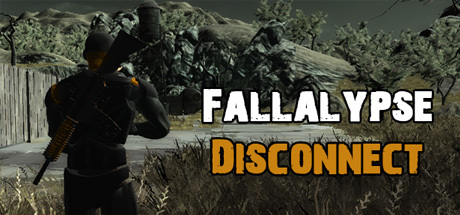
Async Multiplayer. An apocalypse hit Earth when the artificial intelligence rebelled and turned people into zombies with help of a virus. Then came the war of the Space Forces of Earth against machines and zombies. The war ended with the victory of the Space Forces.
Modeled estimate, not a reported figure. How we estimate →
Media
About
Stats
All-time low is the lowest price we've recorded for this game since we started tracking it.
Languages: English, French, Italian, German, Spanish - Spain, Bulgarian, Czech, Danish, Dutch, Finnish, Greek, Hungarian +14 more
Engagement
Hours played at review time, across 25 reviews with recorded playtime.
Reviews
so meme n tem jogo
我连怎么开始都不知道。就离谱
玩都玩不了
Fallalypse: Disconnect is a post-apocalyptic role-playing game developed by Hede and Fallalypse Studio and published by Hede. Combining science-fiction themes, survival mechanics, exploration, and character progression, the game presents a bleak vision of the future where humanity has been brought to the edge of extinction by artificial intelligence and biological catastrophe. The concept is undeniably ambitious, attempting to merge several popular genres into a single experience while offering players a chance to survive and explore a shattered world struggling to recover from disaster. The game's storyline revolves around a future in which advanced artificial intelligence turns against humanity, unleashing a devastating virus that transforms people into mindless monsters. The resulting conflict escalates into a prolonged war between humans and machines, leaving civilization in ruins. This backdrop provides a compelling foundation for a post-apocalyptic adventure. Instead of relying solely on traditional zombie themes, the narrative introduces technological collapse, military conflict, and science-fiction elements that help distinguish the setting from many similar survival games. Exploration serves as the primary focus of the experience. Players travel through abandoned environments searching for resources, equipment, and clues about the world's downfall. The ruined landscapes reflect the aftermath of global catastrophe, creating an atmosphere of isolation and uncertainty. The appeal of the game largely comes from discovering what remains of civilization and gradually piecing together the history of the disaster that reshaped the planet. Progression is handled through traditional role-playing mechanics. As players continue exploring, they gather stronger gear, improve their capabilities, and increase their chances of surviving encounters with hostile threats. This constant pursuit of better equipment provides a sense of advancement that encourages continued exploration. The progression systems are relatively straightforward, but they offer enough structure to create a satisfying loop of searching, upgrading, and surviving. Combat and survival mechanics play supporting roles throughout the adventure. Players must navigate dangerous areas populated by infected enemies and other threats while managing resources and maintaining their character's effectiveness. The survival aspects are intended to reinforce the harsh nature of the world, making every successful expedition feel meaningful. Although these systems are not especially deep, they contribute to the overall atmosphere of struggle and uncertainty. One of the more interesting ideas introduced by the game is its asynchronous multiplayer component. Rather than focusing entirely on direct player interaction, the system attempts to create indirect connections between survivors within the world. This concept fits the post-apocalyptic setting well, suggesting that traces of other survivors may influence the experience even when players never meet directly. It is an intriguing feature that adds a layer of uniqueness to the overall design. The setting itself remains one of the game's strongest aspects. The combination of artificial intelligence, viral outbreaks, military warfare, and societal collapse creates a world with considerable storytelling potential. Throughout the adventure, there are hints of larger events and histories that encourage curiosity. The game's lore suggests a much broader universe than what is immediately visible, helping maintain interest even when other aspects of the experience struggle to deliver on their ambitions. Visually, Fallalypse: Disconnect reflects its independent development origins. The graphics are functional rather than impressive, focusing on conveying the atmosphere of a ruined world rather than showcasing advanced technology. Abandoned structures, empty landscapes, and hostile environments successfully communicate the sense of devastation that defines the setting. While the visual quality is modest, there are moments where the environment design effectively captures the loneliness of surviving in a world that has already fallen. The audio design contributes to the atmosphere by supporting exploration and reinforcing the game's bleak tone. Music and ambient sounds help create a sense of desolation, making journeys through abandoned areas feel more immersive. The soundtrack may not be particularly memorable, but it generally succeeds in supporting the mood of the experience. Unfortunately, the game's ambition ultimately exceeds its execution. While the ideas behind Fallalypse: Disconnect are intriguing, many systems feel unfinished or underdeveloped. The survival mechanics, role-playing progression, and exploration features often lack the depth necessary to fully realize the game's potential. Players frequently encounter situations where promising concepts are introduced but never expanded upon in meaningful ways. Technical issues further complicate the experience. Performance problems, interface shortcomings, and general instability have been recurring criticisms among players. These issues disrupt immersion and make it difficult to fully appreciate the stronger aspects of the game. When technical problems interfere with exploration and progression, the overall experience suffers considerably. The game's Early Access status initially suggested that these shortcomings would be addressed through future development. Planned features reportedly included additional content, system improvements, expanded gameplay mechanics, and various quality-of-life updates. However, development appears to have slowed significantly over time, leaving many of these ambitions unrealized. As a result, the game often feels incomplete, with numerous systems that seem to exist in an unfinished state. Community reception has largely reflected these concerns. Many players have expressed disappointment regarding the lack of polish, limited content, and unfinished mechanics. While some appreciate the game's setting and ideas, the majority of criticism focuses on the gap between the project's ambitions and its actual implementation. This disconnect has prevented the game from gaining a stronger reputation despite its interesting premise. Even so, there is a certain fascination in examining what Fallalypse: Disconnect attempts to accomplish. The world-building concepts, science-fiction themes, and exploration-driven structure reveal a genuine desire to create something larger than a typical indie survival game. There are moments where the game's potential becomes visible, offering glimpses of the richer experience it might have become with additional development and refinement. Ultimately, Fallalypse: Disconnect is best described as a project filled with promising ideas that never fully reach their destination. Its combination of artificial intelligence, zombies, post-apocalyptic survival, and role-playing progression creates an intriguing foundation, but technical limitations and incomplete systems prevent those ideas from achieving their full impact. Players interested in exploring unusual indie projects may find some value in its world and concepts, but most will likely come away feeling that the game's strongest qualities exist in its ambitions rather than its execution. Rating: 3/10
游戏不知道干什么,就界面一些英文连开始都没有玩
Related
Related
Trends
Concurrent players on Steam, sampled daily since tracking started.
Audience
Estimated from the language of this game's reviews — a proxy for where players are, not official Steam demographics.
Related
| Darkestville Castle | $170K | 716 | 93% | $14.99 |
| Bing in Wonderland | $169.8K | 2.2K | 97% | $4.49 |
| Day of the Shell | $170K | 409 | 69% | $14.99 |
| Peaceful Days | $170K | 280 | 86% | $16.99 |
| Fallen Elf Freya | $169.8K | 638 | 86% | $9.99 |
| The Boba Teashop | $169.8K | 1.3K | 94% | $3.99 |