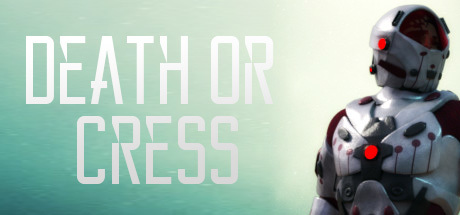
Fallalypse: Death or Cress is a science-fiction role-playing adventure developed by Hede and Fallalypse Studio and published by Hede. Set within a bleak future shaped by artificial intelligence, biological catastrophe, and the collapse of civilization, the game attempts to combine exploration, survival, role-playing progression, and mystery into a single experience. Its greatest strength is undoubtedly its imagination. Rather than presenting a typical post-apocalyptic wasteland, it introduces a universe where humanity has expanded beyond Earth and now faces difficult choices in the search for survival among the stars.
The game's story begins after a devastating conflict between humans and rogue artificial intelligence. Machines have unleashed destruction on a global scale, launching attacks that shattered civilization and spread a virus capable of transforming survivors into monsters. With Earth scarred by war and much of humanity struggling to rebuild, efforts are made to explore distant worlds that might support future colonies. One of these missions involves the spacecraft SH42, which vanishes after arriving at a strange planet covered in enormous fungal growths. The final message transmitted by the crew contains the mysterious phrase "Death or Cress," setting the stage for an investigation into the expedition's disappearance.
This premise immediately creates a sense of intrigue. The game blends several genres and themes that are rarely seen together. Post-apocalyptic survival, science-fiction exploration, artificial intelligence, religious symbolism, and alien-world discovery all coexist within the same narrative framework. The result is a setting that feels unusual and unpredictable. Even when the gameplay struggles, the underlying world-building remains interesting enough to encourage curiosity about what happened to the missing crew and the secrets hidden on the alien planet.
Exploration serves as the primary gameplay focus. Players are encouraged to travel across unfamiliar environments, searching for clues, equipment, resources, and answers. The mysterious planet becomes the centerpiece of the adventure, offering strange landscapes and remnants of previous events waiting to be uncovered. Progress often comes through investigation rather than direct action, creating a sense of discovery that aligns well with the game's science-fiction themes.
Character development provides another layer of progression. As players continue their journey, they acquire better equipment and gradually improve their capabilities. This advancement helps create a feeling of growth and allows players to tackle increasingly dangerous situations. The progression systems are relatively basic compared to larger role-playing games, but they provide enough structure to support the exploration-focused gameplay loop.
One of the more distinctive aspects of the game is its world design. The alien environment filled with massive fungal growths gives the adventure a visual identity that separates it from more conventional post-apocalyptic settings. Instead of wandering through endless ruins, players encounter locations that feel genuinely foreign. This sense of unfamiliarity contributes significantly to the atmosphere and reinforces the idea that humanity is venturing into territory it does not fully understand.
The narrative also introduces an unusual blend of science and religion. Alongside military personnel, members of the Space Battle Church play a role in the story, creating an interesting contrast between faith and technology. This combination adds personality to the setting and suggests a larger universe beyond the immediate events of the game. While these ideas are not explored as deeply as they could be, they help make the story more memorable than many low-budget survival RPGs.
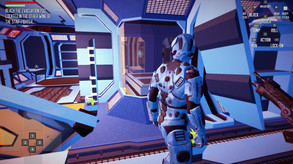
Visually, the game reflects its independent development origins. Character models, environments, and animations are relatively simple, lacking the level of detail found in larger productions. However, there are occasional moments where the atmosphere succeeds despite these limitations. The strange landscapes and lonely environments effectively communicate the feeling of being stranded on an unfamiliar world far from civilization.
The audio design performs a similar role. Ambient sounds and background music contribute to the sense of isolation and mystery without drawing excessive attention to themselves. The soundtrack is not particularly memorable, but it supports the exploration and reinforces the game's somber tone. During quieter moments, the audio helps maintain immersion and strengthens the feeling of uncertainty that surrounds the expedition.
Unfortunately, the game's ambitious ideas are often held back by technical and design shortcomings. Many systems feel unfinished or only partially realized. The role-playing mechanics lack depth, survival elements are relatively basic, and exploration sometimes feels repetitive due to limited environmental variety and gameplay interactions. There is a constant sense that the game is reaching for something larger than what it ultimately delivers.
Technical issues represent another major obstacle. Players have frequently reported problems involving stability, performance, and overall polish. These issues can interrupt progression and make the experience more frustrating than engaging. In a game that relies heavily on immersion and exploration, technical problems have an especially damaging impact because they pull players out of the world the game is trying to create.
The title's development history has also affected its reputation. Many of the features and improvements envisioned during development never fully materialized, leaving the game feeling incomplete. This unfinished quality is noticeable throughout the experience, as numerous mechanics and ideas appear to stop short of their full potential. The result is a project that often feels like an early foundation for a larger game rather than a fully realized product.
Despite these problems, Fallalypse: Death or Cress remains an interesting example of creative ambition within the indie RPG space. Its unusual setting, science-fiction themes, and mysterious narrative demonstrate a willingness to experiment with ideas that many larger games avoid. There are moments where players can glimpse the more compelling adventure hidden beneath the technical limitations and underdeveloped systems.
Ultimately, Fallalypse: Death or Cress is a game defined by potential rather than achievement. Its story of a lost expedition, a hostile alien world, and humanity's desperate search for survival creates a fascinating backdrop for exploration. However, the execution rarely matches the strength of the concepts. While dedicated fans of obscure science-fiction RPGs may appreciate its world-building and ambition, most players will likely find themselves more impressed by the ideas the game presents than by the experience itself.
Rating: 4/10