ESPER is a compact but cleverly constructed puzzle game developed and published by Coatsink, built around the fantasy of controlling objects with the power of your mind. Rather than sending players across vast environments or elaborate levels, the game confines you to a sleek, modular testing chamber. This minimalist approach is deliberate: by stripping away narrative clutter and environmental complexity, ESPER ensures that your attention remains entirely on the mechanics of telekinesis and the logic of the puzzles themselves. The result is an experience that feels both focused and intimate, as though you are the subject of a quiet psychological experiment where the only tools that matter are your wits and a set of invisible mental abilities.
The core premise situates you as a participant in a government-driven assessment, one aimed at studying individuals who have spontaneously developed psychic powers. These powers manifest through telekinetic manipulation of objects, and each test you face asks you to demonstrate increasing finesse with these abilities. You will pick up blocks, tilt platforms, redirect moving objects, and navigate obstacles by shifting items across floating grids or into designated targets. Though the mechanics are simple, the puzzles are structured in a way that requires attention to spatial reasoning, timing, and sequencing. Solutions often hinge on understanding weight, momentum, or how to guide a moving piece through a tight gap without letting it fall out of reach.
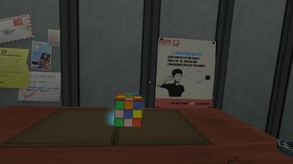
Visually, ESPER maintains clean and restrained design principles. The testing chamber is bright, sterile, and geometrically consistent, with only a handful of textures and props used throughout. This visual uniformity is not a limitation but a conscious stylistic choice that supports the game’s theme. With no extraneous clutter or distractions, players can focus entirely on puzzle-solving. Even the color palette—dominated by whites, pale grays, and soft blues—reinforces the feeling of being inside a controlled scientific environment. The simplicity also benefits readability: objects that can be manipulated stand out clearly, and the layout of each puzzle is easy to parse at a glance.
The addition of VR compatibility elevates ESPER for those who play it with a headset. In VR, the sensation of reaching out mentally to grab an object, lift it into the air, or slide it into a receptacle feels far more intuitive and tactile. Even without VR, the controls are accessible, using straightforward mechanics that let you move objects smoothly with traditional input devices. Coatsink’s design emphasizes accessibility; whether you’re an experienced puzzle player or approaching this type of game for the first time, the learning curve remains gentle without sacrificing the satisfaction of solving a well-constructed challenge.
Where ESPER’s strengths are most apparent—its focus, simplicity, and streamlined design—also define its limitations. The entire experience is notably short, often lasting only one to two hours. By the time the puzzles begin to hint at broader possibilities, the game is already concluding. Additionally, the narrative, delivered primarily through a distant and somewhat humorous voice-over, provides context but never evolves into a deeply engaging storyline. This is not a rich character-driven mystery nor a layered psychological drama; rather, the story functions as light framing for the gameplay itself. Players hoping for a more complex narrative arc or puzzles that build into a grand finale may come away wanting more substance.
Some of the physics interactions can feel imprecise as well. Objects occasionally behave unpredictably when moved near edges or tight corners, and certain puzzles rely on fine adjustments that may require repeated attempts. While these issues never break the experience, they do highlight the game’s small-scale production and the inherent challenges of physics-based design. Had the game been longer or more demanding, such quirks might have become more noticeable, but within ESPER’s brief runtime, they remain manageable inconveniences rather than major frustrations.
Ultimately, ESPER succeeds by leaning into what it does best: offering a compact, polished sequence of telekinetic puzzles presented in a clinical but appealing setting. It is not a sweeping adventure or a deeply replayable challenge, but rather a short, self-contained experiment in mental manipulation and spatial logic. Players who appreciate focused puzzle design, enjoy the novelty of telekinetic mechanics, or want a quick, engaging VR-compatible title will find plenty to like. For those seeking length, complexity, or extensive variety, ESPER may feel more like an intriguing prototype than a full-featured game. Yet even as a concise experience, it demonstrates Coatsink’s talent for crafting clean, concept-driven games that explore a single mechanic with clarity and charm.
Rating: 7/10