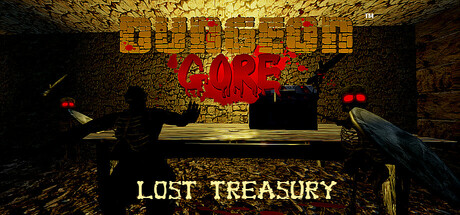
Dungeon Gore is a Strategy & Stealth game where you explore the dungeon and collect enough ancient treasure and escape with your findings.
Modeled estimate, not a reported figure. How we estimate →
Media

About


Stats
All-time low is the lowest price we've recorded for this game since we started tracking it.
Languages: English*, French, Spanish - Spain, Spanish - Latin America, Japanese, Russian, Simplified Chinese*languages with full audio support
Reviews
Dungeon Gore: Lost Treasury, developed and published by JJTW Games, is a compact first-person dungeon crawler that mixes exploration, survival tension, and light strategy into a focused, objective-driven experience. It places players inside a hostile underground environment where the goal is not simply to fight or survive, but to gather enough treasure to escape. This premise creates a constant push-and-pull dynamic, where progress is tied directly to risk, and every decision carries consequences. The central gameplay loop revolves around navigating dark, interconnected dungeon spaces while collecting valuable items scattered throughout each level. The more treasure the player gathers, the closer they move toward completing the objective, but at the same time, the danger steadily increases. Enemies become more aggressive and persistent, turning what begins as cautious exploration into a tense race against escalating threats. This system creates a natural sense of pressure, forcing players to constantly evaluate whether to continue searching for more loot or retreat and secure what they have already collected. Combat is presented through a straightforward first-person system, with melee weapons serving as the primary means of defense. Encounters rely on timing, positioning, and awareness rather than complex mechanics, making them easy to understand but somewhat limited in variety. The inclusion of stealth elements allows players to avoid unnecessary confrontations, adding another layer to how situations can be approached. However, the balance between stealth and direct combat is not deeply developed, and over time, players may find themselves relying on similar tactics in most encounters. The structure of the game is divided into a series of levels, each offering a new layout while maintaining the same core objective. This consistency makes the game easy to pick up and understand, but it also contributes to a sense of repetition. While the environments change in layout, the overall experience remains largely the same from one level to the next. The lack of significant mechanical evolution means that once players have mastered the core loop, there are few new challenges or systems introduced to keep the experience feeling fresh. Atmosphere plays an important role in shaping the overall experience. The dungeon setting is dark and enclosed, with limited visibility and a constant sense of danger. Enemy designs and environmental details reinforce this tone, creating a feeling of unease that complements the game’s survival elements. While the visuals are relatively simple, they effectively support the mood, even if they do not offer much variety or visual progression over time. Progression is handled through basic upgrade systems that allow players to improve their survivability and effectiveness. Enhancements to health, stamina, and combat capabilities provide a sense of gradual growth, but they do not significantly change how the game is played. These upgrades serve more as incremental improvements rather than introducing new strategies or playstyles, which keeps the experience accessible but limits its depth. The pacing is well-suited for shorter sessions, with each level functioning as a self-contained challenge that can be completed in a reasonable amount of time. This makes the game easy to revisit, especially for players who enjoy quick bursts of gameplay. However, extended play sessions can highlight the repetitive nature of the design, as the same objectives and mechanics are repeated without major variation. One of the more effective aspects of Dungeon Gore: Lost Treasury is its ability to create tension through its risk-reward system. Moments where the player is carrying a large amount of treasure while enemies close in can feel genuinely engaging, as every movement becomes critical. These situations highlight the strength of the game’s core idea, showing how a simple mechanic can create meaningful decisions and memorable moments. Despite its strengths, the game’s limited scope and lack of refinement prevent it from reaching a higher level of engagement. The mechanics are functional but do not evolve enough to sustain long-term interest, and the repetition of its core loop can make it feel more like a short-term experience than a fully developed one. In the end, Dungeon Gore: Lost Treasury is a focused and straightforward dungeon crawler that offers a clear and engaging gameplay loop built around tension and decision-making. It is best suited for players who enjoy survival-oriented mechanics and are looking for a compact experience that can be played in short sessions. While it does not stand out in terms of depth or variety, it delivers a consistent and cohesive experience within its limited scope. Rating: 6/10
Related
Related
Trends
Concurrent players on Steam, sampled daily since tracking started.
Momentum
Pace estimated from the game's recent review growth (our daily snapshots) at its own sales-per-review ratio — a momentum signal, not booked sales.
Related
| I Am The Prosecutor: No Evidence? No Problem! | $309.6 | 50 | 76% | $0.49 |
| Glasses and Girls | $315.6 | 51 | 82% | $0.99 |
| Bongo Quest | $322 | 52 | 46% | $0.49 |
| Dances and Girls | $322 | 52 | 83% | $0.99 |
| Anime Sunset Ride | $334.4 | 54 | 67% | $0.49 |
| Cosmic Journey PC Live Wallpaper | $336.3 | 52 | 71% | $0.49 |