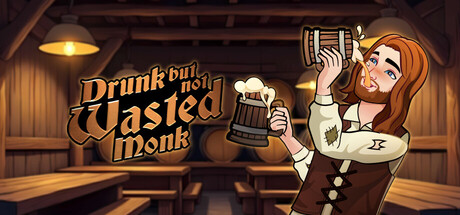
Drunk But Not Wasted Monk is a fantasy comedy visual novel that fully embraces chaotic humor and ridiculous storytelling without ever trying to take itself seriously. Developed and published by BRB Drama, the game follows a poor and desperate protagonist whose search for a better life quickly spirals into bizarre encounters, questionable decisions, and nonstop absurdity. Instead of focusing on dramatic storytelling or deep fantasy lore, the experience revolves almost entirely around awkward conversations, strange situations, and player-driven comedy. The result is a short but entertaining visual novel that succeeds because of its personality and unpredictable writing.
The strongest part of the game is easily its dialogue. Nearly every interaction feels intentionally exaggerated, awkward, or completely nonsensical in a way that constantly keeps the experience entertaining. Characters rarely behave rationally, and that unpredictability becomes one of the game’s biggest strengths. Conversations often begin normally before collapsing into absurd arguments, drunken confusion, or bizarre fantasy nonsense. The writing feels deliberately chaotic, creating the impression that no one in this world fully understands what is happening, including the protagonist himself.
The game’s humor works particularly well because it commits entirely to its comedic identity. It never attempts to become emotionally serious or transform into a traditional fantasy epic. Instead, it constantly mocks fantasy tropes, heroic storytelling conventions, and the idea of spiritual enlightenment. The monk at the center of the story is far from a wise or noble figure, and much of the comedy comes from how badly his guidance and advice tend to affect everyone around him. The game feels like a parody of medieval adventure stories where every attempt at heroism or wisdom somehow turns into a disaster.
Choice-driven dialogue adds another layer of entertainment because players are constantly deciding how foolish, reckless, or sarcastic the protagonist should behave. Some decisions lead toward surprisingly successful outcomes, while others create complete chaos almost immediately. The branching structure gives players reasons to replay the story and experiment with different approaches. Multiple endings also help the game feel less linear, even though the overall experience remains relatively short.
Visually, the presentation is simple but effective enough for the type of game it wants to be. Character artwork is expressive and exaggerated in ways that support the humor well, especially during awkward conversations or ridiculous reactions. The fantasy-themed backgrounds help establish the medieval setting without distracting from the dialogue, which remains the true focus of the experience. The art style is not especially detailed or ambitious, but it fits the lightweight comedic tone perfectly.
The pacing also helps maintain the game’s energy. Drunk But Not Wasted Monk moves quickly from one strange encounter to another without lingering too long on a single joke. New characters, bizarre situations, and increasingly ridiculous misunderstandings appear constantly, helping the story avoid becoming repetitive too quickly. Even when certain jokes are intentionally silly, the game’s fast pacing keeps the humor feeling lively and unpredictable.
One of the more enjoyable aspects of the experience is its self-awareness. The game openly understands how ridiculous its own world and characters are, and it uses that awareness to create comedy from almost every interaction. Fantasy clichés are exaggerated to absurd levels, and the protagonist’s attempts to improve his miserable life often result in situations that are even worse than before. This playful approach gives the game a distinct identity compared to more traditional fantasy visual novels.
However, the simplicity of the gameplay does create limitations. Outside of reading dialogue and selecting choices, there is very little actual gameplay depth. Players looking for puzzles, combat systems, or detailed role-playing mechanics will likely find the experience too shallow. The entertainment value depends almost entirely on whether the player enjoys the game’s style of humor and absurd storytelling.
The short runtime may also leave some players wanting more. Although replayability through alternate dialogue paths and endings adds some value, the experience itself can still be completed fairly quickly. Certain jokes may also lose some impact during repeated playthroughs once players become familiar with the game’s comedic style and recurring patterns.
Despite these shortcomings, the game succeeds because it understands its purpose completely. Drunk But Not Wasted Monk is not trying to become a massive fantasy RPG or an emotionally complex visual novel. Instead, it focuses entirely on delivering a chaotic comedy experience filled with ridiculous conversations and player-driven disasters. That commitment to absurd humor gives the game most of its charm.
Drunk But Not Wasted Monk is ultimately a funny and entertaining fantasy visual novel that delivers a memorable comedy experience through bizarre writing, awkward interactions, and branching dialogue choices. While limited gameplay depth and a short runtime prevent it from becoming more substantial, the game’s chaotic personality and energetic pacing make it enjoyable for players who appreciate absurd humor and comedy-focused visual novels.
Rating: 7/10