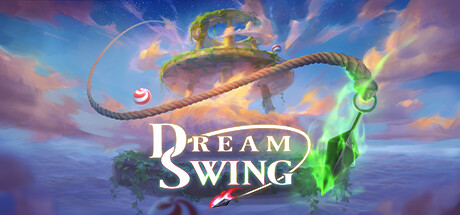
 Dream Swing
 is a fast-paced grappling hook game where you swing above the clouds.
The whole game is simple as "How many orbs can you collect in 5 minutes swinging around like
Spider-Man?" with
leaderboard and replays. Not more, not less. A true benchmark for your movement skills from the maker of
Remnants of Naezith.
Great
mini-game for
relaxing while
chatting, listening to a
podcast/video, or waiting for the
matchmaking queue of another game.

Features Summary
- Single level, collect as many orbs as you can in 5 minutes
- Grapple and Swing, Bunny-hop and Air-strafe
- Game Modes for different play styles: Original, Random, Weekly, Zen Mode
- Get better and better and climb the Leaderboards
- Compete with your friends on the Friends Leaderboard
- Watch replays in Leaderboard with video player controls
- 14 Ranks to achieve
- Kunai and rope look changes as you rank up
- Chill and enjoy the Zen Mode while listening to your favorite podcast or music
- Use your own funny image and sounds for the gameplay
- Lots of statistics and achievements
- Mesmerizing day and night cycle with dynamic lighting and shadows
- Clean, minimalistic, and toggleable HUD
- In-game video guide
- Tight 125 tick physics
- Light and still pretty for low-end computers

Detailed Features
- It is a mini-game with only one beautiful, symmetrical, non-linear level which allows you to do all kinds of maneuvers. You try to keep your momentum and accelerate while avoiding bumping the monuments. There is no speed limit.
- The goal is to collect as many orbs as possible within 5 minutes. You'll see yourself improving really quickly as you get used to the mechanics.
- There are multiple game modes with their own dedicated Leaderboards:
- Original: The orbs spawn in the original positions. You can memorize the positions and perfect your route. All entries in the Leaderboard are equal.
- Random: The orbs spawn in random positions. There is no memorization so you need to improve your base movement skills and strategy. All entries in the Leaderboard are different.
- Weekly: Everyone plays with the same orb positions for the entire week. The leaderboard resets every Monday .
- Zen Mode: No timer, no stress, no Leaderboard; just chill and enjoy!
- You can also compete in the separate Friends Leaderboard.
- There is a rank system with 14 ranks from 40 orbs up to 150 orbs. After 40 orbs, your Kunai starts changing color and material. At 100 orbs, you get the Flame Kunai and above 130, your rope turns into a lightning beam. Among the players above 150 orbs collected, only the best one gets the "Ascendant" rank.
- The movement mechanic is custom, hand-tailored for grappling hook and air-strafing like in Team Fortress 2 or Counter-Strike. But it's more intuitive because unlike in those games, you hold the forward key while air-strafing, and you can also move in all directions in the air without air-strafing. With this, you can micro-adjust your movement to pick up the orbs easily. There is also auto-bunnyhopping when you hold the jump key, so you don't need to focus on timing your jumps. Instead, focus on your route and swings.
- The replays in the leaderboard have video player kinds of controls, like a timeline, play speed, and pause for ease of use.
- Physics runs at 125 ticks (8 milliseconds) to make sure the movement is smooth and detailed. The replays are recorded as lossless, and high quality at the same rate.
- You can put your own meme image to the orbs, and use your own sounds for orb pickup, hook throwing and hook landing to customize your experience.
- The HUD in the game is made clean and minimalistic to make sure you see it only when you need to. It's not blocking your view. You can also turn specific ones off in the HUD settings, and change the crosshair and orb outline colors.
- There is a mesmerizing day and night cycle in the sky. This creates beautiful dynamic lighting and shadows during the run. You can customize the day length and the hour the day starts.
- There are lots of fun lifetime and run-based stats like "how many orbs did you collect", "how many times did you bump" or "how many kilometers did you travel" in total.
- There is a guide within the game, full of short videos where you can learn the deeper mechanics.
- There are lots of achievements to challenge yourself.
- The game is quite light and optimized to run smoothly on older machines while still looking pretty.
- There is an option, "Null-Cancelling Movement" which is a famous script in Source games. When it's off, just like in any other game, holding left and right keys makes you stop. When it's on, you move in the last-pressed direction. This allows quicker and cleaner direction switches.