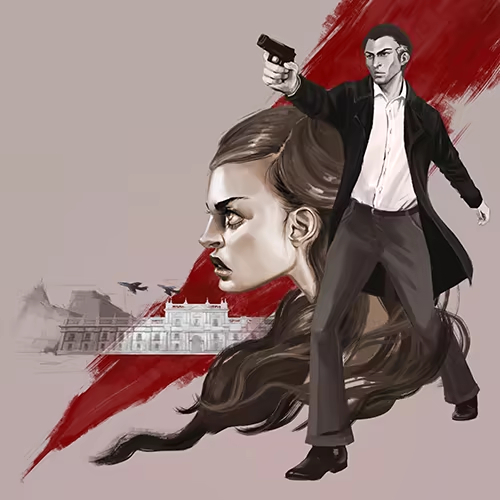
Historical indie videogame about the suburbs of the Cold War in South America.
Modeled estimate, not a reported figure. How we estimate →
About


Genres
Stats
All-time low is the lowest price we've recorded for this game since we started tracking it.
Languages: English, Spanish - Latin America**languages with full audio support
Add-ons
Each DLC is estimated with the same model as a game, then summed — a modeled figure, not reported DLC sales.
Reviews
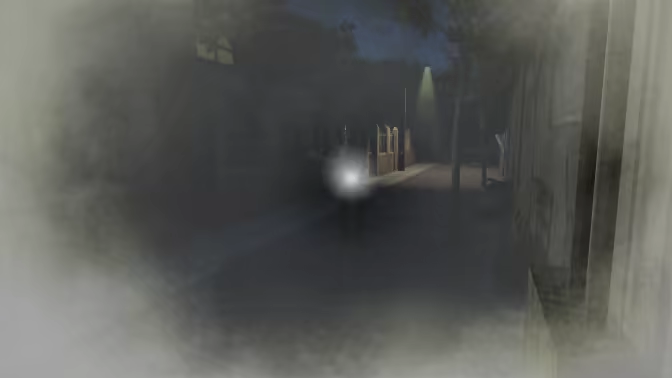
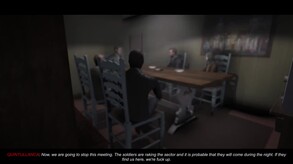
Considerando la totalidad de sus aspectos, el juego cumple su objetivo de ser una experiencia inmersiva e histórica distinta a lo acostumbrado a ver en la industria. Entendiendo sus limitaciones desde el contexto que se creó, tiene el mérito de ser un producto auténtico y evoca distintas emociones a partir de su tratamiento artístico; fundamentalmente en el guion y la musicalización. GRÁFICOS Este es probablemente el punto más débil del juego y lamentablemente una débil carta de presentación en una industria tan visual como esta. En los primeros niveles las luces están bien logradas tanto en el baking como real-time, pero luego hacia el final del juego esto va decayendo significativamente. Los modelos 3D urbanos recrean bien la escena histórica (sobre todo el centro de Santiago y las Poblaciones Callampa), aunque suelen verse muy modulares en algunos escenarios y sin mayor detalle en algunos niveles. El esculpido de personajes es aceptable, pero en momentos también mediocre y retrotrae a generaciones de consolas anteriores lo que se conjuga no de la mejor manera con el trabajo de animación. ANIMACIONES El trabajo de animación se nota que proviene de Mixamo, lo cual es aceptable en Gameplay, pero definitivamente se ve excedido en las cinemáticas y ha ratos mitigado en sus notas altas de planos y movimientos de cámara, sumado a que los personajes no tienen animaciones faciales ni mayor gesticulación esto denota que el director, quizás por su formación ajena a los videojuegos, no supo reconocer sus propios límites en producción, pudiendo haber resuelto estos tópicos de otras maneras. A pesar de esto, en momentos durante las cinemáticas, los limitados clips de animación logran encajar de buena manera con el cometido del guion y la actuación de voz en sus momentos cúspide prescinde de la falta de lip-sync. UI Un punto crítico es la UI: Los Menús, son simplones, se sienten incompletos y con pretensiones estéticas que parecen creados por un principiante. Los coleccionables no son accesibles desde el Menú pause (lo que dificulta mucho la fluidez de la mecánica) y las opciones del juego son las básicas, pudiendo sacar mucho más partido a esto. Los Menús de pausa en algunos diálogos se traban y el flujo entre este y el inicio también lo que puede ser un gran punto en contra al volver la experiencia frustrante por reinicio del juego. Los Checkpoint son estáticos y no se guardan al salir de la escena, así tampoco son seleccionables las escenas entre los niveles. Por lo que se entiende en los créditos del juego la UI estuvo a cargo de la gente de "SudakaGames/Starseed Forest" pero al parecer no dieron el ancho de brindar una mejor experiencia al jugador en esta área; está por debajo del standard de este tipo de juegos y al parecer tampoco trabajaron en las mejoras de UI introducidas en los parches (En Twitter comentaron que dejaron de participar en el juego a días del lanzamiento). ACTUACIONES DE VOZ Este es un punto con claroscuros, algunas actuaciones suenan bastante profesionales, mientras otras bastantes amateurísticas. Se sabe que en la fase terminal del juego, y ya sin recursos tuvieron que recurrir a casting de actores voluntarios y esto pudo influir en lo variopinto del elenco en sus desempeños, sin embargo en general el trabajo es aceptable y logra empapar de los personajes principales, aunque a ratos esto también es empañado por un trabajo de edición de audio bastante volátil e incluso en momentos precario o ausente, en lo cual también como se muestra en créditos, tuvo participación gente del equipo de SudakaGames. MECÁNICAS Las mecánicas, aunque simples, son surtidas, lo cual da dinamismo a la historia. Los niveles logran diferenciarse entre sí y esto es un aliciente respecto a otros aspectos que puedan ser tediosos, sin embargo, da la impresión a su vez de que "se abarcó mucho y se apretó poco" pudiendo complejizar el sistema de sospecha de los diálogos o los puzzles entre codificados y localizar puntos de contacto. MÚSICA Ya pasando a los puntos más fuertes del juego, la musicalización de las escenas y cinemáticas evoca variadas emociones: desde sigilo, alerta, miedo o suspenso. El trabajo de orquestación está muy bien logrado para provenir de fuentes VST y las composiciones tienen el remanente de folclore chileno y sonidos marciales que generan una atmósfera muy ad-hoc al contexto. Mientras en las escenas los temas son loops in-crescendo en las cinemáticas se desarrollan de manera más dinámica y a "tiempo-real" lo cual muestra claramente las ventajas del compositor al ser director a la vez. La música es muy original en sus elementos compositivos y al final del día como banda sonora, no tiene nada que envidiar a las grandes producciones de la industria. GUIÓN Lo que más se puede reclamar en este aspecto es su extensión y la incapacidad de explayarse por medio de gameplay para evitar el tedio de cinemáticas muy largas. Probablemente esto responde otra vez a la falta de experiencia del director en la industria y si lo comparamos con otros juegos del estilo (como Metal Gear) esto es totalmente aceptable y perdonable. La introducción de los coleccionables y su mecánica "museográfica" colabora mucho a alivianar lo expositivo del guion y dar fundamento documental al mismo. En lo demás el tratamiento es muy bueno, tiene giros importantes de trama y “colchones emocionales” (como la participación de Chasca, Cuchufleta y hasta el Negro Matapacos) que ayudan a absorber el drama histórico y corroboran el hecho de que el juego no es un panfleto político, sino una historia con un elenco variopinto de personajes en el que cada uno cumple su función y expresa su propia óptica del conflicto histórico, rompiendo el estereotipo vago de "comunachos vs fachos". El final cierra bien la primera parte y deja bastantes flancos abiertos respecto a varios personajes, lo cual da a entender que el juego se diseñó pensando en secuelas. EN RESUMEN: Técnicamente y en promedio el videojuego es aceptable, con algunos puntos bajos (como la UI, los gráficos y animaciones) y otros funcionales, no tiene bugs insalvables y se nota que con las últimas actualizaciones han mejorado mucho la optimización y experiencia de juego. Sigo el proyecto desde sus orígenes y no me ha decepcionado, doy fe de que técnicamente nunca se prometió algo más de lo que hay aquí e incluso se hicieron esfuerzos muy grandes para conseguirlo, por lo que NO RECOMIENDO este juego a quienes buscan una experiencia exclusivamente gráfica, mecánicamente compleja o no tengan al menos una noción mínima de lo que es crear un videojuego solo y de cero, puesto no tendrán el discernimiento y herramientas de juicio para evaluar una obra con sus defectos y virtudes (como algunos lo han hecho en reseñas colindantes). Dicho esto, SI RECOMIENDO el juego como obra más allá de lo técnico a quienes busquen una experiencia genuina a través de inmersión, historia y tratamiento artístico, en este sentido, y aunque yo adquirí el juego en la semana de descuento, considero que si vale su precio para lo que entrega junto a las mejoras que se le han realizado tras su lanzamiento, lo que en este caso es a su vez una innovadora propuesta documental sobre un momento histórico de Chile que más en estos días, parece no haber cerrado o cicatrizado.
Media

Related
Related
Price dynamics, follower growth, revenue and sales trajectories with interactive tooltips
This and every other Pro feature is free until October 20, 2026. A free account is all it takes.
This game shows what many people experienced when facing Pinochet's terrible military dictatorship. It really made me feel like I was immersed in that era, living each of the stages of the game and trying to survive all the simulated difficulties that this incredible production gives us. The graphics of the game respond exactly to how this game was made, self-managed and without support from large economic groups, obviously due to its political and social connotation in our country. I recommend it!
这是一款以智利独裁政府时期反抗者为主角的反战艺术作品,玩家扮演的一对青年男女决定对独裁的智利政府做出反抗,通过游戏中扮演反抗者的过程来展现艺术家眼中的智利独裁政府统治下居民们动荡而痛苦的生活和智利军政府的残暴统治。游戏的语言在书写上采用英语,但是其他人说语音配音是西班牙语——区别不大,对我们普通玩家来说都不懂。试着玩儿了玩儿,差不多是个潜行,解密收集的动作游戏,没什么对抗射击要素,感兴趣的玩家试一试就行了,这东西是个艺术家表达思想的艺术作品,不是个给人们带来欢乐的游戏。
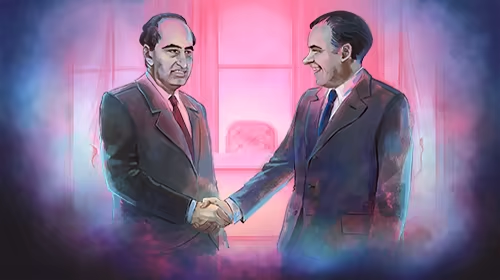
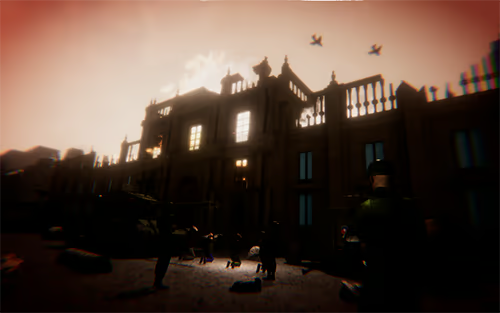
没中文 没成就 《肮脏战争:9月11日》 在20世纪70年代初,冷战背景下,尼克松政府和中央情报局支持了一场针对萨尔瓦多·阿连德的政变。阿连德当时正通过征用和国有化重要的北美资本来推动“智利式社会主义道路”。 在这种支持下,1973年9月11日,智利武装部队轰炸了拉莫内达宫,阿连德被推翻,建立了以奥古斯托·皮诺切特为首的军民独裁政权,持续了17年,造成了数千人流亡、政治犯、酷刑以及被拘留和失踪人员。 智利,1973年9月11日 历史叙事电子游戏 《肮脏战争:9月11日》是一款独立叙事历史电子游戏,一个受真实事件启发的虚构故事,让我们沉浸于对智利军民独裁政权的抵抗中。通过八个关卡,你将控制马克西米利亚诺和阿比盖尔,一对加入智利革命委员会“COMIREV”以反抗独裁政权的年轻夫妇。 构成游戏时间线的8个任务发生在独裁政权的头几年。每个任务由马克西米利亚诺或阿比盖尔线性展开。 DINACH,该政权嗜血的秘密警察,已部署所有资源和资金来消灭任何反对派痕迹和被推翻的民主政府残余。 病态 信息隔离机制。 这款电子游戏具有潜行机制和图形冒险元素,其中信息管理比武器对于生存更为重要。完成诸如从一个地点移动到另一个地点、获取信息、解码联络点和传递包裹等任务,同时通过身份检查。它从主角的立场重新构建了对军事独裁政权的抵抗。 游戏独特的机制之一是通过与其他角色的互动对话来获取信息并维持其信息隔离,在每次对话中必须保持“怀疑指数”。 根据主角的身份,回应选项的语境会有所不同。 身份 主角们不断被迫改变或双重身份,以避免在高度危险的情况下被发现。 玩家将负责根据所采用的新身份和传记来回应身份检查或不同情况。 谜题 游戏中的一些谜题基于抵抗运动历史背景中的特定情况,例如发送不被政权秘密警察检测到的伪装包裹,或使用“密码文本”来寻找与抵抗运动其他成员的联系点。 独裁政权控制了国家的电话线路,通过电话联系是不可能的。 记忆收集品 仅仅完成故事本身是不够的,在《肮脏战争》中,你可以在关卡中找到大量隐藏的收集品,这些收集品会保存在“记忆”部分,这对于100%完成游戏至关重要。 这些收集品有助于补充游戏所涵盖的历史时刻的叙事和背景。 游戏体验 《肮脏战争》旨在通过其简约的用户界面和基本动作,创造一种沉浸式的历史动态,重现背景本身的脆弱性和不对称性。其在关卡设计、音乐和各种历史内容方面的艺术部分,为游戏的氛围和体验增添了色彩,不仅娱乐,还传授了智利和南美洲的历史。 这是一个完全属于智利和拉丁美洲的故事,展示了这个世界这个地区的文化、艺术、音乐和美学。
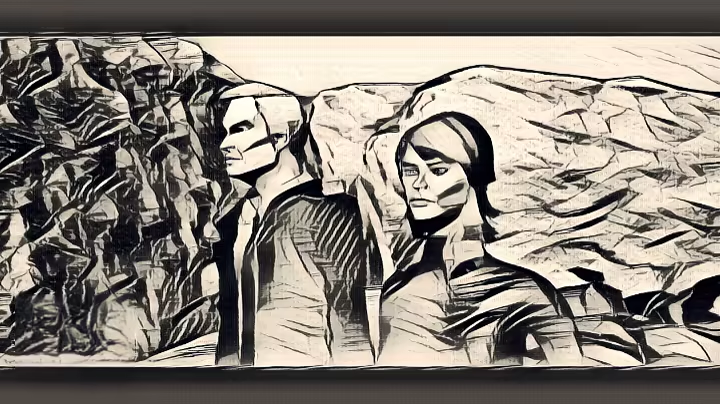
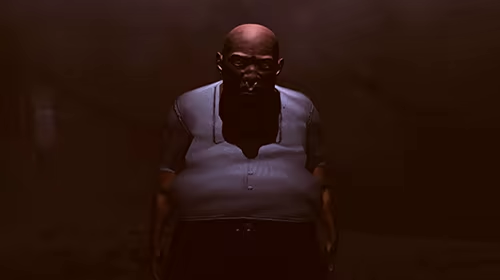
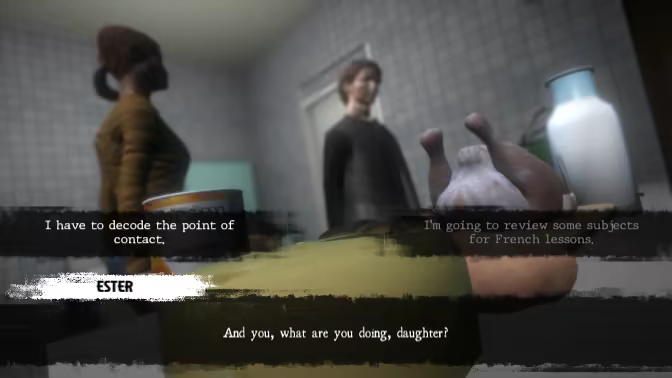
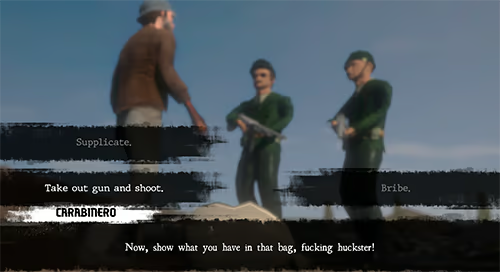
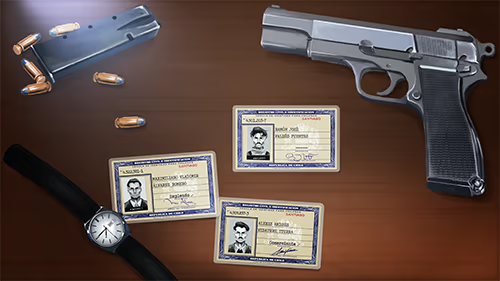
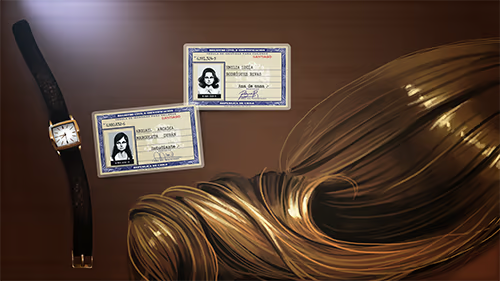
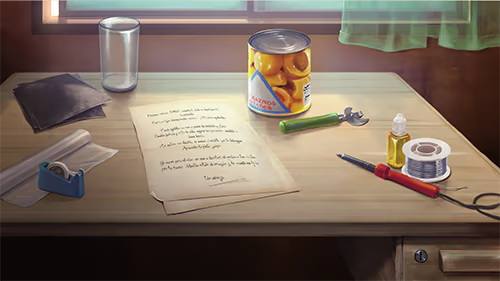
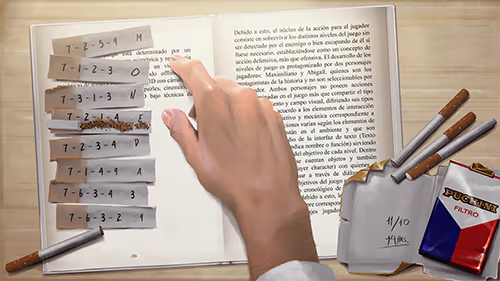
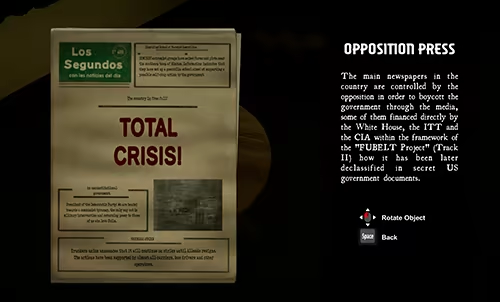
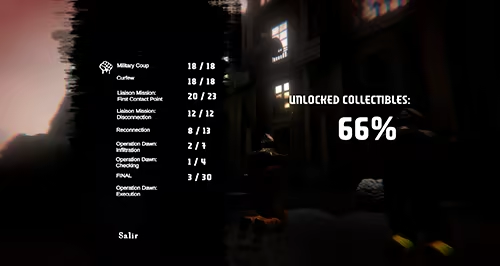
Dirty Wars: September 11 is an ambitious historical narrative game that approaches the Chilean dictatorship from a perspective rarely explored in video games. Rather than turning political conflict into a conventional military power fantasy, it focuses on the vulnerability of ordinary people involved in clandestine resistance. The fictional story follows Maximiliano and Abigail, a young couple who become members of COMIREV, an underground revolutionary organization attempting to survive and resist while the fictional secret police organization DINACH hunts down opposition. The game was developed by Uglycat Studios and Sudaka Games and published by Uglycat Studios. The campaign is divided into eight linear missions set during the early years of the dictatorship, with control alternating between Maximiliano and Abigail depending on the chapter. The structure is intentionally restrictive, emphasizing that these characters have little control over the larger political forces surrounding them. Players are frequently concerned with seemingly straightforward objectives such as traveling to a location, acquiring information, identifying contacts, delivering packages, or avoiding detection. These activities become considerably more tense because the protagonists cannot simply fight their way through every dangerous encounter. One of the game's most distinctive ideas is its emphasis on information compartmentalization. Knowledge is effectively another resource that must be protected. Conversations require attention because revealing too much information can increase suspicion, while the Suspicion Index gives dialogue a mechanical connection to stealth. This makes social interaction more meaningful than simply selecting dialogue options to advance the story. Knowing what a particular identity should know, and more importantly what that identity should not know, becomes part of surviving encounters. False identities expand this concept. Maximiliano and Abigail sometimes need to adopt alternative identities and biographies to move through dangerous situations without exposing themselves. When questioned, the player must respond consistently with the identity currently being used. This creates tension without depending on gunfights, because an incorrect response can compromise a carefully maintained disguise. It is an effective representation of clandestine activity and complements the game's broader focus on secrecy, surveillance, and distrust. The puzzle design is similarly tied to the historical setting. Tasks include preparing disguised parcels that can escape detection and deciphering coded messages used to locate resistance contacts. Conventional communication cannot always be trusted because telephone lines are presented as being controlled by the dictatorship, forcing resistance members to rely on alternative methods. The puzzles themselves are not extraordinarily complex, but their narrative justification makes them more interesting. They generally feel like activities people operating underground might reasonably need to perform rather than arbitrary obstacles inserted simply to extend the campaign. Exploration provides additional historical context through hidden Memory collectibles scattered throughout the levels. These items are stored in a dedicated Memory section and are required for complete progression. More importantly, they provide supplementary information about the historical period and reinforce the game's interest in remembrance. Searching environments therefore has a purpose beyond finding gameplay resources. Players willing to investigate thoroughly can obtain a broader picture of the circumstances surrounding the fictional protagonists. The presentation deliberately uses a minimalist interface and relatively basic interactions to reinforce the imbalance between the protagonists and the forces pursuing them. Its visual design, environments, cultural references, music, and historical material place particular emphasis on Chilean and Latin American identity. That specificity is one of the game's strongest qualities. Instead of using the Cold War merely as an aesthetic backdrop, Dirty Wars attempts to communicate how political upheaval affected people within a particular South American society. The soundtrack complements this direction with influences associated with Chilean and Latin American music. The game also contains exceptionally disturbing subject matter. Its portrayal of dictatorship includes executions, political persecution, forced disappearances, torture, corpses, threats, abuse of civilians, and discussions or depictions involving sexual violence. Some sequences reference specific torture methods and the so-called Flights of Death. These scenes are presented in the context of historical oppression rather than as entertainment, but they nevertheless make the experience unsuitable for players who are uncomfortable with graphic descriptions or representations of state violence and abuse. Mechanically, Dirty Wars is less impressive than it is conceptually. Its linear missions, straightforward interactions, and relatively modest stealth systems cannot match the complexity of dedicated stealth simulations. Players expecting large environments filled with emergent possibilities, elaborate enemy behavior, or extensive combat options may find it restrictive. The strongest mechanics are those connected directly to its themes, particularly identity management, suspicious conversations, coded information, and clandestine communication. The game works better when treated as interactive historical fiction with stealth and puzzle elements rather than as a traditional action game. Steam Deck compatibility is less certain. The Steam store page does not currently present an official Valve Steam Deck compatibility rating for Dirty Wars: September 11, so it should not be described as officially Verified or Playable. The game does have full controller support listed in Steam's application data, which is encouraging for handheld controls, but controller support alone does not guarantee trouble-free operation through SteamOS and Proton. Anyone buying specifically for Steam Deck should therefore approach it as an unverified title and be prepared for possible compatibility issues or adjustments. Ultimately, Dirty Wars: September 11 is more compelling for what it attempts to communicate than for mechanical sophistication. Its combination of stealth, dialogue, identity checks, information management, historical puzzles, collectibles, and first-person exploration gives the narrative an interactive dimension that a purely cinematic presentation would lack. Some systems feel limited and the linearity reduces player freedom, yet there is a coherent relationship between the mechanics and the themes of vulnerability, secrecy, resistance, and political repression. For players interested in historically grounded narrative games and perspectives rarely represented by the medium, it offers something genuinely unusual, provided they are prepared for its extremely heavy subject matter and comparatively modest production. Rating: 6/10
ta bn si meo jueguito -____-
Selling now
See how fast this game is selling right now — estimated copies and revenue per day from recent review growth.
Related
| Game | Estimated lifetime revenue | Reviews | Review score | Price |
|---|---|---|---|---|
| $578 | 6 | 33% | $3.99 | |
| $0 | 0 | — | Free | |
| $613 | 6 | 67% | $2.99 | |
| $353 | 2 | 100% | $5.99 | |
| $22.1K | 136 | 68% | $12.49 | |
| $19.1K | 45 | 84% | $19.99 |
Related
| Game | Estimated lifetime revenue | Reviews | Review score | Price |
|---|---|---|---|---|
| $1.7K | 87 | 37% | $0.99 | |
| $1.7K | 52 | 100% | $1.99 | |
| $1.7K | 75 | 75% | $0.89 | |
| $1.7K | 50 | 60% | $1.99 | |
| $1.7K | 66 | 92% | $0.99 | |
| $1.7K | 63 | 51% | $0.99 |