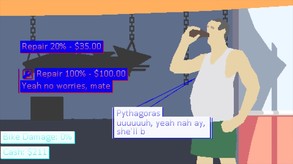
You are a hungry, young hoverbike racer who needs to get off Earth before it E-X-P-L-O-D-E-S. Hunt bounties, throw races, and do whatever you can to get to Mars and win the Grand Prix.
Modeled estimate, not a reported figure. How we estimate →
Discounts
Every price cut of more than 20% we have observed, in each market that quoted one, with this game's chart position on either side of it. These are episodes, not a model: a sale is one event, and one event cannot tell you what the next one will do.
Reviews, worldwide (the counter carries no country): 0/day in the week to Sep 3 → 0.14/day in the week after.
About
You’re broke, you’re hungry, and your only friends are a vintage hoverbike and a bowl of ramen noodles.
In Desert Child, you are a young and talented hoverbike racer who needs to figure out how you can scrape enough cash together through racing and odd jobs to punch your one-way ticket to the Red Planet to enter the biggest race in the universe, the Grand Prix.
The world as we know it is slowly starting to become unhabitable, as many people on Earth have moved to Mars for a better quality of life, thanks to a government subsidy that assisted in relocating citizens by providing affordable passage. After several years of running this program, the government announces that in two weeks, tickets to Mars would go up in price, making the exodus to the Red Planet unobtainable for regular citizens.
You’ll deliver pizzas, collect gun parts, hunt bounties, and make some fans along the way. In between races, you’ll explore colorful cities where you can repair and upgrade your bike, dine on the local cuisine, and fight your way through gangsters, bounty hunters, and all sorts of interesting characters, just so that you can have a decent meal and keep your bike running.
Nothing’s free in Desert Child.
Genres
Sums Steam only; PlayStation, Xbox, GOG, Nintendo publish no volume signal, so the true total is higher by an unknown amount.
| Store | Price | Audience | Score | Chart | Est. revenue |
|---|---|---|---|---|---|
SteamYou are here | $11.99 | 356reviews | 56% | — | $135.2K |
| $11.99 | 202ratings | 73% | — | not modelled | |
Engagement
Reviews
Themes across 43 recent reviews and how positive each mention is. A keyword signal, not full sentiment analysis.
Reviews
👎
Desert Child es un juego divertido, con personalidad e ideas entretenidas. Es un runner y tiene ciertos toques de gestión en un mundo cerrado. A pesar de que el grueso del juego esta en las carreras, las recompensas obtenidas son nimias en comparación a otras actividades que se descubren a medida que se desarrolla el juego. Esto se soluciona presentándonos diferentes actividades basadas en la mecánica de manejar nuestra moto: Desde repartir pizzas, pasando por probar armas y hasta ser un cazarrecompensas. Aun así, creo que para algunas personas puede llegar a ser repetitivo o aburrido a pesar de que el juego es muy corto. Igual, el juego esta muy bueno y creo que vale su precio si es que te ha interesado al verlo, aunque si hace falta, se puede mantener la vista a la espera de un descuento de mitad de precio
Media

Related
Related
Price dynamics, follower growth, revenue and sales trajectories with interactive tooltips
This and every other Pro feature is free until October 20, 2026. A free account is all it takes.
For scale, across Steam · Top Sellers · Brazil over the last 30 days: the 26 chart moves that followed a price cut of more than 20% went a median of 7 places towards #1, and the 2,400 moves with no price cut behind them went 2 away. One store, one chart, one country — it is the only place we have enough observations to say even that.
Prices outside the United States have been collected since 6 August 2026 and chart positions since 19 July 2026, so a cut older than that has no market to compare and a market that joined later has no history yet. Nothing here is converted between currencies.
Stats
All-time low is the lowest price we've recorded for this game since we started tracking it.
Languages: English, French, Italian, German, Japanese, Russian, Portuguese - Brazil, Simplified Chinese, Spanish - Latin America
| $1.79−85% |
| 98ratings |
| 84% |
| — |
| not modelled |
| $4.19−65% | 36ratings | 58% | — | not modelled |
| $2.99−75% | — | — | — | not modelled |
Matched by title — a reused name can pair the wrong games. * is a critic aggregate. Prices and positions are each store's United States storefront; Epic charts worldwide. Audience and Score too, except Steam's, which is worldwide.
Hours played at review time, across 43 reviews with recorded playtime.
positive critical· bar length = how often the theme comes up
有卡 有中文 有成就
"Desert Child" has a cool concept and style, but the gameplay is just boring. The racing mechanics feel sluggish, the missions are repetitive, and the whole game ends up being more grind than fun. The pixel art looks great, and the soundtrack is solid, but none of that matters when the actual gameplay feels empty. It’s got vibes, but no substance.
It's too short but the unique art and vibes are worth the play. The racing starts out frustrating but gets fun the more you practice. I felt like it ended just like I was getting into it.
My opinion about this game is a bit neutral. The aesthetic is what I enjoyed the most; it’s pretty great, and the nice soundtrack and artwork give really good vibes and create a fantastic atmosphere overall. Unfortunately, it just didn’t click with me. It seems like the necessary elements are there, but it turned out to be a repetitive loop of actions. Still, I'm giving this a thumbs up because it's well-made and I appreciate the effort put into it. It’s simply not my cup of tea.
I was liking it a bunch until the Grand Prix, which laid the game's flaws wide open. With an EXTREMELY rubberbanding AI, a camera that sometimes fails to follow you if you are going too fast (which is often), and often not being able to react to incoming obstacles, on top of tedious navigation in the overworld and as I noticed in my struggles, a somewhat repetitive gameplay loop. Shame, I enjoyed playing the first 2 chapters and I could have left an optimistic review, but the Grand Prix smashed my rose-tinted glasses.
The game takes place in another planet where you will be racing most of the time which is fun if you're into that kind of stuff. The game is decent considering that it's made by independent developers, however there were a few bugs here and there. For instance to win a race, all you could do is just ... not try at all. Because it counts as a win as long as the person is not in your window and you get to the goal. Nevertheless, 11 hours well spent. Good job on making the game.
Desert Child, developed by Oscar Brittain and published by Akupara Games, is a genre-blending indie title that fuses hoverbike racing with light RPG mechanics, open-ended exploration, and a strong retro-futuristic aesthetic. Set in a near-future world where Earth is struggling and humanity is preparing to relocate to Mars, the game casts players as a young, broke racer trying to scrape together enough money to buy a ticket to the red planet and compete in the ultimate Grand Prix. This simple but compelling premise drives the experience forward, framing every race, side job, and odd task as part of a larger personal ambition. Rather than focusing on a grand epic narrative, Desert Child centers on survival, hustle, and self-made progress in a world that feels worn, colorful, and slightly melancholic. The racing component forms the backbone of the gameplay. Races unfold in a 2D side-scrolling perspective where you and a rival speed across desert tracks on hoverbikes, dodging obstacles, managing boosts, and occasionally firing weapons to gain an edge. Boost management is crucial, as it determines how aggressively you can push forward, while shooting floating objects scattered along the track can provide extra cash or speed boosts. The mechanics are easy to grasp, emphasizing quick reflexes and tactical timing rather than deep simulation physics. While individual races are relatively short, they carry tension through close competition and the ever-present need to earn money for survival and progression. Beyond the racetrack, Desert Child opens into explorable urban hubs filled with eccentric characters, small businesses, and odd jobs. It is here that the RPG elements come into play. Players must manage basic survival needs such as hunger while taking on part-time gigs to supplement race earnings. These side activities range from food delivery to bounty-style missions and contribute to a sense of living day-to-day in a futuristic but financially strained society. The ability to upgrade and repair your hoverbike adds another layer of progression, allowing you to fine-tune performance and increase your chances in tougher competitions. Though the RPG systems are relatively light, they provide enough structure to make the world feel interactive rather than purely decorative. One of the game’s strongest qualities is its audiovisual identity. The pixel art style is vibrant and expressive, drawing inspiration from classic sci-fi anime and cyberpunk influences. Neon-lit cityscapes, dusty highways, and lively character sprites combine to create a world that feels alive despite its economic decay. The animation work and color palettes evoke a sense of movement and atmosphere that supports both the racing intensity and the laid-back exploration segments. Complementing the visuals is a lo-fi, hip-hop-inspired soundtrack that reinforces the game’s relaxed yet restless tone. The music gives the world a soulful rhythm, making long stretches of exploration feel immersive and cohesive. Despite its creativity, Desert Child does show some limitations in terms of gameplay variety. The core racing loop, while engaging at first, can become repetitive over extended play sessions. Tracks share structural similarities, and while upgrades improve performance, they do not drastically alter the nature of competition. Similarly, side jobs and exploration activities, though flavorful, may begin to feel routine after several hours. The narrative remains intentionally minimal, relying more on world-building and atmosphere than on deep character arcs or plot twists. For some players, this understated storytelling enhances the mood; for others, it may leave the experience feeling somewhat thin. Ultimately, Desert Child stands out not because of mechanical complexity, but because of its personality and cohesion. It captures the feeling of chasing a dream in a world that is both vibrant and struggling, combining arcade racing with slice-of-life survival elements in a way that feels distinct from mainstream titles. The fusion of stylish presentation, accessible gameplay, and an open-ended progression system makes it a memorable indie experiment. While it may not sustain long-term engagement for everyone, it offers a compelling and stylish journey for players drawn to retro-futuristic aesthetics and character-driven ambition. Rating: 6/10
Ride to Mars.
Selling now
See how fast this game is selling right now — estimated copies and revenue per day from recent review growth.
Players by region
Where this game's players are, estimated from review languages.
Related
| Game | Estimated lifetime revenue | Reviews | Review score | Price |
|---|---|---|---|---|
| — | 0 | — | — | |
| $7.2K | 76 | 92% | $5.99 | |
| $64.7K | 744 | 88% | $4.99 | |
| $59.7K | 517 | 86% | $4.99 | |
| $51.3K | 216 | 75% | $9.99 | |
| $138.5K | 328 | 86% | $19.99 |
Related
| Game | Estimated lifetime revenue | Reviews | Review score | Price |
|---|---|---|---|---|
| $135.2K | 341 | 72% | $14.99 | |
| $135.2K | 540 | 54% | $9.99 | |
| $135.2K | 465 | 80% | $9.99 | |
| $135.2K | 122 | 70% | $39.99 | |
| $135.2K | 1.2K | 90% | $2.99 | |
| $135.2K | 466 | 82% | $19.99 |