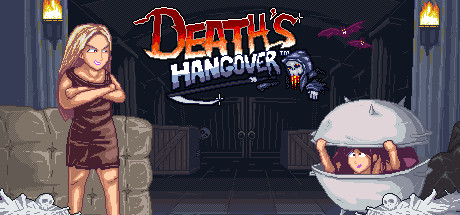
Death’s Hangover, developed by Retro Army Limited and published by Paul Stephen Davis, is a bizarre, chaotic, and often hilarious twist on the traditional brick-breaker formula. It’s a game that clearly doesn’t take itself too seriously, blending arcade action with grotesque humor, irreverent storytelling, and an experimental approach to gameplay structure. At its heart, it still revolves around the timeless concept of bouncing a ball to destroy blocks, but what surrounds that core is a strange mixture of horror parody, crude comedy, and light adventure elements that make it one of the more unusual entries in the genre. Rather than simply emulating classics like Breakout or Arkanoid, Death’s Hangover tries to transform them, injecting narrative layers, boss battles, and unpredictable hazards to create something that feels both familiar and delightfully offbeat.
The story sets the tone immediately with its absurd premise: Death, nursing an apocalyptic hangover, tasks two resurrected souls with retrieving spirits stolen by Dracula. It’s a setup drenched in tongue-in-cheek humor, full of snarky dialogue, cheap jokes, and intentionally over-the-top cutscenes. The plot serves more as a comedic wrapper for the gameplay than as a serious narrative, but it does give the adventure a distinct personality. Between missions, you’ll encounter short animated sequences that highlight Death’s laziness, the heroes’ incompetence, and Dracula’s melodramatic antics. These interludes, while crude and often juvenile, contribute to the game’s chaotic charm. The writing occasionally crosses into the kind of lowbrow humor that might divide players—some will find it endearing, others tiresome—but it succeeds at establishing a gleefully irreverent tone rarely seen in arcade games.
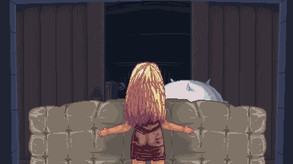
Gameplay is where Death’s Hangover diverges from its traditional inspirations. The core mechanic remains simple—you control a paddle at the bottom of the screen, keeping a ball in play to destroy blocks—but Retro Army expands this formula with exploration elements and enemy encounters. Many stages are more than static walls of bricks; they’re small arenas or mazes with interactive features such as levers, moving obstacles, and traps. Some levels include miniature 2D platforming sections, allowing players to move around before entering the breakout zones. This hybrid design adds variety, giving each stage a distinct identity and sense of progression. The developers also pepper the game with secrets and branching paths, encouraging experimentation rather than repetition. Boss fights punctuate the adventure, forcing you to juggle traditional block-breaking reflexes with pattern recognition and environmental awareness, creating moments that are equal parts frantic and comedic.
Power-ups and items play a major role in shaping the experience. Throughout the game, destroyed blocks or defeated enemies drop bonuses that can drastically alter the flow of battle. These range from classic extensions like larger paddles and multiple balls to bizarre novelties such as explosive projectiles, temporary shields, or “fart balls” that turn the battlefield into a comedy sketch. Some power-ups stack, letting players combine effects for short bursts of chaos, while others can be stored for tactical use. Death’s Hangover also introduces a “Cheat Death” mechanic, a small minigame triggered upon failure that allows you to spin for another chance at life. It’s an amusing twist that fits the irreverent tone and adds a layer of unpredictability. The inclusion of a ball speed control mechanic—allowing players to briefly slow or accelerate time—adds a surprising degree of finesse to the otherwise hectic action. These small additions give the game a more dynamic rhythm, rewarding adaptability rather than pure reflex.
Visually, the game leans heavily into a retro aesthetic that mirrors its old-school roots. The pixel art is intentionally rough and exaggerated, filled with cartoonish characters, garish color schemes, and gothic settings that evoke both horror and humor. The art direction has the charm of a parody, using exaggerated animations and slapstick violence to keep things light-hearted despite the grotesque themes. While it won’t win awards for technical sophistication, the art does exactly what it needs to—deliver clarity during chaotic moments while maintaining a consistent sense of personality. The soundtrack complements this style with chiptune-inspired tracks mixed with eerie melodies and campy horror motifs, though repetition becomes noticeable after extended play sessions. Sound effects, from the bouncing of the ball to the cries of vanquished enemies, are deliberately exaggerated to heighten the sense of arcade absurdity.
Structurally, Death’s Hangover offers a surprising amount of content for what appears at first to be a simple indie title. There are nearly a hundred levels spread across various zones, each introducing new obstacles or environmental gimmicks. The inclusion of a cooperative mode lets two players share the chaos, while the level editor allows creative fans to build and share their own stages, extending the game’s lifespan far beyond the campaign. Despite the comedic exterior, the difficulty can be quite steep. Later levels demand precise control of the ball’s angle and speed, and some bosses or hazards feel unfairly punishing, especially when the ball physics behave erratically. This inconsistency—combined with occasionally unresponsive paddle movement—can lead to moments of frustration. However, persistence tends to be rewarded, and completing tough sections provides genuine satisfaction.
Performance-wise, the game runs smoothly even on modest hardware, thanks to its minimalist graphics and compact design. Load times are quick, and the controls, while occasionally clunky, are straightforward enough to learn quickly. Some technical hiccups—like the ball getting stuck in corners or bouncing unpredictably—appear sporadically but rarely break the game entirely. These small flaws feel more like the quirks of a scrappy indie production than major faults. What keeps players engaged despite these issues is the constant sense of discovery: new traps, strange enemies, and unexpected jokes lurk in nearly every corner. The balance between challenge and comedy keeps the momentum alive, making it easy to play in short bursts or extended sessions alike.
Ultimately, Death’s Hangover stands out because it doesn’t conform to expectations. It’s messy, loud, and unapologetically weird—a passion project that takes a familiar concept and stretches it in every direction possible. It doesn’t achieve the polish or precision of the genre’s classics, but it replaces them with personality, variety, and a mischievous sense of humor. The combination of breakout-style action, adventure elements, and absurd storytelling makes it unique among its peers, even if that uniqueness comes with rough edges. For players who appreciate retro-style arcade games with a comedic twist, or anyone looking for something unconventional and slightly unhinged, Death’s Hangover offers a surprisingly entertaining experience. It’s the kind of game that feels homemade in the best sense: imperfect, eccentric, and full of heart—a drunken love letter to the glory days of arcade madness.
Rating: 8/10