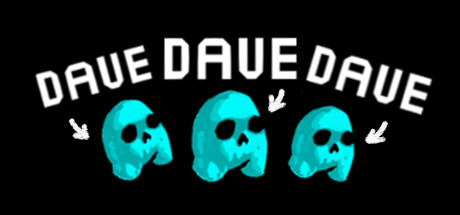
Dave Dave Dave, is a retro style hardcore platforming game set in an unknown world for you to explore with a single goal, reaching freedom.
Revenue comes from in-game items and microtransactions, which our price-based model doesn't estimate. Copies below reflect the player base, not paid sales.
Media

About

Stats
Languages: English
Engagement
Reviews
⠀
Short and fun platformer. I had a couple gripes with it, like having to wait for things to respawn in order to attempt the level again after dying, like the jump refreshers and disappearing blocks. Though in the end, it was still a good time. And the dev still cares about the game and updates it when needed a year after release, which is also a big plus.
literally the best game ive ever played. life changing. here since launch day!!!
Related
Related
Trends
Concurrent players on Steam, sampled daily since tracking started.
Hours played at review time, across 30 reviews with recorded playtime.
This game wants you to be Dave. To understand Dave, to Save Dave, to BE Dave. But are u realy can? Only Dave know this answer. 9999 dead Daves/10
The best game for those who like to tickle their nerves. Interesting and large levels. Many different traps and secrets. This game is hard to tear yourself away!
Dave Dave Dave is a Metroidvania platformer. You play as Dave, a bouncy little cyan figure whose mouth is locked in a perpetual scream, because that is all I can offer him. I can give him no comfort from the inevitable doom the traps up ahead present him. There is nothing I can do to prevent his imminent demise. Dave is a cog in the machine of his own destruction, propelling it forward, while also crushing himself beneath its weight, only to re-emerge to hurl himself upon the machine over and over and over again. This is not, and was never, a game for Dave. This is an exercise in futility, his own boulder rolling up an impossible hill, forced to confront the impossible, because the only alternative is nothing at all. As a metroidvania platformer, the levels of Dave Dave Dave are intricate mazes, filled with traps, locked doors, keys, and collectibles. Players are encouraged to collect the collectibles, and to explore the map around them for hidden collectibles. These collectibles often involve searching in previously hidden areas, or behind extra traps. Checkpoints allow players a certain degree of freedom to explore, a freedom which Dave himself does not and cannot have, nor can he truly aspire to it. The platforming in Dave Dave Dave is difficult and frustrating, both by design, by accident, and because I am terrible at platformers. By design, spike traps are often close together, and solving puzzles requires a balance of skill and timing. Fans of this style of platformer will likely enjoy the overall oeuvre and level design, even as there is some inherent frustration in needing to wait for boosters and triggers to respawn. By accident, however, the game counteracts its carefully designed levels with a programming error within its game engine, Godot. Dave and the obstacles in his way don’t always align in their hit boxes; when Dave looks like he is touching the spikes, the game doesn’t agree that he is, while at other points, the spikes might decide he is touching when he is nowhere near them. It is, in many ways, not dissimilar to touching a cat’s belly. Whether the person touching the belly is attacked or not is not so much up to the person, but up to that which is being touched, with no real way to predict how it will lean at any given moment. All of these things are objectively true things about Dave Dave Dave. It is a game with clear and real love placed into its level design, hobbled by the limitations of its engine. It is, however, my inability to play it and the subjective elements of my opinion that fascinates me. I led this little cyan figure to its death over a hundred times over the span I played. I watched Dave hurl himself against spikes, stride confidently into electricity, and commit every manner of suicide imaginable within the confines of his black, platform-infested world. I was responsible, over and over, for the destruction of this creature, even as the signs around him urged him forward and reassured me that he - and by extension I - was doing a good job. I was not doing a good job. At no point did I feel like I was doing a good job. Perhaps Dave occasionally did, and perhaps that’s why the signs were directed at Dave, not me, or even some nebulous “you.” There exists a divide between those games we can consider “embodied,” and those we do not. Embodied games are those games where we are asked to play as a character in the world. These are games like Skyrim, Mass Effect, or yes, Dave Dave Dave. We are asked to take on the responsibility, not only of solving the puzzle before us, but of being an entity within the world. Dave Dave Dave directs its signs and its congratulations towards Dave because we, the player, are Dave, and Dave is our avatar within this world. We succeed if Dave does, and vice versa. Unembodied games, on the other hand, don’t ask us to be in the world at all. We instead exist as some godly figure, dropping commands from on high, and watching their outcomes play out. Tycoon games, like Roller Coaster Tycoon and Zoo Tycoon, fit into this model, as do games like Age of Empires or the Civilisation series. They’re games that, while they expect us to get immersed in our own ability to succeed, don’t expect us to care about any individual facet or character within the world. In observing the world from on high, we can take it in holistically and think strategically in a way that embodiment could never allow. Each approach has its pros and cons, and both are perfectly valid. However, when I think about why I might be so horrifically bad at platformers, I think about this distinction and how the games we play as children shape the games we are good at as adults. As a child, I played the games that were sent to my dad, at least until my parents noticed how engrossed in understanding the lore and strategy of every game he had I was. That meant that my childhood games were Age of Empires, Axis and Allies, Rollercoaster Tycoon, and Axis and Allies. I didn’t play embodied games, instead thinking about strategy and building to it as best I could. I got pretty decent at these games, enjoying the challenge of planning and understanding economics, and just generally being strategic. That availability as a child reflects how I play today. In addition to playing solely on touchpad, I prefer games that are disembodied and let me view the world strategically. When I do play embodied games, I make liberal use of the pause button, making sure I understand the fight or situation I’m about to get into, and leaving myself space to think before hitting that end turn button by unpausing. I intentionally break at least some aspect of the mechanical immersion by pausing. For platformers, though, that doesn’t work. Platformers are twitchy games that require the player to use precise controls at precise moments. They ask the player to think about timing, to hesitate at some points and rush at others. There is no room for strategy, and the pause button won’t save me. All I’m really able to do is flail my way through and hope for the best. These sorts of embodied platformers, then, rely on the player feeling a sense of accomplishment when they reach a particular goal, but I never do. The character’s actions feel divorced from mine, a product of their own will and my luck more than any amount of my skill. With fingers that like to randomly push buttons and a sense of caution that prohibits forward movement, whether the character makes it never feels up to me. It’s all a game of chance, and a game of chance with constant death, will inevitably cease to fun. If I am to by Sisyphus, it will be a platformer that awaits me. All of these hurdles in enjoying a platformer exist in spades with Dave Dave Dave. Its labyrinthine level designs mean I’m never sure whether I’m progressing, or whether the puzzle I’m about to solve will actually get me anywhere. Its issues with sprite overlap mean my careful planning is moot, because my eyes have no idea whether I’m too close to the obstacle or not. The lack of any real motivation make it difficult to understand why I’m doing this, other than to brag about something that nobody had any expectation I would do in the first place. There is no reason for me to play this game, and no reason for me to want to. That I am bad at platformers is not Dave Dave Dave’s fault. That I have found no reason to get better is also not this game’s fault. That this particular platformer sets its players up for failure in a frustrating and unfun way, however, is this game’s fault. All the level design in the world can’t save a game from its own failed visuals, especially when those visuals mean the difference between progress and an endless loop of pointless repetition. We are all pushing this boulder, and Dave cannot save us. If you enjoyed this review, please check out [url=https://store.steampowered.com/curator/44626948-Loons/] my curator page [/url] for more!
Dave Dave Dave, tek bir hedefle özgürlüğe ulaşmayı keşfetmeniz için bilinmeyen bir dünyada geçen retro tarzı hardcore bir platform oyunudur.
Originally a $2.99 game that went Free. I noticed the spikes felt a little off. Did some testing and at points the character sprite and the spikes could touch and overlap and the sprite would not die. Other times and on other sides the sprite could not be touching the spikes at all but still get a death trigger. Which isn't a good sign for a platformer with tons of obstacles. So I decided to stop there.
fantastic! it's difficult as hell and I often only play in small doses, but it is rewarding and I've kept coming back for more for some time now. love it
Really fun game. It has tight controls and an interesting, well thought out map. There's some tricky platforming and hidden collectibles (some are REALLY hidden). I may have had to get help for the last collectible :P Definitely recommend if you're looking for a short but tough platformer. Poor little Dave.
Audience
Estimated from the language of this game's reviews — a proxy for where players are, not official Steam demographics.